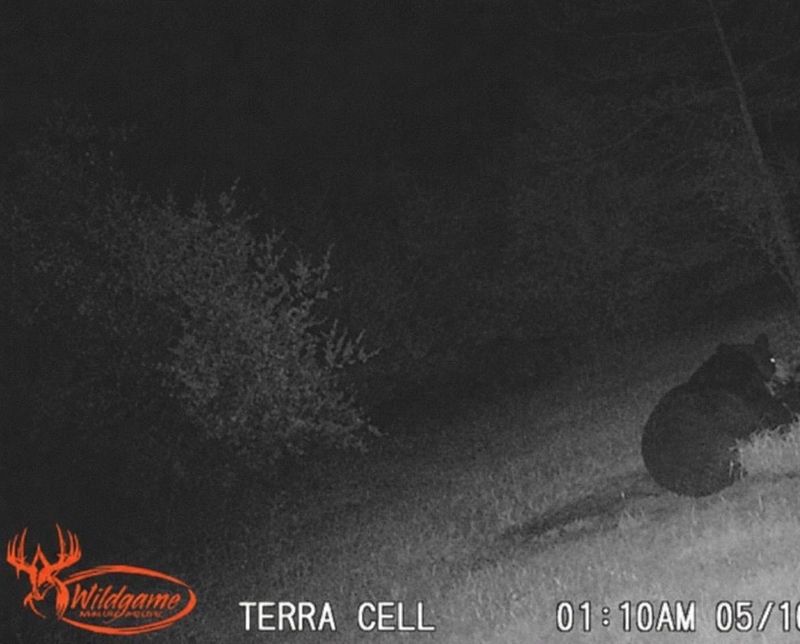
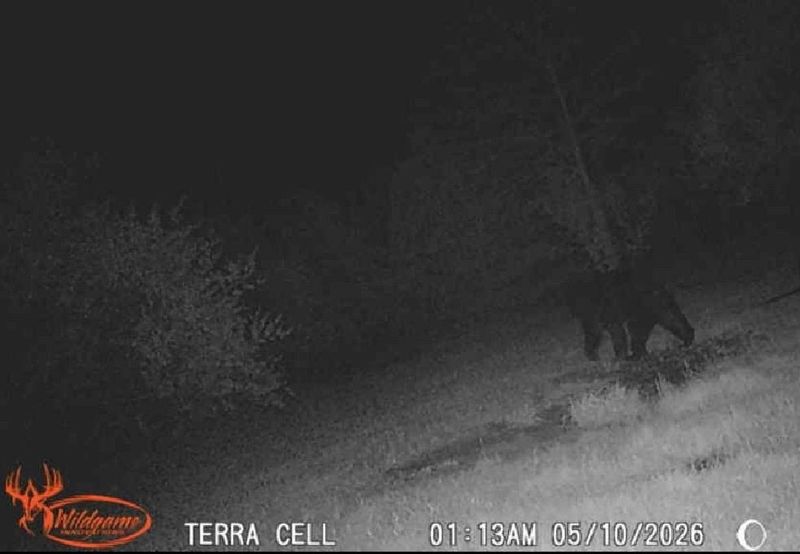
Rare sightings of a black bear on cameras in Wayne and Monroe counties have southeast Michigan abuzz. But Michigan’s wildlife regulator, the Michigan Department of Natural Resources, doesn’t necessarily see it as a bad thing.
Photos from a trail camera near Carleton in Monroe County from the early morning of May 10, and then on Blink security camera footage early the following morning near Flat Rock, about 6 miles away, appear to be of the same bear, said DNR bear specialist Cody Norton.

“It’s certainly extremely infrequent when they do show up in the southeast, especially this far south,” he said. “It’s extremely rare, but they do show up there occasionally.”
DNR will monitor the situation, but if the bear isn’t causing conflicts, the plan is to let it just be a bear, Norton said.
“So far this bear has not exhibited any destructive behavior, nuisance behavior, isn’t causing conflicts,” he said.
“In our bear management plan, we state that one of our objectives is to allow bears to naturally recolonize the southern Lower Peninsula, to the extent that social acceptance allows.
“We will monitor the situation for sure. If it changes, if it starts causing significant conflicts or concern in an area, absolutely, we could then take action. But otherwise, we plan on letting the bears be a bear and try to find a new home range to set up with.”
Carleton residents startled by bear on trail cam
Shane Nolff, who lives on Grafton Road in Carleton in Monroe County, has a trail cam on the back of his property “just for deer, fox, coyote,” that sends images to his cell phone.
When looking at the photos from overnight on Sunday morning, May 10, he was shocked: unmistakable images of a black bear moving through his yard.
“We have property in northern Michigan, so we get bear pictures from our cabin,” he said. “It’s nothing that I ever would think we would see down here in our backyard, for sure. My first thought was, where did this thing escape from?”
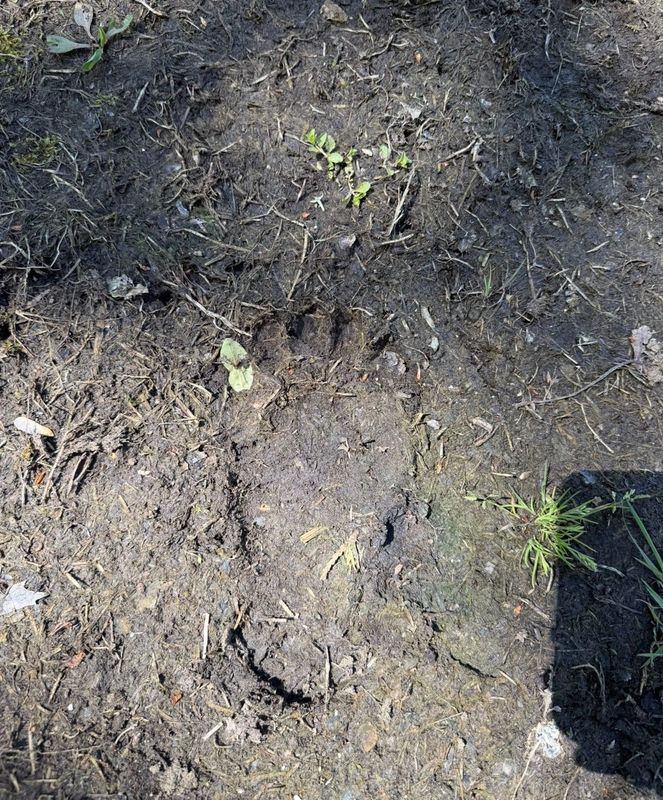
Inspecting the area later that day, Nolff also found a very clear bear print. DNR personnel later came out to his property to confirm the sighting, Nolff said.
“It’s not something we expected to see on a Sunday morning,” Nolff said.
Recent Ann Arbor area sighting, too, but that one’s more uncertain
Norton noted that less than a week before the Carleton and Flat Rock bear captures on camera, an Ann Arbor area resident reported spotting a black bear on May 5. The DNR was sent a photo of what was believed to be a bear track, but it was not, he said.
“So that one is unconfirmed, but it’s interesting timing with it being just five days before the confirmed southeast Michigan sightings,” Norton said.
Norton said it was puzzling that the confirmed southeast Michigan bear wasn’t seen earlier, as it would have traveled through populated areas and relatively open land.
“Your guess is as good as mine for how this particular bear actually showed up in this area,” he said.
Bears expanding their numbers and range in the Lower Peninsula
Encountering a bear in southeast Michigan may be very rare now, but it may not be for long.
Michigan has some 10,350 black bears in its Upper Peninsula, and more than 2,100 bears in the northern Lower Peninsula, according to DNR surveys. That Lower Peninsula population has increased by about 60% since 2012, and bear hunters in the state’s lottery-based September and October hunting seasons have increased their Lower Peninsula bear harvests by 75% over that time, Norton said.
The bears’ range has expanded from northeastern Lower Michigan to the northwestern tip of the Lower Peninsula, down the western side, to as far as Muskegon, with recent expansions into central areas like Bay City.
Norton said it’s still more likely that bears will find habitat more to their liking in places like southwest and south-central Michigan, with more of the unbroken forest habitat they prefer. But it’s in young male bears’ nature, in particular, to expand where they live.
“When male bears turn 1½ years old, they disperse out,” Norton said. “They leave home, and they are looking for unclaimed territories or home ranges, looking for potential suitable mates. And if they don’t find that right away, they might just keep going in a direction. So they can end up anywhere.”
Bear attacks on humans ‘extremely, extremely rare’
On Aug. 15, 2013, a black bear mauled Abigail Wetherell, 12, as she was out running on her grandfather’s property in Wexford County’s Haring Township, north of Cadillac. Wetherell was hospitalized with deep cuts to her thigh, puncture wounds, and bruises, but later recovered.
Three years later, on April 30, 2016, a man in the same Haring Township shot a 9-year-old female black bear as it attacked the man’s dog. Genetic material was taken from the bear by DNR staff and compared to the genetic evidence on the scene of Wetherell’s attack in 2013. It was confirmed as the same bear.
Despite this alarming incident, bear attacks on humans are “extremely, extremely rare,” Norton said. Conflicts far more often involve destroyed beehives and bird feeders, and damage to agricultural stores and other food stocks accessible outdoors.
Michigan DNR makes the following recommendations to be safe around black bears:
Where could bears go in southeast Michigan?
With the bear population growing and its natural urge to branch out, Norton said he expects more bear sightings in southern Michigan.
“I think that’s probably more likely in the western part of the southern Lower Peninsula, maybe in some portions of the south-central (part),” he said. “But there still might be some forested areas along, especially waterways, in the Pinckney Recreation Area, Waterloo, Brighton, some of those areas that are more forested might be able to support a very small population of bears.
“We want to allow them to naturally recolonize. I think that if they are able to find suitable habitat in the southern Lower Peninsula, that could be a really good thing; allowing them to recolonize a portion of their former range.”
Nolff, who had the bear move through his Carleton property, said he has no issue with the DNR’s position.
“That doesn’t bother me,” he said. “With black bears, they’re not known to be a vicious animal − they are more likely to run from you if they see you.”
Contact Keith Matheny: kmatheny@freepress.com.
This article originally appeared on Detroit Free Press: Black bears in SE Michigan? The DNR doesn’t think that’s a bad thing
Reporting by Keith Matheny, Detroit Free Press / Detroit Free Press
USA TODAY Network via Reuters Connect