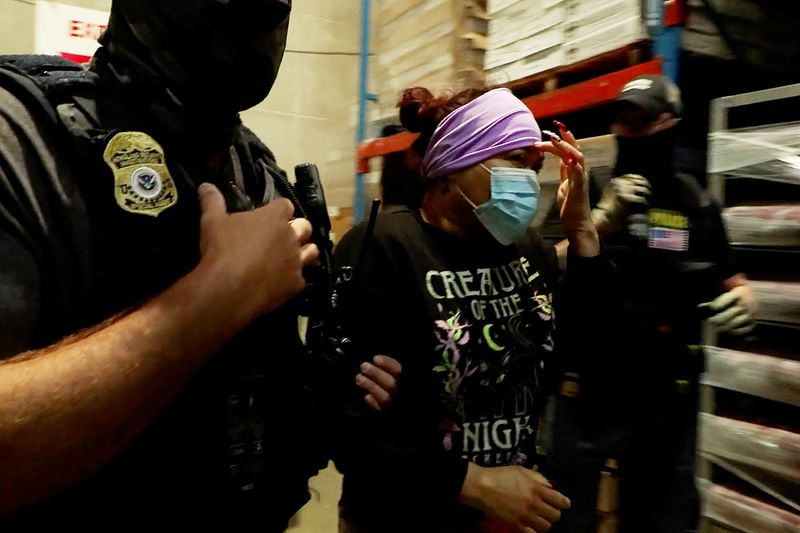
News of Immigration and Customs Enforcement (ICE) raids on dairy farms in Vermont and Texas, to produce farms in California and a meatpacking plant in Nebraska, where dozens of workers were whisked away in buses, immigrant workers and their employers are understandably on edge.

Most farmers, ranchers and produce farm owners believed the Trump administration was interested in rounding up and deporting violent criminals and would leave the agricultural workforce unscathed. However, the government’s push to detain record numbers of undocumented immigrants has set off a “whole new wave of panic,” Chris Thomas, an attorney who represents employers in immigration cases, told USA TODAY.
Despite the uptick in raids, Teresa Romero, president of the United Farm Workers union said workers are still showing up to work.
“Even though they’re scared…they need to pay the rent, they need to pay the utilities, they need to feed their family,” Romero said on NPR’s Morning Edition.
Other sources say workers are afraid to report to work for fear of deportation.
House Agriculture Chair G.T. Thompson, R-Pa., told the media the raids on agriculture producers were “just wrong.”
“Let’s go after the criminals and give us time to put processes in place so we don’t disrupt the food supply chain,” Thompson told Politico.
Trump signals changes to immigration crackdown
Last week, U.S. President Donald Trump said that he would issue an order soon to address the effects of his immigration crackdown on the country’s farm and hotel industries, which rely heavily on migrant labor, Reuters reported.
“Our farmers are being hurt badly and we’re going to have to do something about that… We’re going to have an order on that pretty soon, I think,” Trump said at a White House event, adding that the order would address the hotels sector, too.
According to an internal email reviewed by Reuters, a senior Trump official and a person familiar with the matter, said Trump’s administration has directed immigration officials to largely pause raids on farms, hotels, restaurants and meatpacking plants.
It is unknown what changes the order would implement or when it would take effect.
Immigrant labor is crucial in ag states like Wisconsin
The Associated Press reported that “farm bureaus in California say raids at packinghouses and fields are threatening businesses that supply much of the country’s food. Dozens of farmworkers were arrested after uniformed agents fanned out on farms northwest of Los Angeles in Ventura County, which is known for growing strawberries, lemons and avocados.”
About 46 percent of U.S. immigrants work in the farming industry, according to the Pew Research Center. That number is greater in Wisconsin which has the largest number of licensed dairy herds in the country.
Both large and small dairy farms in Wisconsin depend on immigrant laborers to fill positions that go unfilled by local workers. Undocumented workers perform an estimated 70% of the work on Wisconsin’s dairy farms, according to a University of Wisconsin-Madison School of Workers study.
Wisconsin Governor Tony Evers spoke out on social media about his concern that the raids on farms could leave a void in essential agricultural roles.
“If suddenly those people disappear, I don’t know who the hell is going to milk the cows,” he told Wisconsin news outlet WLUK.
Farmers already have enough to worry about, economic hurdles, trade uncertainty and labor shortages.
U.S. farm industry groups have long wanted Trump to spare their sector from mass deportations, which could upend a food supply chain dependent on immigrants, USA TODAY reported.
Nearly half of the nation’s approximately 2 million farm workers and many dairy and meatpacking workers lack legal status, according to the Department of Labor and Agriculture.
“We are long overdue for immigration reform that fixes our guest worker visa system and provides stability for those currently working in agriculture,” said American Farm Bureau President Zippy Duvall. “Workforce shortages have been one of the greatest limiting factors for growth in U.S. agriculture, and it’s time we find a solution that works for all.”
This article originally appeared on Farmers Advance: As ICE raids on agricultural businesses ramp up, farmers and workers are growing uneasy
Reporting by Colleen Kottke / Farmers Advance
USA TODAY Network via Reuters Connect