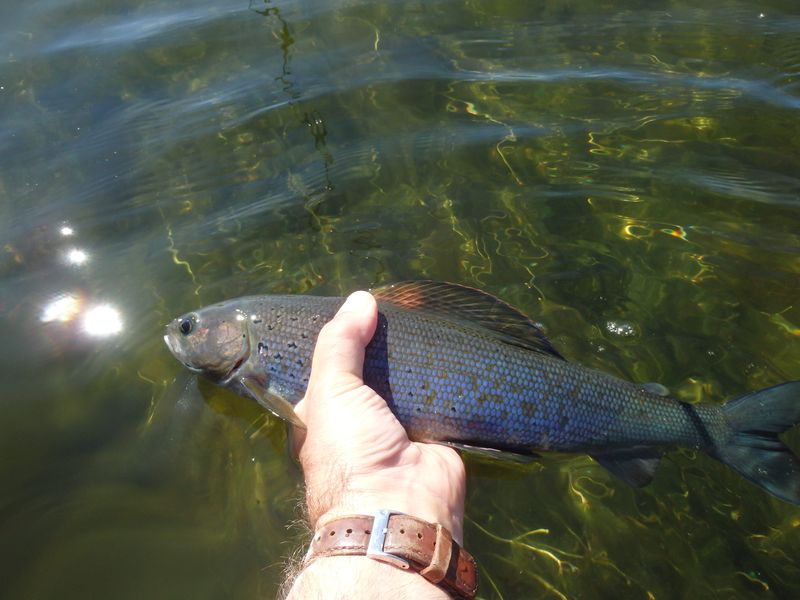
A years-long effort to reintroduce Arctic grayling to Michigan’s lakes and streams recently began a new phase, state officials said this week.
In a ceremony on May 12, the Department of Natural Resources provided an estimated 400,000 Arctic grayling eggs to the Little River Band of Ottawa Indians, the Little Traverse Bay Bands of Odawa Indians, and the Grand Traverse Band of Ottawa and Chippewa Indians at the Oden State Fish Hatchery Visitor Center in Alanson.

The Native American tribes plan to reintroduce the eggs at locations along the North Branch of the Manistee River, the Maple River and the Boardman-Ottaway River, the DNR said in a June 3 release.
Officials hope the delivery of eggs and their placement into Michigan waterways will help the species that disappeared from Michigan nearly 100 years ago to return. Arctic grayling were once prevalent in Michigan’s northern Lower Peninsula, the DNR said, but today, they’re native only to Montana and Alaska in the U.S.
Here’s what we know about the process.
What are Arctic grayling?
Arctic grayling are a freshwater fish in the salmonidae family, the DNR said. They have a prominent, sail-like dorsal fin and often iridescent markings.
The largest of the streamlined cold-water dwellers can grow to 30 inches and weigh up to 8 pounds, according to MSU.
Grayling can have long lives. The oldest lived to 32 years, Michigan State University said. Typically, they mature in three to five years and average 18 years.
Grayling can be found in the Arctic Ocean and Alaskan lakes and rivers, as well as in rivers and streams of the northern U.S. and Canada.
Originally native to only Michigan and Montana in the Lower 48 states, grayling historically were found in cold water streams in Michigan’s Lower Peninsula and were common in the Manistee and Au Sable rivers.
Known to the Anishinaabek as nmégos, they were an important food for Michigan’s northern Native American tribes.
The city of Grayling, along the Au Sable River, is named after the Arctic grayling.
What happened to grayling in Michigan?
Rivers like the Au Sable, Manistee, and Muskegon floated logs to sawmills, destroying the Arctic grayling’s habitat. Overfishing and the introduction of brown trout also hurt grayling populations.
Despite the importance of grayling as a food source, sport fish and cultural resource, habitat destruction, unregulated timber harvest and pressures from non-native fish species led to the extirpation (local extinction) of grayling from Michigan by 1936, the DNR said.
Why are grayling being reintroduced to Michigan?
Before the northern Lower Peninsula was heavily lumbered in the mid- to late 1800s, Arctic grayling was the “abundant” and the dominant species of salmonids found in cold-water streams.
In the areas they currently thrive — Alaska, Canada, Siberia and a rehabilitated population in Montana — they are a popular game fish because of their speed and aggressive feeding style.
Native Americans’ culture developed alongside the iconic fish. Tribes have felt its absence for generations, the DNR said in a release.
When did the reintroduction project start?
In 2016, the DNR, in partnership with the Little River Band of Ottawa Indians, announced an initiative to reintroduce Arctic grayling to the state, creating the Michigan Arctic Grayling Initiative, or MAGI.
Consisting of more than 50 partners, the MAGI seeks to establish self-sustaining populations of the historically and culturally significant species within its historical Michigan range.
About 10,000 eggs collected from Chena River, a tributary to Alaska’s Yukon River, were brought to Michigan in spring 2019, MAGI said. Later, 4,000 fish were transferred to the Oden hatchery as broodstock.
In November 2023, three Michigan lakes were stocked with Arctic grayling that were surplus from the DNR’s grayling broodstock.
Four hundred grayling were stocked at Alger County’s West Johns Lake, 300 at Penegor Lake in Houghton County and nearly 1,300 in Manistee County’s Pine Lake, Michigan Grayling reported. The fish were taken from the Marquette State Fish Hatchery in Marquette and represented year classes from 2019 and 2021.
Has the state tried to reintroduce grayling before?
Previous attempts were made, without success, to bring back Arctic grayling to Michigan, the DNR said.
Between 1900 and 1933, more than 3 million fry were stocked in Michigan, MSU said.
From 1934-41, 60,000 yearling fish were stocked, and from 1958-60 another 300,000 fry were stocked in Michigan.
Finally, between 1987-91, 145,000 yearlings were stocked in 13 lakes and seven streams.
“New technologies and methods have improved the likelihood of effective reintroduction,” the DNR said in January.
What’s the next step for the reintroduction?
The grayling eggs will be placed in streamside incubators that will allow them to imprint on the waters in which they are placed, helping them thrive, the DNR said earlier this year.
MAGI partners will monitor the hatching and development of the fry, as well as follow up on how they move through the systems as they grow.
Are the DNR and tribes reintroducing other species?
Yes, there is an effort underway to build on the state’s whitefish numbrs, which have been dwindling for more than 15 years, in part because invasive quagga mussels are filtering out zooplankton young fish depend on.
Lake whitefish spawn in the Great Lakes, but historically migrated up rivers in the fall and spawned in rocky riffles and rapids. Like salmon and Arctic grayling, lake whitefish imprint on and return to the place where they hatched to spawn.
Most lake whitefish spawning runs were lost during Michigan’s logging era as rocky habitat filled with sediment and dams blocked migration upstream. Few contemporary populations now migrate upstream.
In Michigan, biologists from the Bay Mills Indian Community, Little Traverse Bay Bands of Odawa Indians, Michigan Department of Natural Resources, Sault Tribe of Chippewa Indians, and The Nature Conservancy are studying reestablishing river spawning runs in Michigan.
Since 2022, eggs and young lake whitefish have been introduced into select tributaries to study feasibility and determine how stocked juveniles fare.
In addition, the state has spent decades working to increase the number of lake sturgeon in Michigan.
This article originally appeared on Lansing State Journal: Arctic grayling stocking moves ahead in Michigan. What’s next for prized fish
Reporting by Dan Basso, Lansing State Journal / Lansing State Journal
USA TODAY Network via Reuters Connect