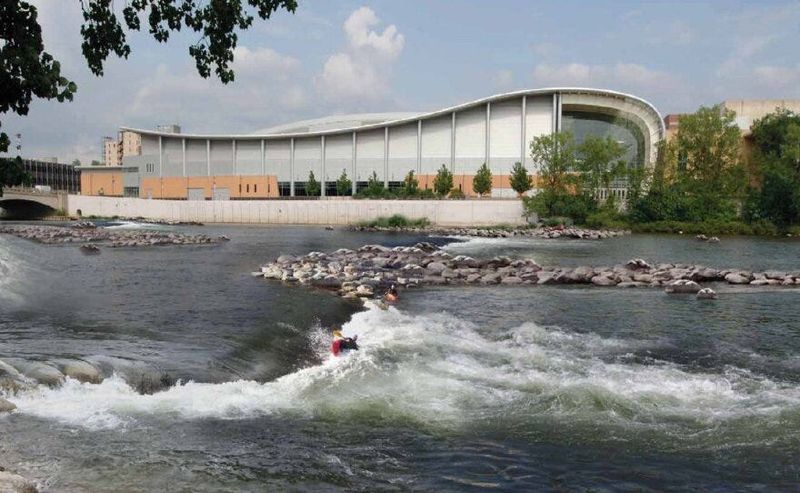
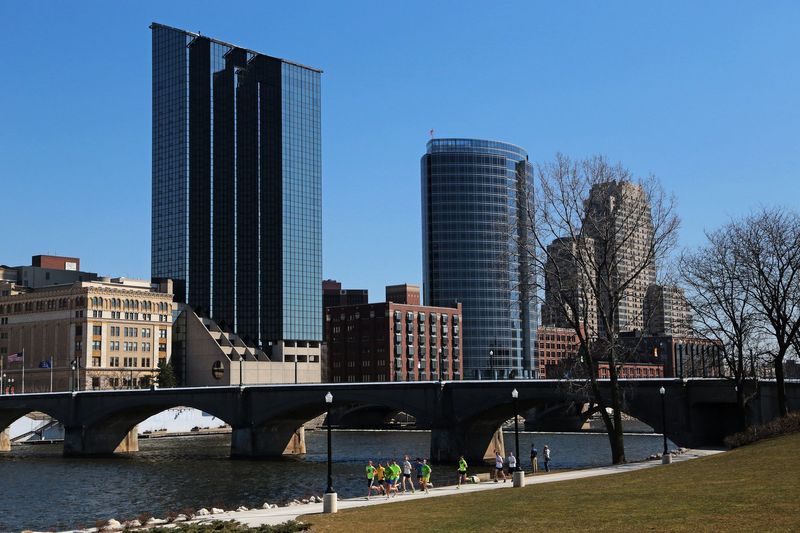
Grand Rapids will soon have rapids once again.
A nearly 20-year local mission has sought to restore a rapid-running Grand River through downtown — the rushing waters that gave Grand Rapids its name long ago. That effort cleared a major hurdle this week with the federal government approving more than $11 million for the project. After an earlier federal environmental assessment found the project would have no significant impacts, construction can move forward on the Lower Grand River Habitat Restoration Project.

“This is a historic moment for Grand Rapids,” Mayor David LeGrand said March 23 in announcing the funding by the U.S. Department of Agriculture’s Natural Resources Conservation Service.
“After 17 years of planning and collaboration, we are finally bringing the rapids back to the Grand River. This project will transform our riverfront, improve access to the water and create a healthier, more vibrant river for generations.”
The whitewater rapids for which the city of Grand Rapids was named were removed systematically as four, low-head dams were built between 1849 and 1926 to provide water power for factories, sawmills, and industrial infrastructure, significantly reducing the river’s flow.
Calls for restoring river flows date back almost as far as the construction of the dams, but regained strong new interest around 2009 with the creation of a nonprofit, Grand Rapids Whitewater, that sought to remove the dams in downtown Grand Rapids and restore the Grand River’s flows, creating a whitewater recreation area for kayakers and others to enjoy and improving fish habitat.
“We’ve worked tirelessly with partners and the community to make this vision a reality,” Grand Rapids Whitewater executive director Matt Chapman said, adding the federal funding approval “represents the final step as we shift from planning to implementation and is a proud moment for everyone who believed in restoring the river.”
The City Commission earlier approved a $14.56 million construction contract with Taplin Group, a Kalamazoo-based environmental services contractor, for the first phase of the project, the Lower Reach, from Interstate 196 to Fulton Street. The work will involve the removal of the four low-end dams, followed by the creation of diverse riffles, runs, waves, and pools in the river to restore aquatic riverine habitat and diversity and improve fish passage.
The work is expected to “recapture the sight, sound and spirit of the historic and iconic rapids for which the city is named,” Grand Rapids Whitewater officials said. It will also enhance distinctive recreational opportunities such as wading, angling and whitewater paddling sports “that are safe, interesting and substantial enough to engage residents, attract tourists and serve as a catalyst for local, regional and equitable economic development opportunities.”
The Lower Reach is anticipated to cost between $19 million and $20 million, according to Grand Rapids Whitewater, met through a combination of public and private dollars. The state of Michigan has provided $9.8 million for the Lower Reach segment of work, with $4.2 million from local governments. Some $15 million in private sector contributions have supported the design, engineering, and development of the overall river restoration project over 15 years, with $7.7 million in private contributions remaining for the Lower Reach construction.
A later, Upper Reach portion of the river restoration is also in the planning stages for the stretch of the Grand River from around Ann Street to the Sixth Street Dam. This would involve removing that dam, while installing barriers to prevent invasive sea lamprey.
The project has gone through 15 years of regulatory hurdles with a number of state and federal agencies. In the summer of 2024, partners worked to find in the river and relocate more than 9,000 mussels, including the federally endangered snuffbox mussel, away from the dam removal area and to other suitable habitats on the Grand River.
In a January finding of no significant environmental impact, the Natural Resources Conservation Service said the project “improved habitat variety and suitability” and “increased Great Lakes native fish variety and productivity,” while protecting threatened and endangered fish and mussel species, including lake sturgeon.
Those approvals, along with the federal funding piece, mean partners can now “begin a transformation and leave a legacy for future generations,” Chapman said.
For more information on the project, go to https://grandrapidswhitewater.org/.
Contact Keith Matheny: kmatheny@freepress.com.
This article originally appeared on Detroit Free Press: After more than a century, rapids will soon return to Grand Rapids
Reporting by Keith Matheny, Detroit Free Press / Detroit Free Press
USA TODAY Network via Reuters Connect