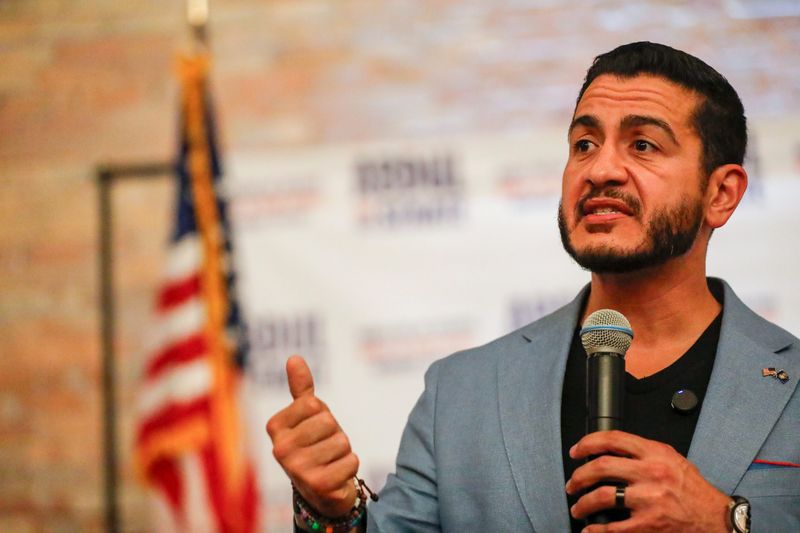
The U.S. Senate campaign of Democrat Abdul El-Sayed topped rival Haley Stevens and Republican hopeful Mike Rogers in the latest fundraising quarter, hauling in $4.57 million for the highest total of any Michigan Senate candidate since the race began.
Stevens, a four-term Democratic congresswoman from Birmingham, raised less than half of what El-Sayed did, with $2.1 million in receipts, despite having led among her primary rivals in overall fundraising last year. She closed out with $3.4 million in cash reserves as of June 30.

Stevens was outraised by the rest of the Michigan Senate field and also by state Sen. Mallory McMorrow of Royal Oak, who dropped out of the race July 5. McMorrow posted a just under $2.7 million raised and had $2.16 million cash on hand.
Rogers, a former seven-term congressman from White Lake Township, posted $2.9 million in receipts for the quarter and is sitting on $5.66 million in cash reserves ― the largest war chest of the bunch.
El-Sayed of Ann Arbor filed a report Wednesday showing that he had $2.7 million in the bank as of June 30.
Stevens had the highest “burn rate” among the two Democratic hopefuls, meaning she spent the most of what she raised last quarter, 98%, followed by El-Sayed at 95%. Rogers spent just half of what he raised, according to quarterly reports.
El-Sayed’s fundraising feat is thanks in part to grassroots and broader national enthusiasm for his campaign, which has helped him stay competitive with Stevens despite her massively lopsided advantage on the airwaves. Outside groups have showered Michigan with nearly $50 million worth of ads to boost Stevens and attack El-Sayed since the beginning of May, including more than $25 million from a super PAC aligned with the pro-Israel group AIPAC.
In contrast, only about $2.7 million has been spent on ads to help El-Sayed’s bid as of Tuesday, mostly by his campaign, with less than three weeks until the Aug. 4 primary election.
Amid the pro-Stevens flood of outside money, El-Sayed has likely benefited on the fundraising front from the campaign implosion of Maine’s Graham Platner, as party activists track the next progressive takeover, tune into Michigan’s primary and help transform El-Sayed into somewhat of a “national celebrity candidate,” said John Sellek, a consultant and CEO of Harbor Strategic who has advised Republican campaigns.
Meanwhile, with fundraising an indicator of excitement for a candidate, Stevens’ has been consistently lagging others, Sellek said.
“If I were a supporter of hers, that might make me a little nervous,” Sellek said of Stevens. “In this super PAC era … her campaign may not feel the necessity to raise a lot if they’re watching $26 million, and we’re only on July 15. There must be a lot more to come.
“Still, it could spell danger for her in the general election if this heavy spending in the primary is just based on stopping El-Sayed,” Sellek added. “Then what happens next?”
Michigan’s Senate race is one of the most closely watched contests nationally in the midterms. El-Sayed and Stevens are vying for the Democratic nomination in the contest to succeed retiring U.S. Sen. Gary Peters, D-Bloomfield Township. The winner of the primary is expected to face off against Rogers in November, who had his best quarter yet in the cycle and is sitting on $5.66 million.
That is more than double the $2.5 million that Rogers reported in terms of cash on hand at this point in the 2024 Senate race, which he lost by about 19,000 votes to Democrat Elissa Slotkin of Holly. At this point in the 2024 cycle, Slotkin had $9.58 million cash on hand.
“Mike Rogers is in a stronger position than ever to win this seat and save Michigan,” spokeswoman Alyssa Brouillet said in a statement. Working families across this state are fed up with the Democrats’ failures and know that Mike’s socialist opponents will only send us spiraling further.”
Rogers is poised to go into the general election season with a “massive advantage” stacking up money without taking a primary beating as he did in 2024, Sellek said.
The super political action committee that supports Rogers, the Great Lakes Conservatives Fund, reported over $1 million in receipts for the three-month period and $5.5 million in cash on hand.
The largest contributions came from $250,000 from transport company Penske Corp. of Bloomfield Township, whose CEO Roger Penske previously gave to the super PAC; $200,000 from Chevron Co.; $100,000 from RAI Services, the cigarette maker formerly known as R.J. Reynolds; and $100,000 from Gregg Williams of Wallon Lake, CEO of the gas turbine engine manufacturer Williams International.
Top spenders among the pro-Stevens groups, aside from the AIPAC-aligned United Democracy Project, are A Stronger Michigan, which has spent about $13 million on paid media but hasn’t filed a report yet with the Federal Election Commission as of Wednesday evening.
The Center Forward Committee, which has spent over $1 million to boost Stevens, reported $535,000 from the affiliated Center Forward group that promotes centrist candidates, and $25,000 from the American Society of Anesthesiologists.
Fighting for Michigan, a super PAC supporting El-Sayed, reported $1.99 million in receipts, including $300,000 from the Institute for Middle East Understanding; $250,000 from former U.S. House hopeful Saikat Chakrabarti in California, who co-founded the progressive group Justice Democrats; $130,000 from Natasha Chokhani, an assistant law professor at the CUNY School of Law; and $115,000 from the group MI Leaders of Tomorrow.
Two other donors that gave $250,000 each are identified as Medicare for All and the Forward Blue PAC.
Other national groups have also promised to invest in Michigan, with Senate Republicans announcing $45 million in initial funding to help presumptive GOP nominee Rogers. In March, the group Sentinel Action Fund said it would spend $15 million with an allied group, Right Vote, to boost Rogers ― money that will reportedly go to advertising, voter outreach and early-vote operations across Michigan.
National Republicans are bullish on their chances of flipping a seat in Michigan, which they consider a top target in the midterms.
The last time the GOP won a Senate race in Michigan, in 1994 ― when former state Republican Party Chairman Spence Abraham defeated former Democratic U.S. Rep. Bob Carr ― was also the last year the state held a protracted, competitive Democratic Senate primary.
mburke@detroitnews.com
This article originally appeared on The Detroit News: Abdul El-Sayed tops rivals with fundraising haul for Michigan Senate bid
Reporting by Melissa Nann Burke, The Detroit News / The Detroit News
USA TODAY Network via Reuters Connect
By Melissa Nann Burke, The Detroit News | USA TODAY Network