

By Jim Bloch

The Michigan Department of Natural Resources and the Michigan Department of Environment, Great Lakes and Energy issued permits July 15 partially clearing the way for Enbridge to proceed with its Great Lakes Tunnel Project to encase Line 5 beneath the Straits of Mackinac.
“The DNR issued a permit needed for the tunnel project under Part 365 of the Natural Resources and Environmental Protection Act,” said the MDNR in a press release. “The permit requires several measures by Enbridge to reduce impacts on rare plants and animals.”

EGLE’s permit was a reissue of an expired permit.
“In 2021, EGLE issued Part 303 and Part 325 permit to Enbridge for the proposed GLTP. Because construction has not yet begun, that permit expired earlier this year,” said EGLE in a July 15 news release. “Today, EGLE issued the new permit following a robust 16-month review period covering Enbridge’s bottomlands and wetlands permit application.”
Juli Kellner, a spokesperson for Enbridge, told the Pipeline Technology Journal that the approvals were “an important step forward” in the company’s effort to maintain Line 5 while protecting the Great Lakes.
Enbridge still needs another permit from EGLE and permits from the Michigan Public Service Commission and the U.S. Army Corps of Engineers. There are currently three outstanding court cases standing in the way of the project; more legal challenges are expected.
Tribes and environmental groups expressed outrage at the new permits.
Tribal response
“Michigan sides with Big Oil as climate-related wildfire smoke chokes the Straits,” announced the Native American Rights Fund.
Whitney Gravelle, tribal chairperson of the Bay Mills Indian Community, condemned the permits.
“The Straits of Mackinac are not simply a place on a map,” Gravelle said on Facebook. “They are sacred. They are where our creation story begins. They are the heart of who we are as Anishinaabe people. They connect our past, our present, and our future. To see this sacred place handed over to a foreign corporation with Enbridge’s record is devastating. This is a company that has spilled oil, violated safety standards, trespassed on lands, damaged ecosystems, pierced aquifers, disregarded Tribal sovereignty, and caused one of the worst inland oil spills in American history. Rewarding that record with another opportunity to threaten the Great Lakes is unconscionable.”
Gravelle pledged to continue the fight against Line 5 and the tunnel project. “The decision to allow Enbridge to industrialize this sacred place demonstrates a disregard for our environment, our treaty rights, and Tribal sovereignty,” said Austin Lowes, chair of the Sault Ste. Marie Tribe of Chippewa Indians, on Facebook.
Environmental groups respond
“Governor Whitmer betrays Great Lakes in 180-degree decision to greenlight tunnel,” said the National Wildlife Federation’s Great Lakes Regional Center on Facebook.
“Was the Kalamazoo catastrophe” — in which Enbridge spilled a million gallons of heavy crude into Talmadge Creek in 2011 – “amongst Enbridge’s long track record of spills, leaks, accidents, explosions, environmental damage, and over $187 million in penalties & settlements that they’ve had to pay not enough for the state to say ‘no’?” the organization asked.
Oil and Water Don’t Mix had a similar reaction.
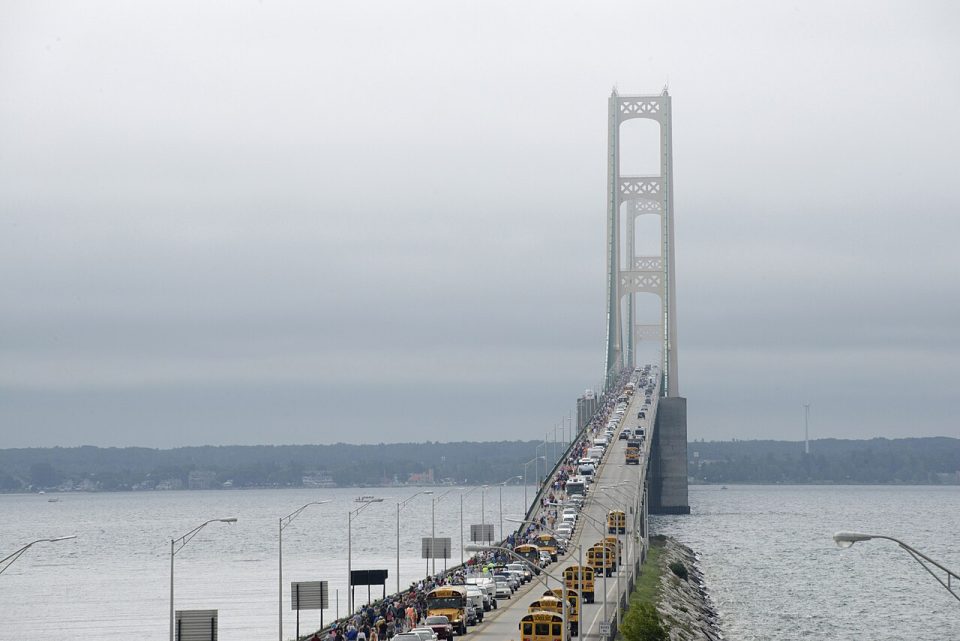
Today, as wildfire smoke from fossil-fuel-induced climate change blotted out the Mackinac Bridge …, EGLE reissued the tunnel’s wetlands and bottomlands permits, brushing aside more than 70,000 public comments opposing this project,” said the organization on its Facebook page.
The project
Enbridge is proposing to drill a 3.9-mile tunnel under the Straits of Mackinac to relocate a portion of 73-year-old pipeline, now runs along the lakebed between the Upper and Lower peninsulas, as many as 370 feet below the bottom of the Straits.
The DNR permit requires Enbridge to keep “topsoil and collect seeds to be used to restore part of the Houghton’s goldenrod and dwarf lake iris populations after construction”; monitor “the restored areas for at least five years to ensure healthy regrowth, clear trees only during winter months to avoid disturbing bats”; take “care throughout construction zones to avoid damaging sensitive plant areas”; keep the “surrounding vegetation as natural as possible and limit herbicide use; consider “long-term protection, such as a conservation easement, to protect surrounding rare plants”; and explore “additional opportunities to support recovery efforts for impacted rare plants.”
The 645-mile Line 5 begins in Superior, Wisconsin and runs through the Upper Peninsula as a 36-inch pipe. It separates into two 20-inch pipes that rest on the silty lake bottom and on stanchions along the floor of Straits. The two pipes recombine as a 36-inch pipe for its journey through the Lower Peninsula to Marysville, where it dips under the St. Clair River enroute to Chemical Valley in Sarnia, Ontario.
Line 5 can handle as many as 540,000 barrels per day of light crude, light synthetic crude and natural gas liquids, which are refined into propane.
Jim Bloch is a freelance writer based in St. Clair, Michigan. Contact him at bloch.jim@gmail.com.
