

By Jim Bloch

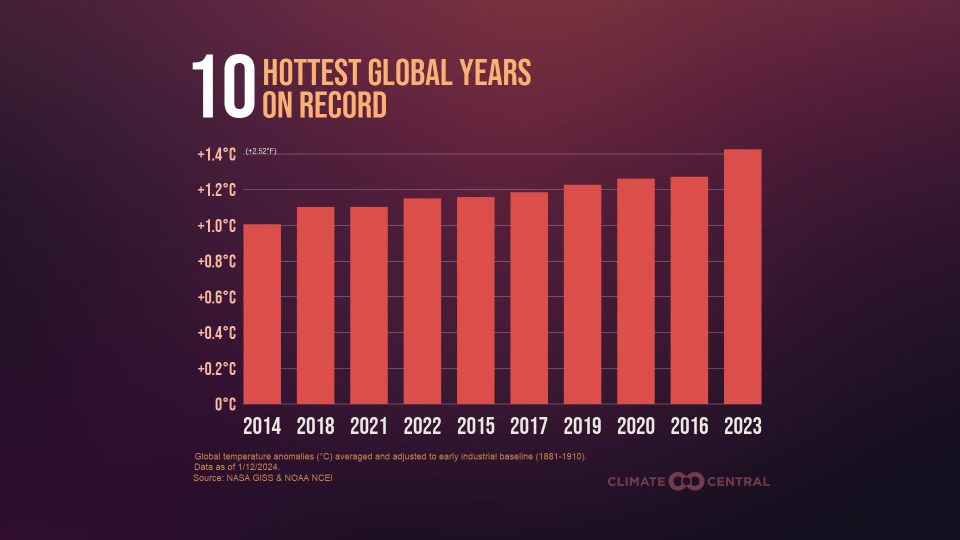
2023 was the hottest year on Earth in recorded history, going back to 1880, early in the Industrial Revolution.
The average surface temperature of the planet was 2.52 degrees Fahrenheit above the baseline established for the years of 1881-1910.

The 10 hottest years on record have all occurred since 2014.
“Global temperatures in 2023 shattered previous records for seven continuous months (June to December),” said Climate Central in its report 2023: Earth’s Hottest Year on Record, released Jan. 12 and based on data from National Aeronautics Space Administration and National Oceanic and Atmospheric Administration.
Climate Central is a nonprofit organization that studies and communicates climate change science, effects, and solutions to the public and decision-makers.
“As exceptional as 2023 has been, it won’t be the last record-breaking year,” the group said. “It’s part of a larger trend of rapid warming since the industrial revolution kicked off a 17-decade surge in heat-trapping pollution from burning coal, oil, and natural gas. More pollution traps more heat and causes more warming.”
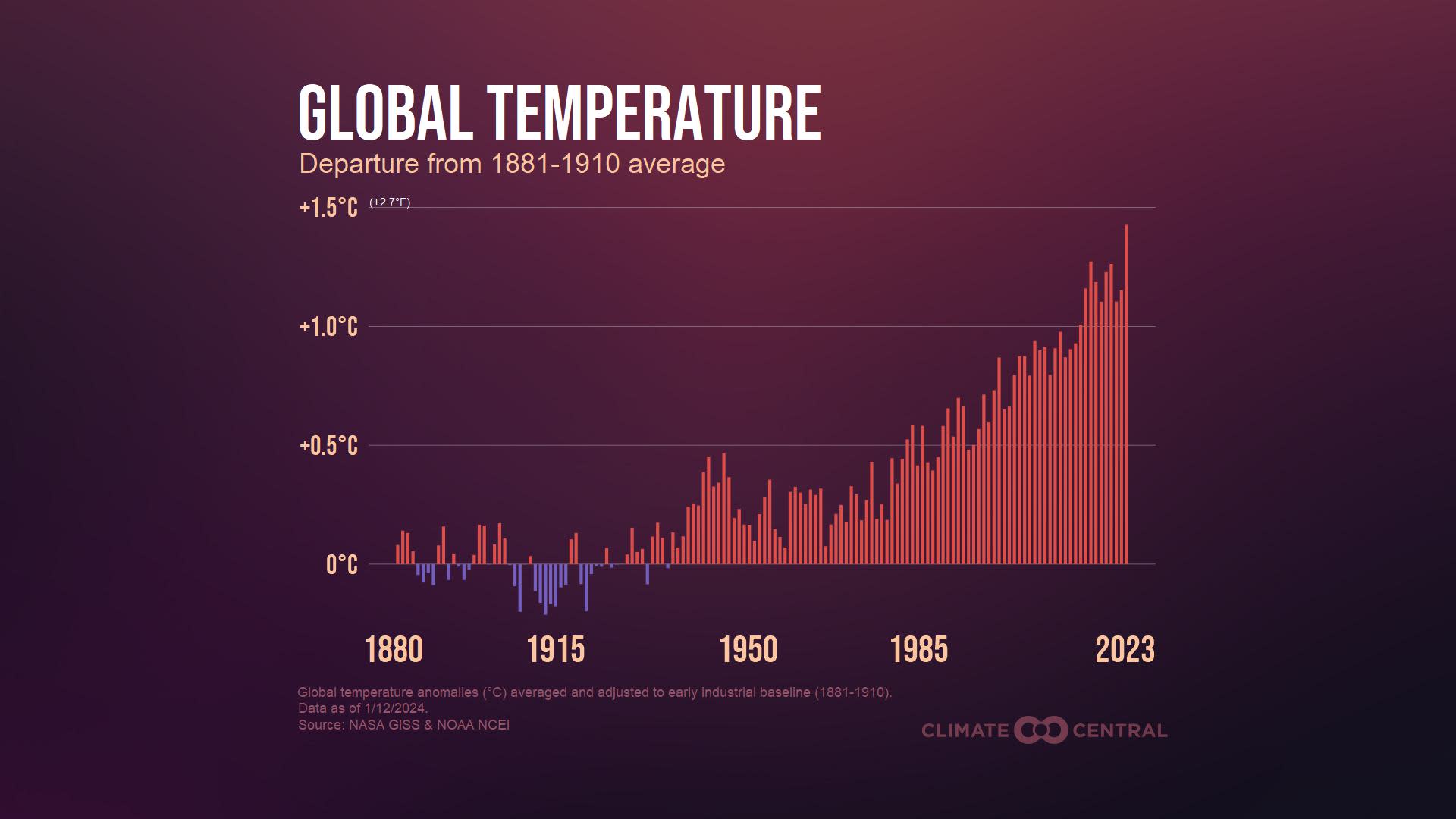
Global temperatures since 1880 in relation to the 1881-1910 average.
With an average temperature of 54.43 degrees F, the contiguous U.S. had its fifth hottest year on record, according to NOAA, going back to 1895.
The burning of fossil fuels by humans over the last century has released more carbon dioxide into the atmosphere at a faster rate than at any point in the last 800,000 years of the Earth’s history, the report said. Earth has warmed more quickly in the last half-century than any time in the last 2,000 years.
“If warming continues at this pace, many of the extreme events and harmful impacts that people are already experiencing will worsen and bring new risks,” Climate Central said.
Think more heat waves, which now are more frequent and longer lasting than they were in the 1960s.
More wildfires, as a result of more “fire weather days,” in some cases two more months of hot, dry, windy weather than occurred in 1970, especially in the southwest of the U.S.
More rainfall and more flooding — for every one degree Fahrenheit increase in average temperature, the air can hold four percent more water, upping the likelihood of big rainstorms and flash floods.
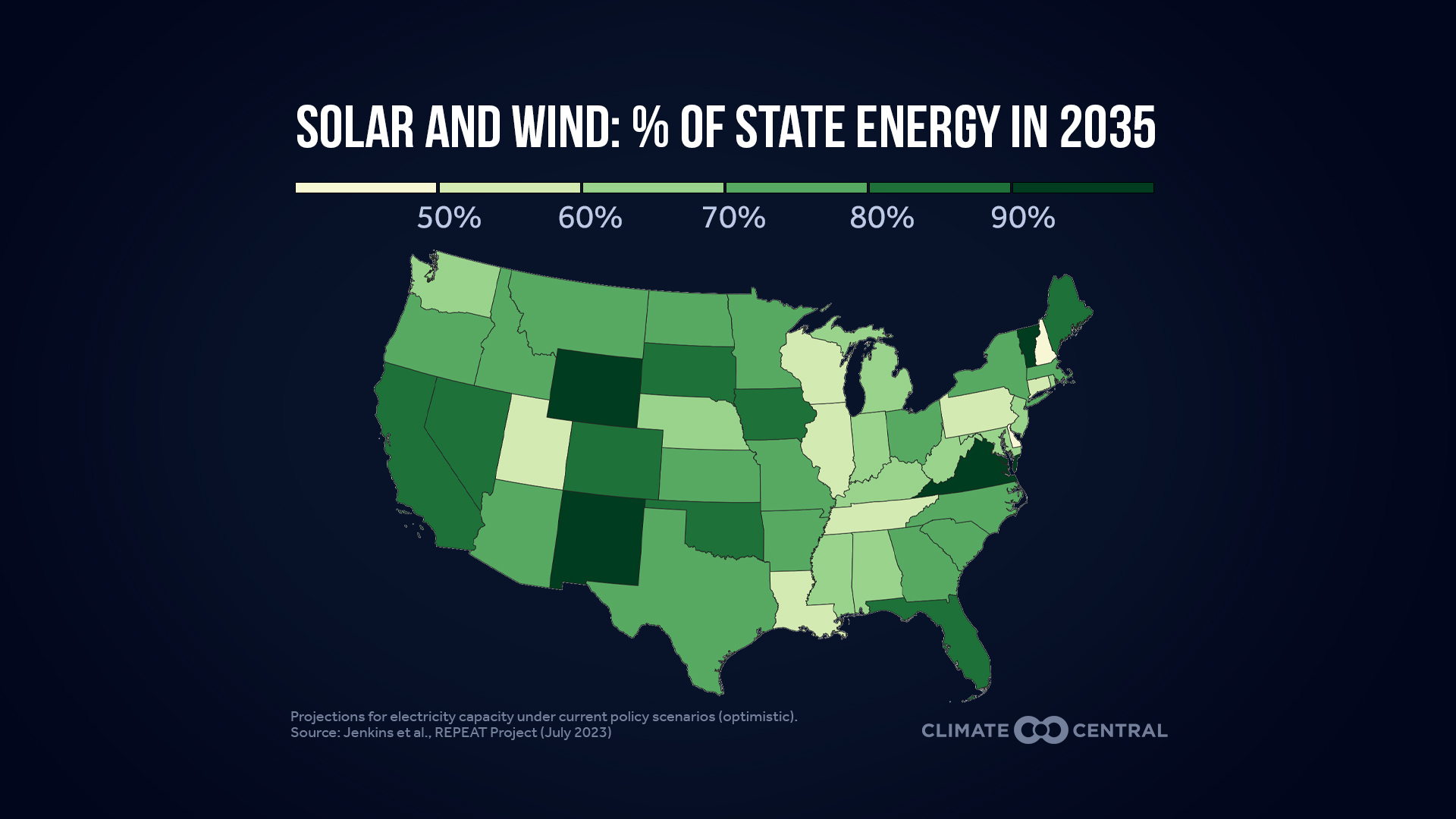
Solar and wind capacity, by state, by 2035.
From 1958 to 2016, the heaviest one percent of rainfall events became 42 percent wetter in the Midwest and 55 percent wetter in the Northeast. All other regions saw nine to 29 percent increases in wetness.
“In the U.S., extreme daily rainfall has become more frequent since the 1980s,” said Climate Central in an earlier report. “Hourly rainfall intensity has also increased since 1970 — by 13 percent on average across 150 U.S. locations analyzed by Climate Central.”
Solution
“Because we know the main cause of rapid warming, we know how to slow this trend and ensure a safer future with less warming and fewer risky extreme events: Deep, rapid, and sustained reduction in heat-trapping pollution,” said the report. “Moving toward clean and efficient sources of energy in is to achieving this.”
Climate Central sees progress in solar and wind power in nearly every U.S. state, including Michigan.
Jim Bloch is a freelance writer based in St. Clair, Michigan. Contact him at bloch.jim@gmail.com.
