

By Mary V. Colie

What was that? What does that have to do with anything?
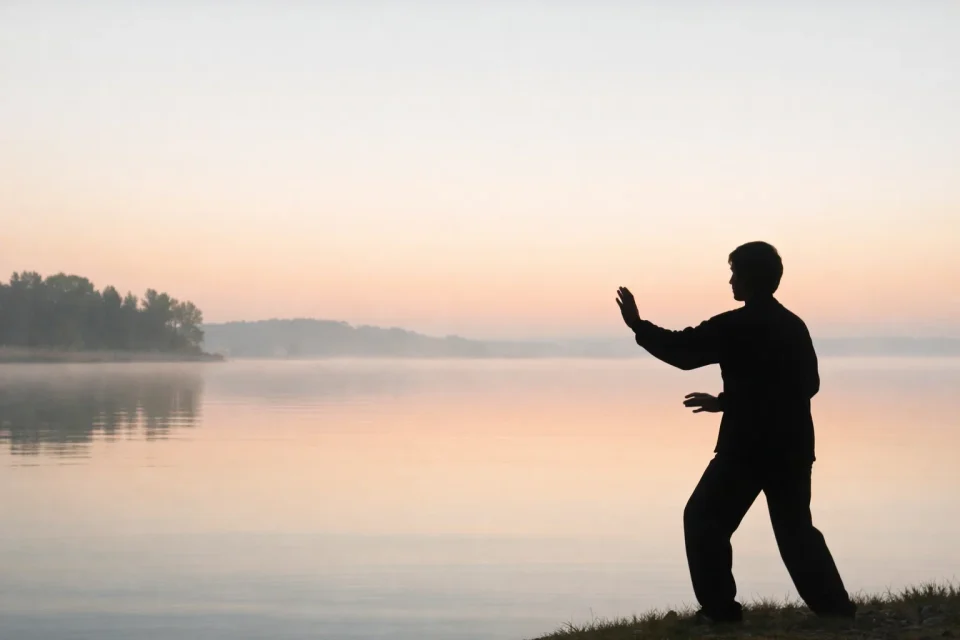
Those of you who have participated in a tai chi chuan class are probably smiling right now, or maybe even chuckling. Part the Wild Horse’s Mane is a tai chi move which is one component of several tai chi forms; the move derives its name from the sweep of both hands as if stroking a horse’s mane. Many of the names of tai chi moves come from Chinese poetry and have minimal relation to the moves themselves. In tai chi class you will learn to Grasp the Sparrow’s Tail and Move Hands Like Clouds.

So why should you do such a thing? Because it is good for you. Tai chi is a very gentle exercise enjoyed by people of all ages and abilities worldwide. It has been shown to improve balance, help prevent falling, improve range of motion, provide better breathing habits, and generally improve the practitioner’s overall health.
How does it do all this? Deep diaphragmatic breathing improves oxygen intake and enhances the functioning of the respiratory and circulatory systems. Conscious and controlled breathing is an essential part of tai chi. Careful placement of the feet and the slow shift of balance from one side to the other is another basic element of this ancient martial art. These are skills which help one to avoid tripping and falling during normal daily activity. Falls are the prime reason most older folk end up in the Emergency Room of their local hospital.
The arm movements, which involve using the muscles of the back and chest as well as flexing of shoulders, elbows, wrists and fingers, provide a gentle range of motion while, at the same time, giving the tai chi student some useful self-protective martial art skills. Tai chi chuan translates to “supreme ultimate fist.” Tai chi has a long and well-established reputation for being a very effective martial art.
While it bears some resemblance to other Asiatic martial arts, it is quite different from the more familiar types. Each move in tai chi provides a specific benefit to some organ of the body. The same cannot be said of karate, for instance.
So how do you find a wild horse? Many hospitals are now including tai chi classes for their patients. Doctors have come to realize that the practice of tai chi provides numerous benefits to those who are learning to cope with new replacement knees or hips. They also find that tai chi is useful in helping arthritic patients to get used to moving stiff and sore joints. It is wise to take a class rather than to rely on You Tube or home videos because a skilled teacher will help you with proper technique and prevent you from making painful mistakes. Tai chi classes are also offered at community centers, senior recreation facilities, and community colleges. Check it out! Soon you will be parting the wild horse’s mane like a pro!
