By Simon Jessop, Alexander Marrow and Richa Naidu
LONDON, May 8 (Reuters) – Some Unilever investors are pressing for the giant food entity created by a $65 billion deal with U.S. peer McCormick to adopt the standards on forestry and sustainabilty more broadly that the UK consumer products company has promoted.

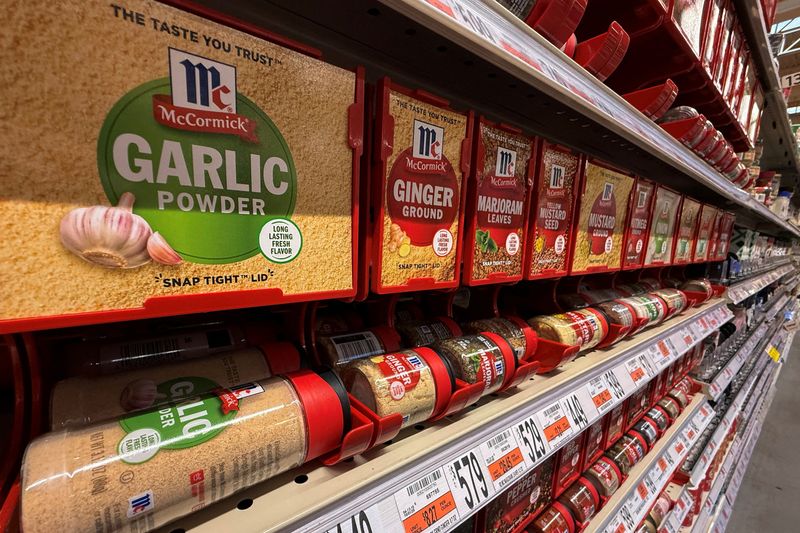
The second largest food transaction to date that was announced in March will combine the Unilever division with McCormick’s into one company that includes brands such as Hellmann’s mayonnaise and Cholula hot sauce.
McCormick will take on oversight of a business nearly twice its current size and with a more complex global supply chain that will bring challenges linked to agriculture, commodities and small-scale farming.
Given Unilever’s historically leading position on sustainability, some investors are keen for reassurance its standards will be maintained.
“We will be seeking assurances about the intention of the combined company to uphold and build upon best practice with regard to deforestation-free sourcing of commodities,” said Vemund Olsen, senior analyst at Norwegian asset manager Storebrand, a top-100 investor in Unilever and a McCormick shareholder according to LSEG data.
CAREFUL SOURCING AND COMPLAINT SYSTEM
Those practices include not sourcing from deforested or converted land along the supply chain, having a public system for complaints, and ensuring full traceability of commodities to plantations, he added.
A spokesperson for Frankfurt-based Union Investment, a top-40 investor in both companies, according to LSEG data, said it would seek transparency “about how it integrates sustainable practices moving forward”.
Under U.S. rules, Hunt Valley, Maryland-based McCormick is not required to disclose the same detailed sustainability information that UK-based Unilever faces in Europe.
Companies with significant European operations are expected to comply with EU‑level sustainability reporting rules. But that compliance may take years, leaving a transition period where disclosure standards depend largely on company commitments.
“If Unilever-McCormick decide to turn their backs (on sustainability), this could create significant risk for shareholders and the new entity,” said Cailin Dendas, environmental health program senior coordinator at shareholder group As You Sow.
“We saw this happen when Kellanova separated from Kellogg in 2023 and dropped its pesticide commitments, among other sustainability goals.”
Mars, which acquired Kellanova last year, said environmental impact is assessed alongside business performance when making acquisitions.
“As integration progresses, Kellanova will be incorporated into Mars broader sustainability commitments, including our Net Zero Roadmap and sustainability governance frameworks,” a Mars spokesperson said.
Unilever will be the biggest investor in the new company with a near 10% stake and four board directors. But smaller shareholders will have limited ability to directly influence the board.
Asked whether Unilever would leverage its shareholding in McCormick to push the spice maker into living up to Unilever’s standards, a company spokesperson told Reuters: “We are working closely with McCormick ahead of the completion of the transaction to support the transition of our Foods‑related sustainability programmes and commitments.”
MCCORMICK CLASSIFIED AS ‘MEDIUM RISK’
Hannah Schalk, an analyst at ESG ratings firm Sustainalytics, classifies McCormick as “medium-risk” in terms of sustainability. The company’s sustainability report does not include an explicit company-wide no-deforestation commitment, and provides less detail on traceability, auditing and certification, she said.
She also noted that McCormick faces the challenge of scaling its sustainability capabilities as its supply chain expands.
McCormick has acknowledged in reporting that meeting its indirect emissions and sourcing targets depends in part on improving data and engagement across its supplier base.
“While we cannot comment on future targets at this time, we are already well underway on a comprehensive strategic update process for our sustainability programme, and we’ll share more details on our approach as the process unfolds,” McCormick said in written comments.
(Reporting by Simon Jessop, Alexander Marrow and Richa Naidu; editing by David Gaffen and Barbara Lewis)