

By Leila Miller
BUENOS AIRES, July 27 (Reuters) – International Monetary Fund Managing Director Kristalina Georgieva expressed confidence on Monday in President Javier Milei’s economic reforms and the country’s ability to navigate a looming debt repayment crunch next year that could coincide with his reelection bid.

At a press conference in Buenos Aires, Georgieva praised Argentina’s accumulation of foreign reserves, decline in inflation, fiscal discipline and improved sovereign risk profile.
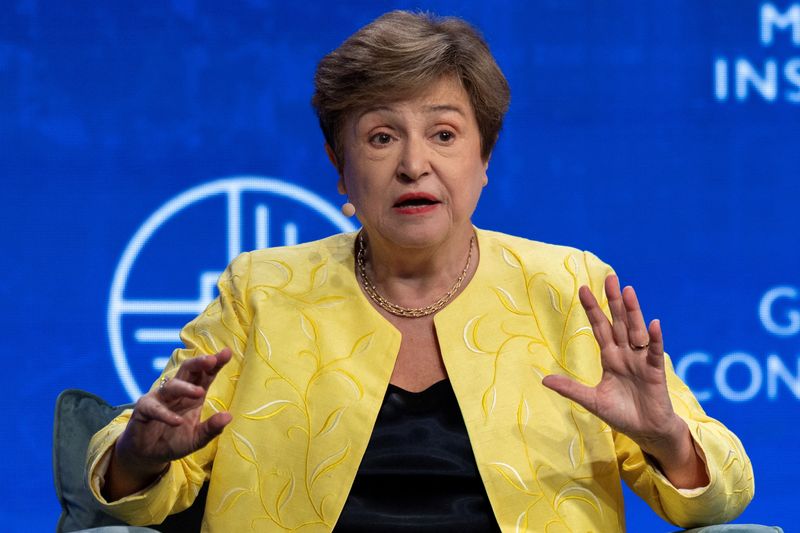
“I’m not worried about Argentina,” she said, seated alongside Argentina’s Economy Minister Luis Caputo.
Last week, Moody’s upgraded the South American country’s sovereign rating, following earlier upgrades by S&P Global and Fitch, adding to investor optimism around Milei’s efforts to stabilize an economy long associated with boom-and-bust cycles.
Investors have been keeping a close eye on what lies ahead. An IMF report had put Argentina’s 2027 foreign-currency debt bill at $32.3 billion, including interest, before the central bank pushed $6 billion in repo financing into 2028 earlier this month.
Milei’s government has said it plans to meet those obligations through a combination of multilateral financing, privatizations and local debt issuance, while avoiding a return to international capital markets.
The timing is sensitive because the repayments will come due as Milei is widely expected to seek a second term. Any perception that the Argentine president could struggle to win reelection, or that a successor might change course on economic policy, could weigh on confidence and complicate financing.
Georgieva’s trip, her first to Argentina as IMF chief, is set to include a meeting with Milei as well as a visit to Patagonia’s Vaca Muerta shale formation, a cornerstone of the government’s strategy to boost energy exports and generate the dollars needed to strengthen the country’s finances.
She told reporters that while Argentina has made strong gains in capital-intensive sectors such as energy, the government should focus on other industries that continue to lag, such as construction, and on improving access to credit for small businesses and households.
Her two-day visit took place ahead of a third review of Argentina’s $20 billion IMF loan program. Since Milei took office in late 2023, the global lender has consistently backed the government’s fiscal discipline, legal reforms and efforts to lower monthly inflation, which dropped from 25.5% in December 2023 to 1.9% in June.
The IMF’s latest staff report nevertheless warned of “exceptional risks,” saying that while Argentina’s debt is sustainable, there was not a high probability it would remain so.
ELECTION TEST
Next year looms as a crucial test not only for Milei’s legislative agenda, but also for the IMF, which has heavily backed Argentina’s economic turnaround.
Argentina remains the IMF’s largest debtor and the two sides have a complex history after a succession of programs failed to prevent repeated economic crises.
Investors’ focus is shifting from Milei’s success in stabilizing the economy to whether the recovery can endure, analysts say. The current challenge is to generate enough dollars, investment and voter support to sustain his belt-tightening reforms beyond the initial turnaround.
Stronger exports and improving financial indicators alone will not guarantee electoral success if many Argentines are burdened by high household debt and precarious employment, analysts said.
“Milei’s problem is no longer whether the macro story is believable abroad. It is whether voters can feel it at home,” said Mariano Machado of risk consultancy Verisk Maplecroft.
The government’s easing of import restrictions has led to steep job losses in inefficient manufacturing sectors, said Aldo Abram, executive director of the Fundacion Libertad y Progreso.
Moody’s, while upgrading the country’s sovereign rating this month, warned that political risks remain a key constraint and that any reversal of reforms could undermine recent gains.
That situation makes the 2027 election almost as important as the debt repayments themselves.
“The great challenge is that this reorganization process, which in the eyes of investors and the macroeconomy is very satisfactory, has to be validated electorally,” said Gustavo Ber, an economist.
(Reporting by Leila Miller. Editing by Lucinda Elliott, Rosalba O’Brien and Paul Simao)
By Leila Miller | Reuters | © Copyright Thomson Reuters 2026.
