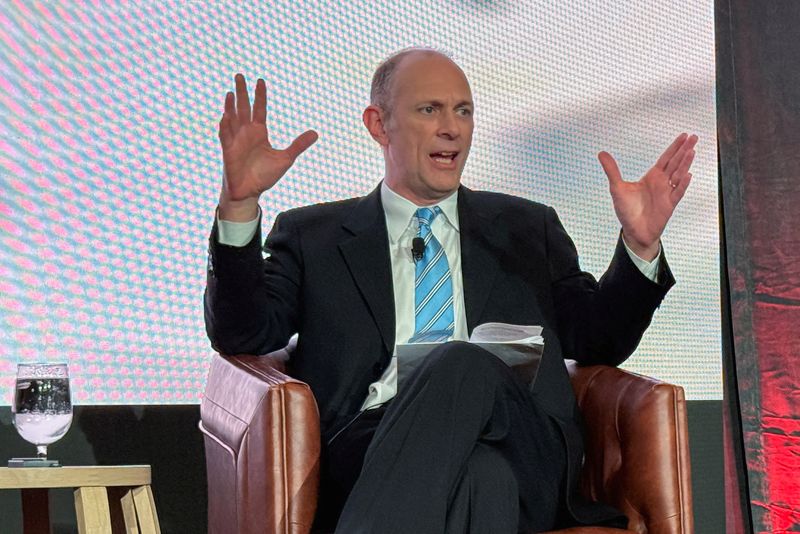
(Reuters) -Chicago Federal Reserve President Austan Goolsbee on Tuesday said higher inflation from U.S. import tariffs could become evident quickly, but he said it would take longer to see a tariff-induced economic slowdown.
With business CEOs signaling they plan to pass on to consumers some if not all of the increased costs from tariffs, higher prices could show up in inflation data in a month, or “certainly within a couple of months if it’s going to affect prices in a significant way,” Goolsbee said at an event held by the Corridor Business Journal in Cedar Rapids, Iowa.

If the higher costs then lead to an economic slowdown, “that one won’t show up in the data for a while.”
Timing aside, President Donald Trump’s trade policies are likely to push the economy in what Goolsbee called a “stagflationary direction,” referring to a combination of stagnating economic growth and rising inflation.
“Employment goes down, prices go up from tariffs, and there’s not an automatic playbook of what does the central bank do if both sides get worse at the same time,” Goolsbee said.
Once the dust clears on tariff policy, if the economy looks like it did before the Trump administration announced a slew of bigger-than-expected tariffs on April 2, the short-term interest rates that the Fed controls can go “a fair bit below where they are today,” Goolsbee said.
“But with the uncertainty, I can’t express that with too much confidence because who knows, if we wake up tomorrow and the tariffs are going back to 50% on the world, there is a lot of domestic production that is going to suffer and we have to figure out how to deal with that,” he said.
(Reporting by Ann Saphir; Editing by Leslie Adler and Paul Simao)