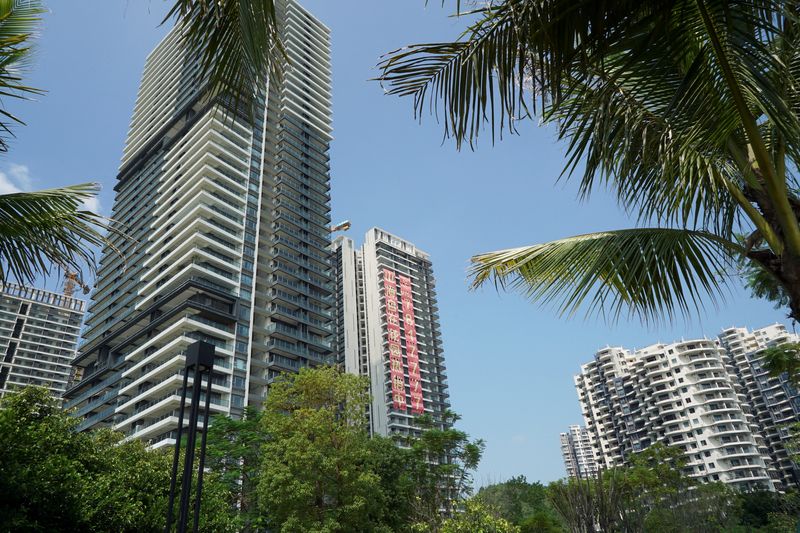
By Clare Jim and Liangping Gao
June 3 (Reuters) – Providers of property services in China are struggling to collect management fees from disgruntled homeowners, threatening their revenue and house prices in general, while making them the latest victim of the country’s prolonged real estate slump.

In a weak economy, some owners cannot afford the fees or withhold payments to pressure the companies to cut their prices. And as service providers withdraw from contracts, some developments are struggling with creaking infrastructure, uncollected waste and unmanned security posts. Other people bought multiple apartments before the bubble burst in 2021 – an investment they no longer hope to recover – and see little reason to keep paying administrative costs.
After decades of overbuilding, many compounds are partly vacant. There, distressed property developers owe the service fees for unsold flats. China’s unsold housing stock has a total floor area that is roughly twice the size of Greater London, ANZ estimates.
IS CHINA’S HOUSING STOCK TOO BIG TO MANAGE?
The average collection rate at China’s top 500 property firms fell to 71% last year from 89% in 2021, according to CRIC, a research firm. The firm did not break down annual figures, but industry executives say 2025 recorded the sharpest drop and the trend has gotten worse since then.
“Risks from the broader real estate slowdown are spilling over into the property management industry,” said He Shuhua, chief operating officer of Onewo, at a recent conference. Onewo, which uses the brand Vanke Service, is a property management unit of state-backed developer China Vanke.
“Falling home prices have changed homeowners’ expectations,” He said. “Difficulties in collecting fees is a common problem across the industry.”
This sets in motion a vicious cycle, property analysts say.
Falling collection rates are forcing management firms to abandon a growing number of projects, leaving homeowners and developers worried that this will further erode the value of their properties. Lower prices then reduce the incentive of homeowners to pay for their assets to be serviced.
It also raises pressure on local governments to intervene by bringing in state-backed companies to maintain basic services and soothe discontent over uncollected waste, unstaffed security posts and faulty lighting or elevators.
“This is a unique and major issue” that has not been seen in other property crises, said Sam Radwan, chief executive of Enhance International, a Chicago-based real estate consultancy with Greater China operations, adding that apartments in compounds with management deficiencies could lose up to 25% in value.
“It’s one of the many dimensions of the property market that is concerning,” he said, citing oversupply, high vacancies, rising foreclosures and falling demand. “It may be decades before you see a resolution to this particular housing crisis.”
The Housing Ministry did not respond to a request for comment.
HOMEOWNERS FEAR FURTHER PRICE FALLS
Linda Cao, 35, who lives in a partly vacant compound in the northern port city of Qinhuangdao, showed Reuters a Vanke Service notice saying it would withdraw from the job in June after six years, citing an unsustainable decline in fee collection.
Cao said she was satisfied with the firm, but other owners had withheld fees for two years, hoping to pressure Vanke Service into lowering monthly fees to 2.4 yuan ($0.35) per square meter from 3.8 yuan. She now wonders which new company would come into such a hostile environment.
“Only weaker companies would be willing to take over,” Cao said. She fears property prices could drop another 20% as a result.
Vanke Service did not comment on specific projects but said an exit is “a normal business decision” and that the company is separately expanding into “new service projects.”
Across China, monthly fees per square metre range from less than 1 yuan to more than 20 yuan, depending on location and building quality.
In Beijing, 33-year-old Jenny Zhao said management firm Shoukai Property is about to withdraw from her compound after replacing another company that left in 2023 citing fee collection rates of 45%.
Zhao said the estate already suffers from poor waste collection, lax security and crumbling alleyways, which she blames for house prices at the compound now being quoted at 5,000 yuan per square metre below neighbouring developments.
“What worries us most is that if the next management company is even worse, no one will want to buy homes here,” Zhao said.
State-owned Beijing Capital Development Holding, the holding company of Shoukai, did not respond to a request for comment.
In the bubble years, property management companies expanded as fast as the developers.
China’s top 100 companies managed around 71 million square meters each on average in 2025, up from 9.8 million in 2012, according to the China Property Management Institute, an official self-regulating organisation.
They are now withdrawing.
State-owned China Overseas Property pulled out of projects totalling 55.6 million square meters last year, an increase of 25% from a year earlier. The management unit of Country Garden, once China’s top developer, withdrew from projects totalling roughly 80 million square meters in 2025.
Small, unlisted management firms generally collect less than 65% of fees, according to CRIC.
John Lam, head of China and Hong Kong property research at UBS, said firms typically incur negative cashflow when collection rates drop below 85%. By comparison, Enhance’s Radwan said U.S. real estate trusts are generally considered “uninvestable” below a threshold of 85%.
“Vacant properties are a key drag on property management firms’ revenue,” alongside “non-occupying, speculative owners,” Lam said.
Nearly a quarter of Chinese households owned at least two homes at the end of 2025, according to a study by Ant Group Research Institute and Xiamen University’s School of Economics.
LOCAL GOVERNMENTS UNDER PRESSURE
Two executives from the property services industry who did not want to be identified publicly because they are not authorised to speak to the media said their companies preferred to walk away rather than get entangled in lengthy lawsuits with non-paying homeowners.
While this lets firms cut their losses, it leaves communities bickering over costs and struggling to find replacements.
Authorities are facing mounting pressure to intervene in such disputes as problems pile up – from untended gardens and poor hygiene to various malfunctions.
At least five county-level governments have issued directives to public officials and Communist Party members to “take the lead” in paying fees on time, according to state media.
One executive at a state-owned property manager who is not authorised to speak to the media said local authorities had in some cases blocked its withdrawals after homeowners failed to find replacements during three-month notice periods.
“It could affect social stability,” the executive said.
(Reporting by Clare Jim and Liangping Gao; Editing by Marius Zaharia and Thomas Derpinghaus)