By Fred Fuller

Thanks to the actions and letter writing of many Michigan citizens, the Sibley Prairie, the largest remaining natural prairie in Michigan, will be preserved if enough money can be raised to purchase it by the end of 2026. It had been put up for auction with a deadline of August 27, 2025. But prior to the deadline, the Michigan Land Conservancy, led by Jack Smiley of Washtenaw County, persuaded Fritz Enterprises, Inc., which owns the property, to accept an agreement for an option to buy the property. The auction was halted. The Conservancy and other environmental groups have expressed their appreciation to the Fritz family for being willing to work with them on the preservation of the prairie.
The option agreement gives the Michigan Land Conservancy until the end of 2026 to raise the purchase price of $6 million. The Conservancy must also raise $1 million by the end of 2025 in order to maintain the option to buy.

Fortunately, a coalition of environmental groups, including the Michigan Land Conservancy, Thumb Land Conservancy, Friends of the Rouge, Legacy Land Conservancy, Wayne County Conservation District, Sierra Club Southeast Michigan Group, Michigan Botanical Society, Detroit Bird Alliance, and Ducks Unlimited, has come together to work on raising the $6 million.
Six million dollars is a lot of money, but the halting of the auction also gives the coalition more time to try to arrange other possibilities, such as for the Michigan Department of Natural Resources to obtain approval to purchase the prairie, to apply for grants, and/or to get help from the Nature Conservancy or the Trust for Public Lands.
The Sibley Prairie is 440 acres (two-thirds of a square mile) located in Brownstown Township, Wayne County, and it is zoned for residential or industrial development. It’s located just west of Telegraph Road and south of Sibley Road, in the middle of suburban Detroit. It is all that remains of a much larger prairie that was in that area, nearly 25 square miles in size, before pioneer settlement. It was large enough to historically have had a herd of native Eastern Woodland Bison. The last native Michigan bison was killed there in 1882. Its skin is still kept at a museum in Flat Rock, Michigan.
Many people are not aware that Michigan once had prairies. Most prairies were in southwest Michigan near the Indiana border, but a few were scattered throughout the Lower Peninsula. Most of them were farmed in the past or otherwise developed.
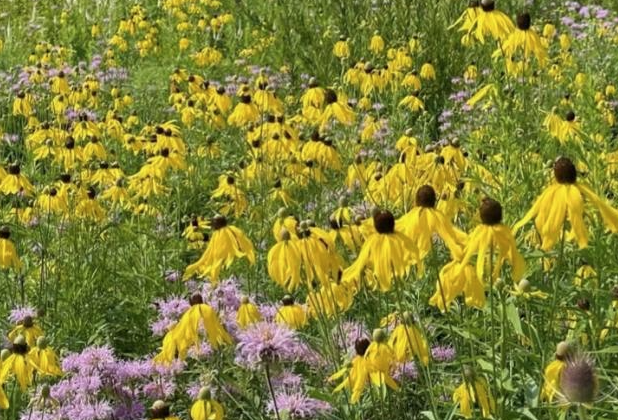
Botanist Dennis Albert, former lead ecologist for the Michigan Natural Features Inventory, described the Sibley Prairie as “a magical garden of asters, goldenrods,
lupine, ironweed, milkweeds, mountain mint, coreopsis, Indian plantain, prairie dock, lobelia, and many more, within a matrix of tall Indian grass, cord grass, and big bluestem.” He stated it is also important for the biological diversity of fauna. It provides habitat for rare prairie insects, threatened turtles, and migrating prairie songbirds.
Albert also believes the prairie holds historical significance because it is linked to thousands of years of Indigenous management by the local Wyandotte and possibly Pottawatomi tribes, who may have managed it with fire, harvested plants there for food, medicine, and fiber, and hunted the abundant waterfowl and mammals. He says there are likely descendants of the Wyandotte peoples in southeast Michigan who know some of the Indigenous history or who could begin relearning that history at Sibley Prairie.
Sibley Prairie is specifically classified as a Lakeplain Prairie, which is ranked as an ecosystem globally as “G2 – Imperiled” and in Michigan as “S1 – Critically Imperiled.” Michigan has less than 1% of its original lakeplain prairies left, and Sibley Prairie is the largest and highest-quality of those. That it is so close to urban Detroit is remarkable. It could provide a tremendous recreational and educational opportunity for the state’s most densely populated area.
If you would like to help save the Sibley Prairie, or would like more information, you can visit this website: SaveSibleyPrairie.org.