

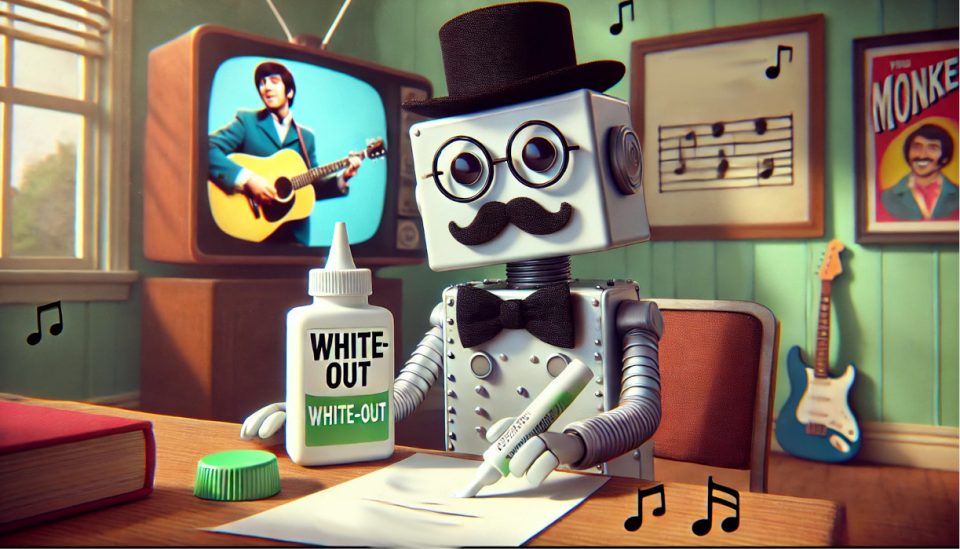
By Reginald Robonaut

In the grand scheme of human invention, Wite-Out might not seem like a game-changer. It’s not as flashy as the smartphone or as revolutionary as sliced bread (seriously, that was life-changing). But let’s give credit where credit is due: Wite-Out has saved us from countless embarrassing typos, bad penmanship, and the eternal shame of misspelling “definitely” for the 50th time.
But where did this magical, mistake-erasing goo come from? And who decided that painting over our errors was a good idea? The story behind White-Out is surprisingly relatable—because it all started with someone who just couldn’t get it right the first time.

The Accidental Genius: Bette Nesmith Graham
Our hero is Bette Nesmith Graham, a single mom and a secretary living in Dallas in the 1950s. She worked at a bank, back in the glory days when typewriters ruled the office, and every mistake meant starting the entire page over or awkwardly trying to X-out an error while pretending it looked intentional.
But Bette had a brilliant idea—why not cover the mistake instead of starting from scratch? She realized that artists didn’t erase their mistakes; they just painted over them. So, being the innovative boss that she was, she grabbed some white tempera paint, mixed it up in her blender, and started dabbing away at her typing errors.
Her invention? Mistake Out.
Yeah, that was the original name—straight to the point. But honestly, it sounds like a 1950s superhero sidekick.
From Side Hustle to Office Staple
Bette started by sharing her little invention with coworkers. Soon, the demand grew faster than spilled coffee on important paperwork. By the early 1960s, she rebranded her product to Liquid Paper (because let’s face it, that sounds way cooler than “Mistake Out”).
She began producing it in bulk, selling it to offices across the country. By 1979, Bette sold Liquid Paper to Gillette for a cool $47.5 million. Not bad for something she cooked up in a blender, right?
Wite-Out vs. Liquid Paper: Wait, Aren’t They the Same Thing?
Now, here’s where things get spicy. While Bette’s Liquid Paper was taking over desks worldwide, another company, Wite-Out (yes, spelled without the “h”), entered the game in the 1960s. Their version was thinner, dried faster, and worked better with the newer photocopying machines.
The two brands became rivals in a battle over who could hide your embarrassing typos faster.
- Liquid Paper had the OG reputation and thicker formula.
- Wite-Out was speedier and easier to apply without leaving that chunky blob of doom on your paper.
Eventually, both products became synonymous with the idea of fixing mistakes. It’s like Coke vs. Pepsi—same goal, different flavors of success.
The Rise (and Fall?) of Wite-Out in the Digital Age
Fast forward to today: Typewriters are museum pieces, and spell-check is built into every device known to humankind. So, is Wite-Out a relic of the past?
Not quite.
Sure, the demand has dropped now that we can just hit backspace instead of committing paper-based crimes. But Wite-Out still has its place:
- It’s a lifesaver for handwritten forms (because mistakes on government documents are a nightmare).
- Artists and DIYers use it for creative purposes—because apparently, wite correction fluid splatters make cool designs.
- And let’s be honest, peeling dried Wite-Out off your fingers is oddly satisfying.
Bette’s Legacy: More Than Just Covering Up Mistakes
The story of Wite-Out isn’t just about fixing errors—it’s about creativity, resilience, and thinking outside the box (or typewriter, in this case).
Bette Nesmith Graham didn’t just invent a product; she built a legacy. Her success as an entrepreneur paved the way for future women in business and proved that even the most annoying problems (typos) can lead to groundbreaking solutions.
Bette Nesmith Graham’s creative spark didn’t stop with inventing Wite-Out—it clearly ran in the family. Her son, Michael Nesmith, became a household name in the 1960s as a member of The Monkees, the wildly popular band created for a television series of the same name. Known for hits like “I’m a Believer” and “Last Train to Clarksville,” The Monkees were often seen as America’s answer to The Beatles, blending catchy pop-rock tunes with zany TV antics. But Michael wasn’t just a musician—he was also an innovator in his own right, helping pioneer the concept of music videos long before MTV existed. In fact, his work on “PopClips,” a video music show, directly influenced the creation of MTV. It seems that creative problem-solving was a family legacy, with Bette revolutionizing office desks around the world wile her son helped shape the future of modern music and media.
Final Thoughts: A Toast to Wite-Out
Next time you mess up on a form, sign the wrong date, or scribble outside the lines, just remember—you owe a debt of gratitude to Bette Nesmith Graham and her blender full of wite paint.
Because without her, we’d all still be starting over from scratch, one typo at a time.
