

By Kathleen Knowles

Introduction: The fourth in the series of Dogs as Pets
Choosing a dog to become a family member is a big decision. You must determine whether you want a mix-breed dog or a pedigreed one. A mix-breed dog is exactly what it implies, more than one breed of a dog mixed together. A pedigreed dog is one breed only with nothing but that breed in the pedigree going back for generations. What size is right for you? Should you buy a long-haired dog or a short-coated one? A big dog or a small dog? In this series, we will examine pure-bred breeds only. So far, we have looked at the Chihuahua, Saint Bernard, and the French Bulldog. In this article, we will examine the German Shepherd Dog as a pet.

The German Sheperd Dog

The German Shepherd Dog is the descendant of several herding breeds. In 1889, Captain Max von Stephanitz wanted to standardized the ultimate working dog. He founded the first German Shepherd Dog club which was devoted to refining the breed. His belief was dogs should be bred for working. While attending a dog show, he purchased Hektor Linksrhein and changed his name to Horand von Grafrath. This dog was the first German Shepherd dog registered with the Verein für Deutsche Schäferhunde (translates to Society for the German Shepherd Dog). He became the backbone of the breed and was bred to other GSDs, which were considered to have traits that were desirable toward standardizing the breed.


The GSD was introduced into the United States in the early 1900s. By 1913, the German Shepherd Dog Club of America was formed. Although originally a member of the Working group, the American Kennel Club split the group in half. Today, the German Shepherd Dog is a member of the Herding group. (Group 7)
As of December 2018, the German Shepherd ranked as the second most popular breed in America with only Labrador Retrievers having more registrations.
Bred initially for herding, the German Shepherd’s talents have expanded far beyond its original purpose. They are probably best known for their work as police dogs. The largest percentage of police dogs around the world are German Shepherds. However, they are also very popular as service dogs. Used extensively by Leader Dogs for the Blind, they help the visually impaired with their daily lives. They have also been used as bomb-sniffing dogs, search and rescue dogs, guard dogs, war dogs, and of course, as herding dogs.

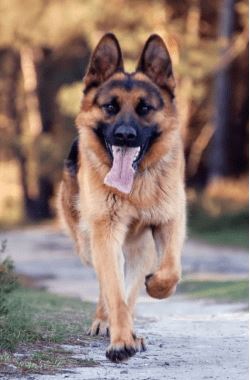
It is probably not necessary to describe the GSD as they are probably one of the most recognizable breeds today. For those who are not familiar with the German Shepherd, they are a large dog, 24 to 26 inches in height. (Females 22 to 24 inches) The male can weigh anywhere from 65 to 90 lbs., with the female 50 to 70 pounds. A strong, muscled dog, the GSD is longer then it is tall. His head is chiseled and strong, but without coarseness. His muzzle is long and his ears are erect with the opening towards the front. The nose is black. His top line is higher at the withers and slopes into a level back. His tail is bushy and his chest is deep. The German Shepherd is a double-coated dog of medium length. The outer coat is dense, straight and lying close to the body. The most common colors are black and tan and pure black. (Written with help from the American Kennel Club standard). Read the entire standard at https://www.akc.org/dog-breeds/german-shepherd-dog/)

As with any deep-chested breed, their life expectancy is shorter than some of the smaller breeds. You can generally expect them to live 9 to 13 years.
There are many reasons why the German Shepherd is such a favorite as a pet in America. A highly intelligent dog, he is fearless and confident. Loyal, protective, and loving, his ability to learn far exceeds that of most breeds.

The German Shepherd is great with children. Devoted to his family, he maintains an aloof demeanor with strangers. He can be domineering and occasionally aggressive toward other dogs but generally will get along with those living in the household. With proper care and training, he will love and protect his family with his life. GSDs are territorial and make excellent guard dogs.
Due to their extreme intelligence, they are very trainable and learn quickly. German Shepherds are very active dogs who need exercise. A large yard is desirable, but long walks can keep your dog healthy and in condition.

The German Shepherd sheds profusely twice a year. He should be brushed a couple of times a week to remove dead coat in order to keep it at a minimum. Otherwise, you will find hair on your clothes and furniture. An occasional bath and trimming of the nails will also be necessary.
As with all breeds, there are medical conditions to look out for. Hip and elbow dysplasia, as well as degenerative myelopathy, are diseases German Shepherds are susceptible to. As a deep-chested breed, they are also susceptible to bloat (twisting of the stomach). This is a dangerous condition that can be fatal if not treated immediately.
If you are looking for an intelligent, loyal, loving, and protective companion, look no further than the German Shepherd Dog. You will enjoy many years with this intelligent, loving canine.
Kathleen Knowles
Blue Water Healthy Living Contributing Writer.
