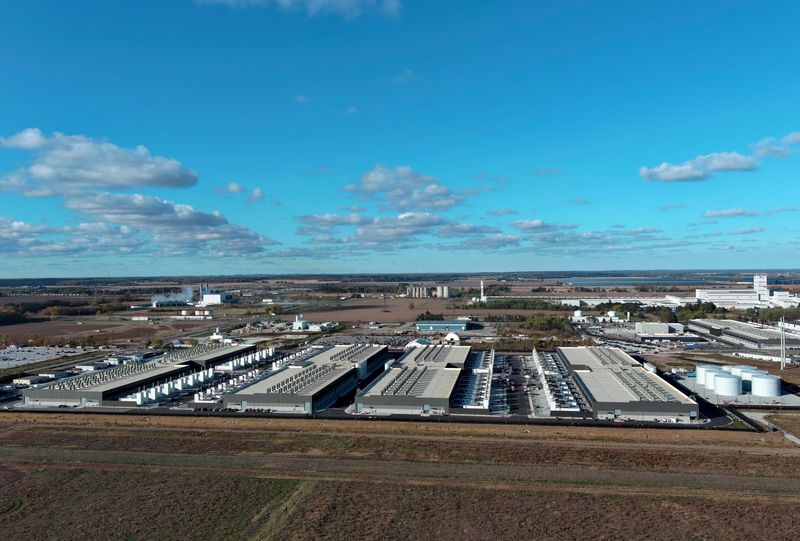
Google is building a data center campus near Monrovia on more than 550 acres of what used to be farmland. AES Indiana wants a new high-voltage transmission line roughly 10 miles long, from its power plant on Blue Bluff Road to a new substation right beside Google’s property to feed this data center.
The utility hosted two open houses earlier this month and served free cookies to the very people whose land it wants to take for that transmission line. Farmers, business owners, homeowners and neighbors were all invited to hear about the vast benefits of putting power lines through their backyards, whether they liked it or not.

AES calls this a regional grid upgrade. It looks more like a power cord. Eminent domain should be off the table for projects that serve one private customer.
Google data center comes at a cost
Google’s data center in Morgan County plans to draw up to 1,200 megawatts of electricity. Running near capacity, it would use nearly twice the electricity of every AES residential customer in Central Indiana combined, and about 4 million gallons of water every single day.
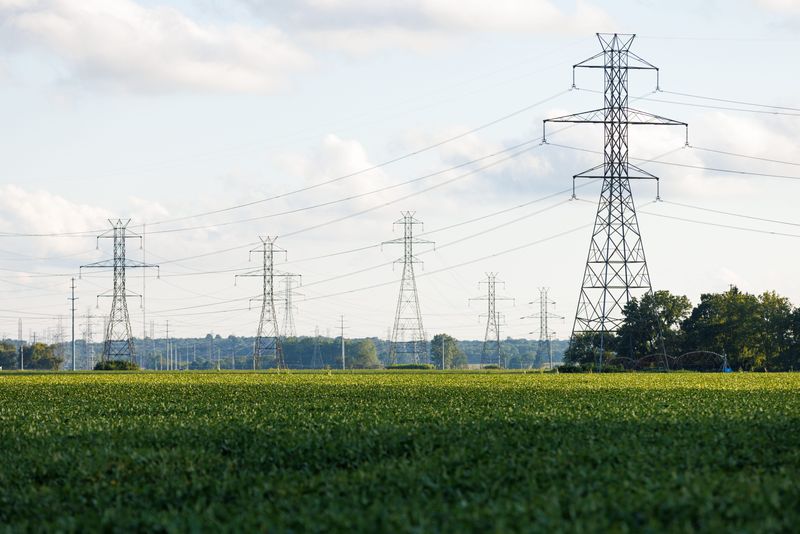
The planned transmission line to serve the data center will include steel poles up to 195 feet tall — the height of roughly a 16-story building. Beneath them, a permanent easement about 200 feet wide will slice across private homes and farms.
Indiana law hands electric utilities the power of eminent domain. If AES Indiana routes the line across your land and you refuse its offer, it can take you to court and a judge can grant it your land anyway. AES Indiana can even deposit the appraisal money with the court and take possession of your property while you are still fighting over the price.
That is what AES Indiana “service territory” means. It means the law is on their side and they know it.
The human toll of data center development
Let me introduce you to a few of the families being asked to make that sacrifice.Paul Slagle is a pastor and the owner of The Parlor, a local restaurant. His family lives on just over 26 acres shared between a brother, a sister, children and in-laws. Hundreds of people come out to that land every year for respite, community gatherings and the annual Independence Day fireworks show over Shadow Lake. The proposed towers would run right past their homes and across the edge of their lake.
“We’ve worked so hard to create a little patch of heaven for our family and friends to enjoy,” Slagle told me. “It’s been a dream come true. Now it’s all in jeopardy. Not only our dreams, our lives. Our retirement was wrapped up in this property.”Shannon Glaze Skyles and her family sit directly on a proposed route.
“The proposed line bisects our 20 acre property,” she wrote. “The property would be completely depleted of all its value.”
Her family uses that land for hay production, bees, fruit trees, recreation and gatherings. She asks: “Who wants to do any of that under a buzzing power line?”Michael Skyles has spent years and thousands of dollars preparing that land for the home his family plans to build. Electric service is installed. Water is paid for. Septic testing is complete. The route would cut down the woods that surround their 20 acres, and with them the walking paths and riding trails.
“They will be gone forever,” he wrote. He estimates the potential losses could exceed $250,000.
“This property represents far more to us than land alone. It is where our family gathers to camp, cook out, ride four wheelers, spend time together, and create lasting memories.”Otis Pugh, a disabled combat veteran, owns 77 acres along White Lick Creek that has been in his family for four generations. On the land he runs Heroes Wildlife Adventures, a nonprofit that provides hunting and fishing opportunities for disabled veterans, first responders, and their families, complete with accessible facilities. If the power line cuts through the property, it would split the land in half, destroy a duck blind and shooting house, take out some of the oldest trees where eagles and wild turkeys roost, and cross their best fishing hole.As I spent hours today on my own 22 acres tending my gardens, vineyard, and orchard, my heart broke for the families facing the loss of their land. As a farmer and grandmother, I care for property where four generations of my own family work, learn, play and gather.
When I planted lavender and picked June bugs off the vines, I felt the same fear my friends and neighbors in Morgan County are feeling — the fear of losing the American Dream they’ve worked so hard to build.
When I ran for Congress this spring, concerns about data centers were one of the top issues I heard. Now I understand why.
Indiana must fix eminent domain
Indiana law must be reshaped to protect these people. The legislature gave utilities the power of eminent domain, and the legislature can take it back.
If a transmission project exists mainly to serve one private customer, condemnation should be off the table entirely. Willing sellers only. If a power line truly serves the public, existing corridors and rights of way should be exhausted before one new foot of family land is touched. Landowners should be treated as partners, not obstacles.Indiana already requires companies to pay more than fair market value when carbon pipelines use eminent domain to take land. If the state can create stronger protections for pipelines, it can create them for power lines.
Sen. Rodric Bray, R-Martinsville, represents Morgan County. He is also the Indiana Senate president pro tempore, the most powerful legislator in the state. He does not have to hope somebody fixes this. He can fix it. He can stand up tomorrow and say that condemning his own constituents’ land for a private corporation’s power cord will not happen on his watch.
The people losing sleep over route maps tonight are no strangers to him. They are his neighbors. They are the voters who sent him to Indianapolis. If the most powerful legislator in Indiana will not use that power to protect his own county, then the people of Morgan County are entitled to ask what, exactly, his power is for.If nothing is done, the message to every utility and every corporation will be simple. Indiana land is cheap, Indiana leaders look away and Indiana people will not fight. Our children will inherit ground with someone else’s towers on it, easements they can never remove and the lesson that ownership is conditional.This was never just about data centers. It is about whether the rights written into our Constitution and Declaration of Independence still mean something on a gravel road out here in Morgan County.
Sarah Brown lives in Greenwood. She is a mother of 15, author of more than 360 educational books and founder of the Fun-Schooling Movement and Dyslexia Games Therapy.
This article originally appeared on Indianapolis Star: Don’t let Google’s data center seize Morgan County families’ land | Opinion
Reporting by Sarah Janisse Brown, Opinion Contributor / Indianapolis Star
USA TODAY Network via Reuters Connect
By Sarah Janisse Brown, Opinion Contributor | USA TODAY Network