Hot dogs are the all-American food. They were “invented” in the U.S. after German sausages were first tucked into buns, and they’ve since become synonymous with baseball games — the all‑American pastime. What would a Brewers game be without a steamy dog slathered with Stadium sauce, mustard and a pile of onions?
More important still, what would it be without a brat?

Hot dogs may be all-American, but in Wisconsin, bratwurst is king. When it comes to tubular meats served in buns, most Milwaukeeans will go for the snappy bite of a beer brat any day.
But why do we love brats so much? Jesse Brookstein, author of the forthcoming book, the Best of the Wurst: Weird and Wonderful Stories of Wisconsin Sausage, put it succinctly.
“That’s just how it’s always been,” he said. “Brats just exist everywhere you go in Wisconsin: restaurants, ballparks, spelling-bee tailgates … no joke. We have festivals in their honor, and it’s almost always the most common sausage at any local meat shop around the state.”
In fact, Brookstein said, locally made hot dogs are pretty rare to find in many of Wisconsin’s sausage shops.
“The brat has become a point of local pride, right alongside a bag of curds, a bottle of Miller High Life and a weathered Packers jersey,” he said.
What is a bratwurst and where did it come from?
While the exact origins of the bratwurst are difficult to pin down, Brookstein believes the oldest bratwurst kitchen is said to have opened in Nuremberg, Germany, in the early 14th century, serving rostbratwurst (“rost” meaning grill or grate, and “bratwurst” meaning any sausage that’s pan-fried or grilled). Today, rostbratwurst is a protected-origin sausage, meaning only those produced in Nuremberg can be called rostbratwurst.
When German immigrants settled in Wisconsin in the mid-19th century, they brought bratwurst with them.
Aside from some creative liberties with what brats are stuffed with, little has changed since. Brats get their distinct flavor and texture from the spices used and the coarse grind of the meat. Typically, a brat is spiced with pepper, an aromatic spice like nutmeg or coriander, and a citrus component, like lemon zest.
It’s made with pork, traditionally, but veal or beef can be added. The meat is cut coarsely and sealed without using curing salt.
How to prepare the perfect brat
How to cook a brat to preserve its flavor, texture and signature snap is a topic of heated debate here in Wisconsin — Brookstein has dedicated an entire chapter of his book to it.
“Some swear by parboiling, while others feel it ruins the brat,” he said.
Parboiling can be useful if preparing brats for a large crowd, but Brookstein cautions home cooks to never fully boil the brat.
“Boiling will not only cause you to lose the brat’s precious juices, but it can also create a chewier, less-snappy casing,” he said. “I believe the name ‘parboil’ leads people to actually boil. Perhaps we need to change the vocabulary to ‘parsimmering.’”
For the perfect brat, Brookstein cooks his low and slow on the grill, rotating them regularly until they’re cooked through (160 degrees if using fresh sausage), but not snapping. That process takes about 20 minutes. Then, he lets them rest two to five minutes to fully absorb the juices inside.
Or, follow the no-fail timing trick Frank Usinger of Milwaukee-based Usinger’s Famous Sausage swears by.
“I call it the two-beer method. By the time you slowly drink two beers is about the time it takes,” Usinger told the Journal Sentinel in 2023.
If you’ve been to any big family gathering or community brat fry, you’ve likely seen a massive aluminum container filled with brats simmering in a mixture of beer, butter and onions. Serving brats in a beer bath helps keep brats warm and prevents them from drying out — it also imparts a little more flavor before serving. And it doesn’t get more Wisconsin than yanking a juicy brat from a burbling bath of beer. It’s part of the charm.
As for toppings, traditionally, brats get a scattering of sautéed onions, some sauerkraut and a squiggle of mustard — spicy brown is classic, but Brookstein doesn’t believe in hard-and-fast rules.
“I generally have 15 to 20 mustards in my fridge at any given time,” he said, adding that he goes for lighter honey or deli mustard when he wants to let the brat’s flavor shine through. But he’s not above adding mustard spiked with ginger, truffle or horseradish if he’s “feeling zany.”
But don’t you dare add ketchup. Heresy!
Why are brats so popular in Wisconsin?
There’s no clear answer as to why brats reign over hot dogs in the state, but over time they’ve become a fabric of our culinary culture, part of Wisconsin’s big three: beer, cheese and brats.
Usinger’s Famous Sausage has been making them in Milwaukee since 1880, and Klement’s Sausage Company since 1956.
But Brookstein believes there’s another person we should thank for brat’s popularity in the city.
In 1953, while working as assistant director of concessions at County Stadium, Bill Sperling was approached by a local butcher who presented a box of unique sausages, white and slightly larger than the typical wieners served at the ballpark.
Bill and coworker Jean Osborne bought the bratwursts but sold only one on their first day. Undeterred, they upped their game, put the brats on a more prominent display and crafted a specialty sauce for their new concession (no, not Secret Stadium Sauce, which would be introduced at County Stadium in the 1970s). The brats sold out within the first hour.
They’ve been a ballpark staple since. In fact, the current home to the Brewers — American Family Field — is the only Major League Baseball stadium that consistently sells more brats than hot dogs each season: roughly 775,000 sausages compared to 350,000 hot dogs.
We can’t get enough of ‘em in Milwaukee and they’re beloved all over the state, but no city is more synonymous with brats than Sheboygan, known as the “Brat Capitol of the World.” Its summertime Brat Days festival has been going strong there since 1953, and Johnsonville — the official sausage of the Milwaukee Brewers — is headquartered in nearby Sheboygan Falls. The city is also home to the famous double brat, which is pretty much just what it sounds like: two brats (fried) served side-by-side on a hard roll and topped with onion, brown mustard and sometimes pickles.
Where to get a good brat in Milwaukee
Most folks will tell you the best brat can be found sizzling on a grill in their backyard. In that case, head to a local meat market — like our readers’ favorite, Bunzel’s — and stock up.
But if you’d rather let a restaurant do the cooking, you can’t go wrong with these Milwaukee favorites.
Milwaukee Brat House
It’s all there in the name. This restaurant — with locations in downtown Milwaukee and Shorewood — is devoted to the mighty brat, with seven varieties and even more sausage styles to choose if you want to go beyond the brat. There’s the creamy-spicy jalapeno popper brat, the honey-mustard stuffed brat, the classic German-style brat with kraut and sauteed onions, and more. Or build your own, with toppings like giardiniera, bacon, avocado spread, pickle chips and tomato. They’re all served on pretzel rolls, and sausages come from local sausage makers Usinger’s Famous Sausage and Bunzel’s Meat Market, so they’re always fresh, flavorful and full of snap.
Go: Milwaukee: 1013 N. King Drive, (414) 273-8709; Shorewood: 4022 N. Oakland Ave., (414) 539-5826; milwaukeebrathouse.com
The Vanguard
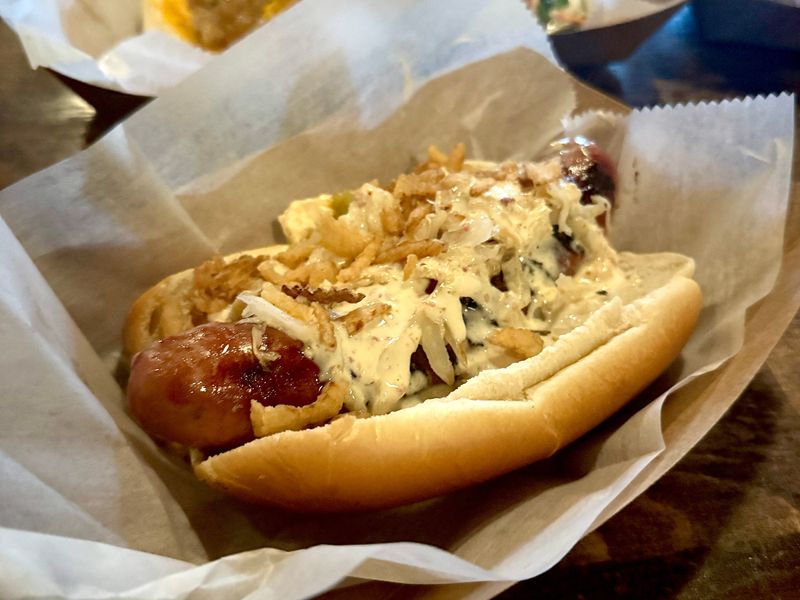
For more than a decade, this Bay View bar and restaurant has been serving chef-driven, gourmet sausages that range from Jamaican lamb currywurst to hot Szechuan chicken sausage. But, of course, there are brats, too. Vanguard has a classic brat topped with sauerkraut and onions and another stuffed with jalapeno and cheddar, and its “Brewer” sausage is made with a cheddarwurst topped with pimiento beer cheese, grilled sauerkraut, Baconstein aioli and crispy onions. And its Milwaukee-style brat is a true feat of fromage: the classic pork brat is topped with cheese curds, cheddar cheese and a smooth house-made cheese sauce. Cheesy overkill? Bite your tongue.
Go: 2659 S. Kinnickinnic Ave.; (414) 539-3593; vanguardbar.com
The Wurst Sausage Bar
Tucked away in a slim nook of the bustling Milwaukee Public Market is the Wurst bar, like a miniature corner tavern where suds and grub are served to diners who wander in looking for comfort.
It’s owned by Foltz Family Market, located just around the corner. Foltz’s meat counter is where you’ll find some of the best house-made sausages in the city, and at the Wurst, you can order its excellent brats right from the bar, and enjoy while sipping one of the 16 beers on tap. You’ll always find the Milwaukee brat, boiled in beer and grilled, then topped with fresh tomato, pickle, caramelized onion and sauerkraut — all served on a soft Pretzilla pretzel bun. But be sure to ask your server about the rotating specialty sausages available that day; brats like the cheddar-jalapeno “Packer” and the “Uecker” — stuffed with kraut, onion, cheddar and bacon — are must-trys.
Go: 400 N. Water St.; (414) 277-5070;foltzfamilymarket.com
Jennifer Borresen contributed the interactive graphic to this story. She is a graphic journalist at USA TODAY, specializing in explanatory graphics and illustrations in various fields, including politics, science, weather and entertainment.
This article originally appeared on Milwaukee Journal Sentinel: Hot dogs rule America’s summer. But in Milwaukee, bratwurst is king
Reporting by Rachel Bernhard and Jennifer Borresen, Milwaukee Journal Sentinel / Milwaukee Journal Sentinel
USA TODAY Network via Reuters Connect
By Rachel Bernhard and Jennifer Borresen, Milwaukee Journal Sentinel | USA TODAY Network