

JUPITER — Three decades as a firefighter and 14 years on rescue crews prepared Sam Adler for the job he took on in La Guaira, Venezuela, but maybe not the bravery he witnessed or the tears of joy he cried when it was finished.
Adler and Battalion Chief Eric Johnson of Palm Beach County Fire Rescue dug and crawled through tunnels for three days to free Hernan Gil, a 43-year-old security guard who was buried under 160 tons of concrete following the June 24 twin earthquakes that left over 4,500 people dead and 50,000 missing.

On July 2, Adler and Johnson watched as crews pulled Gil out alive after nine days under the rubble. Footage of the rescue went viral on social media and has became a symbol of hope for Venezuelans worldwide.
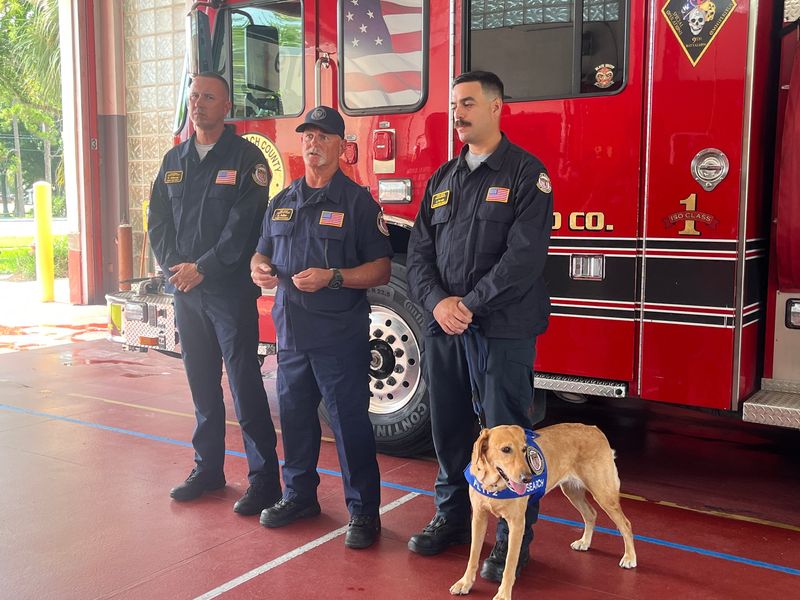
“Seeing him come out of the hole was a relief and very emotional,” Adler said during a July 10 press conference at Fire Station 19 on Central Boulevard in Jupiter. “With all the roadblocks we hit, we were just happy to save a life and return somebody to their family.”
Venezuela earthquakes stronger than 2010 one in Haiti
A 7.2 earthquake struck Venezuela’s northern coast at 6:04 p.m. on June 24, followed by a 7.5 magnitude tremor a minute later. Both were more powerful than the 2010 quake that rocked Haiti, which registered 7.0.
Five Palm Beach County Fire Rescue firefighters — Adler, Johnson, Lt. Alexander Parada, Capt. Anthony de Jesus and driver operator Zachary Shepherd — flew on June 27 to Venezuela as part of a South Florida task force assisting with search-and-rescue efforts along the South American nation’s north coast
Adler said the earthquakes had devastated La Guaira, about 7 miles from Caracas and the nation’s major port. He said entire streets have collapsed buildings with thousands of people trapped — or worse — underneath.
“We’ve never seen anything like this,” Adler said. “We probably never will again. I’m just proud that we can serve and go down and help people.”
Palm Beach County firefighters part of international rescue crew in Venezuela
Upon their arrival, Alder and Johnson joined a group of nearly 100 international rescuers searching for survivors under a collapsed nine-story shopping center in Catia La Mar, a port city west of La Guaira.
Two days after the earthquakes, Chilean rescuers had picked up signs of life under the rubble. Inside was Gil, who had been stationed on the first floor when the earth shook and buried him.
The operation required cutting through 160 tons of concrete to carve a tunnel, even though the heavy construction equipment that makes those jobs faster wasn’t available, Alder said. Instead, rescue crews used a method known as tunneling: digging and reinforcing narrow pathways through the debris.
Johnson said rescuers worked 12-to-16 hour shifts and took turns every 30 minutes going down the tunnel to dig. Some sections of the 25-foot tunnel were as narrow as 3 feet.
“But you almost had to rip these guys out of the hole they were digging. Nobody wanted to leave,” Johnson said. “It’s the adrenaline and the chance of finding somebody alive.”
“The rule is: Even if one person, it’s one life. We’re going to finish that mission no matter how long we take.”
On June 29, five days after the earthquakes, the tunnel collapsed during an aftershock.
On June 30, rescuers heard Gil’s voice for the first time through a second tunnel. A small opening on the debris allowed a Chilean rescuer and Gil to touch fingers.
Johnson said the hole allowed him to give Gil water through a tube he refilled with syringes as Chilean rescuers translated their conversation.
The team continued despite the unstable surface, heavy rains and aftershocks, Adler said. They extracted Gil right before the tunnel caved.
“We knew that going into this hole and trying to rescue this gentleman, we were potentially giving up our families,” Adler said. “It was just downright bravery. Everybody who went to that hole without hesitation were some of the bravest men and women that I’d ever had served with.”
K-9 Piper and her handler rescue victims of the Venezuela earthquake
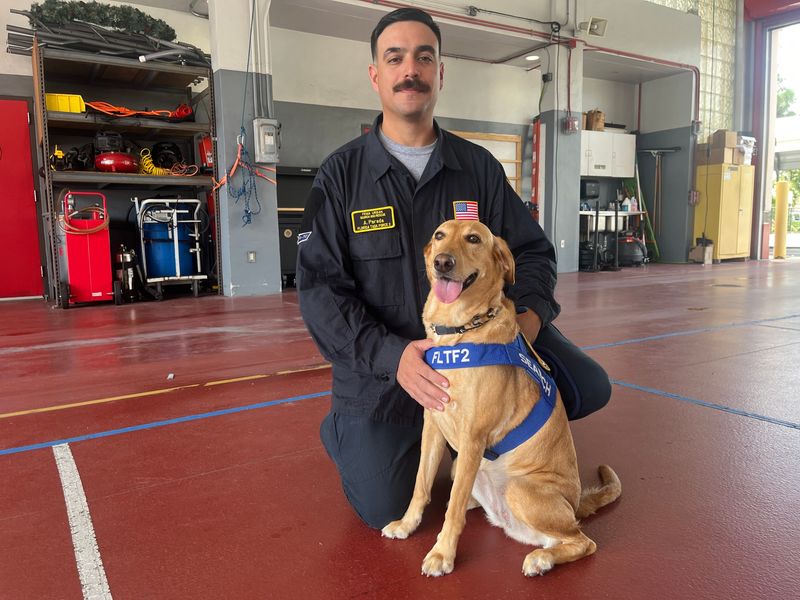
Miles away, Parada, a K-9 search specialist and a Venezuelan native, toured collapsed buildings with K-9 Piper, a 4-year beige Labrador serving her first deployment mission.
“On Piper’s first day, she got two hits for body remains,” Parada said scratching the back of her ears. “She doesn’t know how important she is.”
Piper is trained to find humans through the smell of their body odor and the oxygen they exhale, Parada said. Instead of having to remove all the rubble, rescuers focus on the area identified by a dog like Piper.
“Dogs are lighter and they’re more agile. So usually, where a human being would stumble on walking into rubble, the dogs are able to traverse all that and using their nose they’re able to locate potential victims,” Parada said.
At night, Piper served an emotional support animal for rescuers in the base. Parada said she came back to cheer rescuers by playing or cuddling.
Parada, who left Venezuela in 2001 and had not returned since 2015, said he never expected to return to his home country through a rescue mission.
“It was a beautiful experience just being able to give back,” Parada said. “There was a mom and a kid going around give trying to offer everybody coffee because we were working for people. It’s those things.”
Johnson said the warmth and generosity of the Venezuelan people kept them going.
“It was heartwarming to see that they went through such a devastating moment and they were still so welcoming and so happy that we were there to help,” Johnson said. “It was a big part of the fuel that drove everybody to do as best as they could.”
Valentina Palm covers immigration and West Palm Beach for The Palm Beach Post. Email her at vpalm@pbpost.com and follow her on X, the platform formerly known as Twitter, at @ValenPalmB.
This article originally appeared on Palm Beach Post: County firefighters helped rescue man buried by Venezuelan earthquakes
Reporting by Valentina Palm, Palm Beach Post / Palm Beach Post
USA TODAY Network via Reuters Connect
By Valentina Palm, Palm Beach Post | USA TODAY Network
