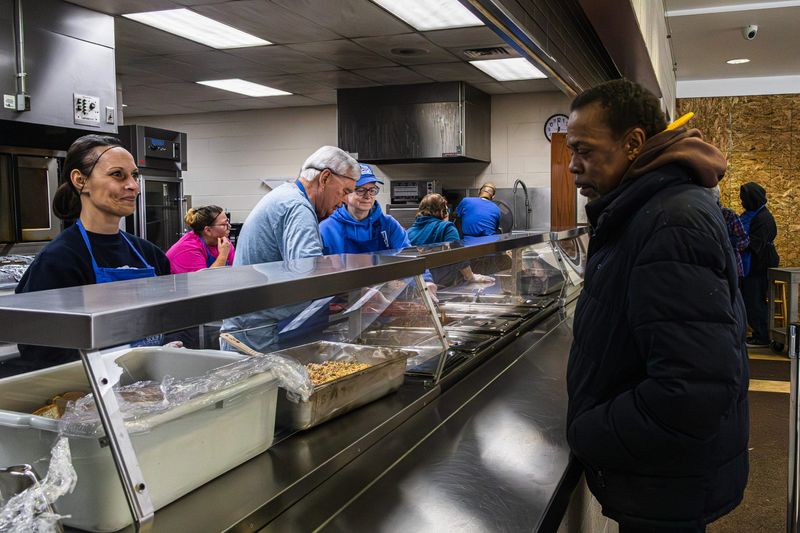
SAGINAW — The wind was whipping in 30-degree weather at 11 a.m. one April day as people of all backgrounds stood outside waiting in line at the East Side Soup Kitchen in downtown Saginaw. Waiting for the doors to open, it might be their only meal of the day.
Inside, everyone from working moms to elderly people received a nutritious, free meal in an area that is increasingly worried about affordability. Saginaw County has a median household income of $61,455, according to 2024 data from the U.S. Census Bureau — $20,000 less than the national average and $11,000 less than the state average.

Saginaw is categorized as a middle suburb per the American Communities Project, a journalism effort studying demographics and geography based at Michigan State University. Trump won big in these counties, which have generally been slower to urbanize, less diverse and less wealthy than larger suburbs like those near Detroit.
A manufacturing hub with plants that supply parts to General Motors, Ford, and more, Saginaw County paints a picture of how President Donald Trump was elected in 2024. The county voted for Trump in 2016, followed by Democrat Joe Biden in 2020. In 2024, though, Saginaw County shifted back to Trump, who got 50.2% of the countywide vote.
But in a county that has continued to struggle economically, it’s not clear what story the midterms will tell.
The same year Trump last won here, Democratic U.S. Rep. Kristen McDonald Rivet won a competitive area congressional seat that’s up again this fall (Amir Hassan is the apparent front-runner in the Republican primary). And in a recent special state senate election that included part of Saginaw County, Democrat Chedrick Greene bested Republican Jason Tunney by nearly 20 points. Pending primary results, they could be up for a rematch this fall.
In Saginaw County, manufacturing is key
Former Michigan state senator Ken Horn, a Republican, represented the area in Lansing for 15 years before being term-limited out in 2022. He served as chair of the Economic and Small Business Development Committee and focused on creating manufacturing jobs, and after leaving office, joined a group focused on bringing more economic opportunities to the area.
Saginaw County has seen a decline in population over the past 50 years. In 1970, it was home to nearly 220,000 residents, according to census data. In 2020, that number fell to under 190,000, in part due to a decrease in manufacturing jobs. Horn is looking for ways to bring those jobs back to the area, but not in the traditional automotive field.
“We’re trying to transition our manufacturers into being flexible, trying to get past strictly being suppliers to the auto manufacturers, trying to gear up for either space or for your defense industry,” Horn said. “Where you innovate is where you build, and where you build is where you grow.”
Horn said Saginaw voters backed Trump in 2024 largely because they believed he would bring jobs and economic opportunity back to the city.
The city’s unemployment has stayed relatively flat since Trump’s return to the White House, according to state data. In December 2024, the seasonally unadjusted unemployment rate in Saginaw was 10.7%. In December 2025, it sat at 10.2%, and the most recent data, for May 2026, put unemployment at 10.6%. All those run higher than unemployment statewide, which was 5.2% in May of 2026.
“These guys just want to work. They just want to build things, whether it’s building buildings, or building cars, or building something, they want to work,” Horn said. “The candidate that gives them the best opportunity is the candidate that they’re going to support.”
And there are some bright spots. Earlier this year, for instance, General Motors announced it would invest $150 million into its metal casting plant along the Saginaw River. In a statement, plant director John Lancaster said the investment will position the plant for success and secure jobs for the future.
Working class ‘taking it on the chin’
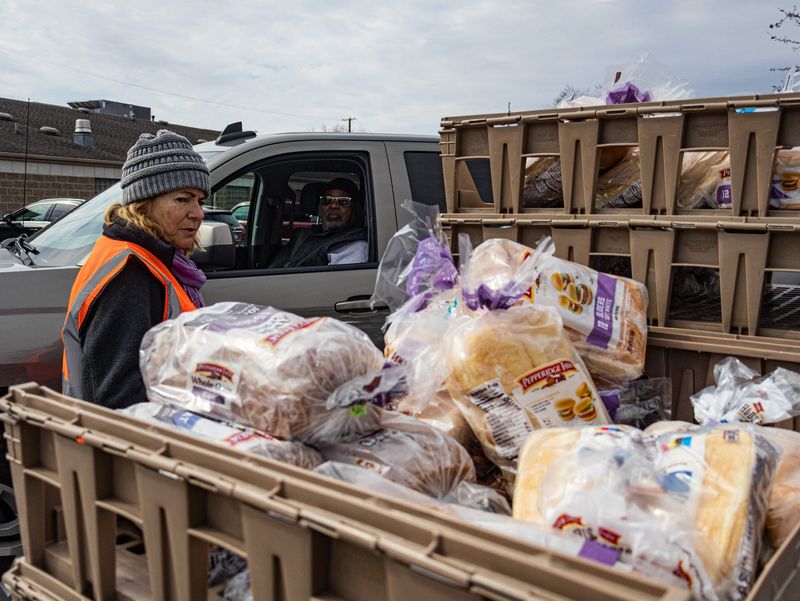
Jeremiah Janze, program manager of Hidden Harvest, a local food bank, has been helping families in need for over 10 years. He works with the East Side Soup Kitchen, supplying its ingredients for daily meals. Janze said he has seen more people in the past year receiving meals than ever before.
“There are parts of rural Saginaw County, Midland County, where there are families that are in just as rough shape as inner-city families,” Janze said. “I think the working class is taking it on the chin. The working class has been taking it on the chin for a while, but now it’s just kind of blatantly on the chin.”
Residents of the county have echoed a similar sentiment. Brady Nelson, a retired social worker, said he has noticed his grocery bills growing.
In 2025, 32% of Saginaw County residents are on Medicaid, compared with 25% of Michigan residents. Nearly 18% of county residents received SNAP benefits in 2025, which was five points higher than the state average. Nelson said he wants Washington to pay more attention to health care, saying far too many people are not receiving adequate treatment.
“Stop the oppressive policies that destroy poor people’s lives, No. 1,” Nelson said. “People need help with medical care and a secure medical base to be able to do anything. They need assistance at the base level for people who cannot maintain their own medical insurance.”
According to the U.S. Department of Agriculture, at-home food prices rose 24% between 2020 and 2024, a sharper increase than housing and transportation. The department projects that will increase another 2.8% in 2026.
The East Side Soup Kitchen dished out 202,340 meals in 2025. Executive Director Diane Keening said she’s starting to see a wider section of the city’s population coming in.
“We see a lot more working poor people come in, and our numbers have risen, year to year, which is sad,” Keenan said. “There’s one man that just sticks out in my mind because he came through the drive-through. And he goes, ‘I don’t know what to do. I don’t know what information you need.’ I said, ‘We don’t need any information except the number of meals you need.’ And he teared up.”
A Saginaw-based nonprofit serving minority youths and small businesses is feeling the indirect effects of federal funding cuts, even as it expands its programs into its fourth year. United We Go, founded by Gina Anayana, hosts community mural festivals, kids’ fashion shows, funds birthday parties for families in need, and hosts a podcast for kids and teens to build their communication skills.
Gina said United We Go does not receive direct federal or state funding, but has noticed sponsor organizations pulling back as their own budgets tighten.
“Indirectly, we can feel it,” she said. “Some organizations that sponsor us, their funding is being cut, so they cannot increase what they gave us last year.”
At the Saginaw YMCA, seniors partake in daily activities with light exercise.
Madeline O’Neal stood in the lobby bagging popcorn to fundraise for the seniors she oversees, greeting each visitor with a smile. She said she was very passionate about caring for elderly people, but funding for her programs has been tighter than in years past.
The Trump administration’s “One Big Beautiful Bill,” signed in July 2025, cut more than $900 billion from Medicaid over the next decade, directly impacting nursing home funding across the country. Nationally, the cost of nursing homes is $135,050 per year, according to CareScout, which tracks long-term care trends. In Michigan, that figure jumps to roughly $155,000.
“There’s a lot of seniors suffering,” O’Neal said.
This November’s midterm elections will be important in middle-suburb counties like Saginaw. Trump has seen success in these regions, but, at least in Saginaw, not consistently.
“Donald Trump is a builder, and that’s what they saw,” Horn said about moderate voters in the Saginaw area. “With Biden, they saw him as a labor guy, and so they may have switched over to Biden, thinking he’s a good labor guy. So you see a little bit of back and forth.”
Editor’s note: This story has been updated to correct the name of U.S. Rep. Kristen McDonald Rivet.
This article was produced in partnership with the American Communities Project and Michigan State University. For questions about the collaboration or this article, contact Free Press politics editor Emily Lawler: elawler@freepress.com.
This article originally appeared on Detroit Free Press: Working class hurting in purple Saginaw County as midterms approach
Reporting by Lucas Gentilia, Special to the Free Press / Detroit Free Press
USA TODAY Network via Reuters Connect
By Lucas Gentilia, Special to the Free Press | USA TODAY Network