As America celebrates 250 years of independence, St. Augustine acknowledges the role its Menorcan citizens played during the Revolutionary War.
According to the Journal of the American Revolution, some Menorcans served the British during the war, but not out of true loyalty.

“Most served the Crown out of desperation and to avoid a bitter death in a harsh, war-torn, scarcely populated frontier colony that rested on the far-flung fringes of the British Empire,” the Journal noted. “The reluctance of many Minorcans to evacuate with the British speaks volumes about not only their lack of commitment to the British government, but also the loyalty they had for each other and their community.”
Ann Browning Masters, board member of St. Augustine’s Menorcan Experience, Menorcan poet laureate and the city’s poet laureate, told the St. Augustine Record that this group of Greeks, Italians and Menorcans that came to be collectively known as Menorcans, came to British America like many immigrants of that time.
“They were looking for opportunities for a better life,” she said. “After their first sojourn of nine years at Andrew Turnbull’s failed indigo plantation, British Governor (Patrick George) Tonyn allowed them to move to St. Augustine.”
Sandie Stratton, historian to the board of St. Augustine’s The Menorcan Experience, said she believes the Menorcans benefited from the American Revolutionary War, arriving at a time when the British population had become so sparse, the northwest portion of town had become virtually deserted.
Stratton said Tonyn pointed the Menorcans to settle in that area, in what is today known as historic downtown.
“When they first migrated to St. Augustine from New Smyrna, they arrived at a time when the population of British St. Augustine was around 2,000 people,” she said via email. “Later, as the British shifted their war strategy to the southern colonies, many British loyalists fled to British St. Augustine, eventually swelling the population to more than 20,000.”
Historical records show that at the onset, the Menorcans moved into abandoned houses and palm-frond huts on St. George Street. They built garden plots north of the city walls and became farmers, hunters and fishermen. The population growth of the loyalists gave the Menorcans opportunities to further establish their trades as revenue.
“A lot of loyalist mouths to feed were to the Menorcans’ advantage,” Stratton said. “By the time the war ended and the British abandoned St. Augustine to the Spanish, the Menorcans were well-established in St. Augustine and were finally on their way to successful lives on their own land.”
Lea Craig, the president of St. Augustine’s Menorcan Experience, described the life of the Menorcans in America’s oldest city as difficult.
“They were left to their own devices to find housing and basic necessities of life,” she said. “In time, they became the backbone of the local community, helping provide for hundreds of loyalists who fled to St. Augustine in East Florida.”
Masters added: “The descendants of these Menorcans remember the hard times of their immigrant ancestors in Florida. History and folk lore were passed down. They worked hard to survive. They became the majority backbone of St. Augustine’s population during the Second Spanish Period and part of U.S. Territorial days. Today it is estimated that they represent 10% of the population in St. Johns County.”
Local historian David Nolan described the history of the Menorcans as essential for St. Augustine’s culture and architecture.
“When the Menorcans left the hardships of New Smyrna for sanctuary in St. Augustine 249 years ago, building was a priority, to house the new settlers as well as loyalists fleeing the American Revolution to the north,” Nolan told the St. Augustine Record via email. “Menorcans not only built buildings here, they designed, financed and sold them.”
Nolan said Menorcan history has been shortchanged in St. Augustine in part because it was considered Spanish Colonial.
“Even though the Menorcans came during St. Augustine’s British period, the historical focus has been on the military people who came in short stints,” he said. “The Menorcans who came and stayed became the old timers of our Ancient City and have seemed to be forgotten. I hope the upcoming celebration of their 250 years here will correct that.”
The Menorcan Plight
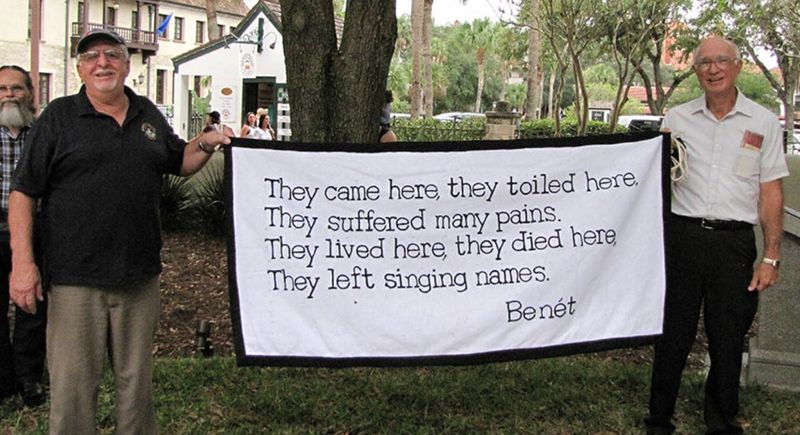
While today the Menorcans are proudly relished, the journey of its descendants into America’s oldest city is one of heartbreak and courage.
Historical records show that Dr. Andrew Turnbull, a New World colonist, brought the Menorcans to America in 1768 from Menorca, a Balaeric Island in the western Mediterranean Sea. Those recruited — mostly poor people — had agreed to work as indentured servants on Turnbull’s indigo plantation, harvesting the plant used as a coloring dye, which was at the time a lucrative cash crop.
Florida’s then governor, James Grant, had awarded the Scottish physician 60,000 acres 70 miles south of St. Augustine.
Turnbull’s contract promised laborers a piece of land as their own upon completion of their nine years of servitude. The agreement also promised workers lodging, food and the ability to harvest their own garden plots during their years of labor.
According to St. Augustine’s Menorcan Cultural Society website, more than 1,400 Menorcan, Greek, Italian, Corsican and French peoples, the largest single group of European settlers, migrated to Turnbull’s plantation in New Smyrna.
History describes the voyage as treacherous. Almost 200 settlers never set foot in America.
Life in the new world fared no better. The labor — seven days a week with no time to rest or work on their own garden plots — was arduous and the treatment brutal. Many died from abuse, disease and malnutrition. At the end of nine years of mistreatment and neglected contracts, three men, Francisco Pellicer, Antonio Llambias and Juan Geonoply, journeyed to St. Augustine by way of Old King’s Road seeking asylum from the city’s British governor, Tonyn.
Asylum granted, the remaining colony members — less than half of the original group — walked to St. Augustine to live within the city’s walls in 1777. Welcomed to the northwest corner — historical drawings show Charlotte Street — the Menorcans settled to become a vital component of the city’s culture, commerce and history.
This article originally appeared on St. Augustine Record: The Menorcans, ‘forgotten’ settlers who built St. Augustine
Reporting by Lucia Viti, St. Augustine Record / St. Augustine Record
USA TODAY Network via Reuters Connect
By Lucia Viti, St. Augustine Record | USA TODAY Network