Rogers Behavioral Health filed a complaint against the professional licenses of two therapists whom it fired following a union election, and tried to block unemployment benefits for another fired worker, according to the union and the workers.
It is the latest controversy involving Rogers and employees of its outpatient clinic in West Allis, known as the Lincoln Center, who voted in April to form a union under the National Union of Healthcare Workers, voicing concerns about declining patient care and unmanageable workloads.

Rogers, which provides mental health care, has filed an objection to the union election and is seeking to invalidate it. Meanwhile, the union has filed complaints against Rogers, alleging illegal retaliation against employees supportive of the union. Since the union went public with its campaign in February, Rogers has fired six of its would-be members.
The union says the complaint against two former employees’ licenses, filed in May by Rogers Vice President of Regulatory Affairs Steve Hertig, is another instance of retaliation against union supporters. Meanwhile, Rogers said in a statement it has followed the law and holds staff accountable who do not meet standards of professional conduct.
The Wisconsin Department of Safety and Professional Services, which received the complaint, recently closed the case after finding no indication of a violation, a spokesperson for the agency confirmed.
The complaint, a copy of which was obtained by the Milwaukee Journal Sentinel, cited the same set of circumstances that led to the therapists’ firing.
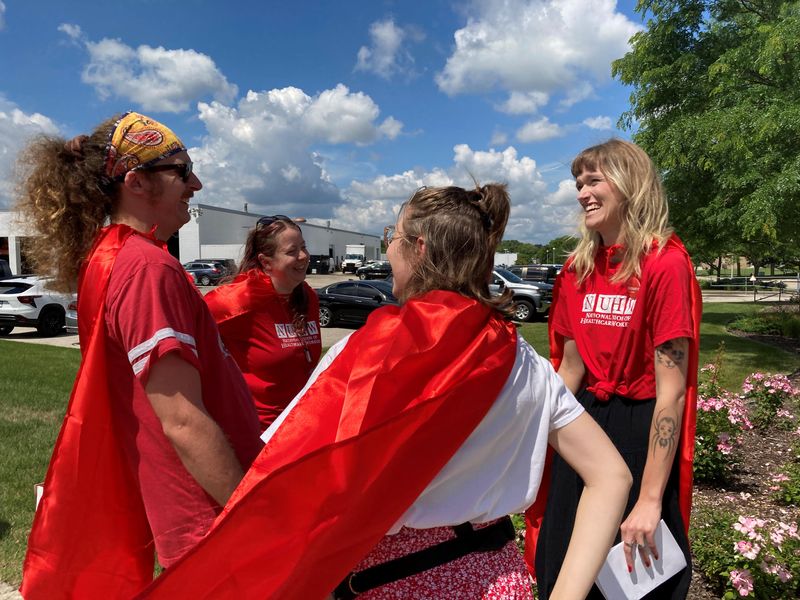
Rogers fired them in April for wearing costumes – one a cape and the other an inflatable unicorn costume – for about a half hour the day of the union election, saying they violated company policy and caused a patient to become dysregulated.
Kate Zolandz, one of the fired therapists, has disputed the company’s version of events, saying she and her co-worker donned the costumes to wish co-workers a happy election day and tried to limit any patient interaction by visiting their offices over the lunch break. She said she had no interaction with the patient in question and that it was a private security guard hired by Rogers for the election who upset the patient hours later.
The West Allis clinic, at 2424 S. 102nd St., sees more than 100 adolescent and adult patients every day. The clinic runs intensive outpatient programs and a partial hospitalization program, in which patients spend the full day at the clinic going to group therapy, classes and other treatment.
Zolandz, who worked at Rogers for four years, was stunned by the company’s move to threaten her professional license.
“Until now I had believed that there were some lines Rogers was not willing to cross,” Zolandz said during a June 25 protest outside the clinic, wearing the same cape she had donned for the election. “I could deal with being fired and suspended. I knew that I was taking that risk when I was fighting for the patients. But my license – that is the thing that I worked most of my adult life for. That is my career.”
Rogers does not comment on personnel matters. Marketing Executive Director Maureen Remmel sent a statement saying Rogers takes concerns about patient care and working conditions seriously and addresses them through direct communication.
“Any claims to the contrary do not accurately reflect the reality of the care we provide or the workplace we have built,” the statement said.
According to the union, Rogers also contested the unemployment claim filed by a front desk worker, who was fired in April after letting former employees who the union alleges were wrongfully terminated go into the clinic to vote in the union election.
That worker, Delaney O’Connor, said it turns out she will receive unemployment benefits, despite Rogers’ objection.
“I know Rogers is trying to make an example out of us,” she said.
Employees at the West Allis clinic decided to form a union after Rogers made changes to its clinical model that they believe worsened care. Rogers changed most programs to a “one-size-fits-all” model that emphasized group therapy, Zolandz said. Most patients were no longer guaranteed one-on-one time with a therapist. Rogers also more than doubled caseloads, making therapists responsible for more patients, Zolandz said.
“This meant that we had 80 hours of work to do in a 40-hour work week. It also meant that our patients couldn’t get the same level of care that Rogers used to provide and was known for,” Zolandz said.
Rogers is a nonprofit mental health care provider based in Oconomowoc that has psychiatric hospitals and clinics across 10 states. It provides mental health care and addiction treatment to adolescents and adults, including people struggling with eating disorders, obsessive-compulsive disorder, anxiety and depression.
Reporter Sarah Volpenhein can be reached at svolpenhei@usatodayco.com or at 414-607-2159.
This article originally appeared on Milwaukee Journal Sentinel: Rogers targets licenses of staff fired after union vote
Reporting by Sarah Volpenhein, Milwaukee Journal Sentinel / Milwaukee Journal Sentinel
USA TODAY Network via Reuters Connect
By Sarah Volpenhein, Milwaukee Journal Sentinel | USA TODAY Network