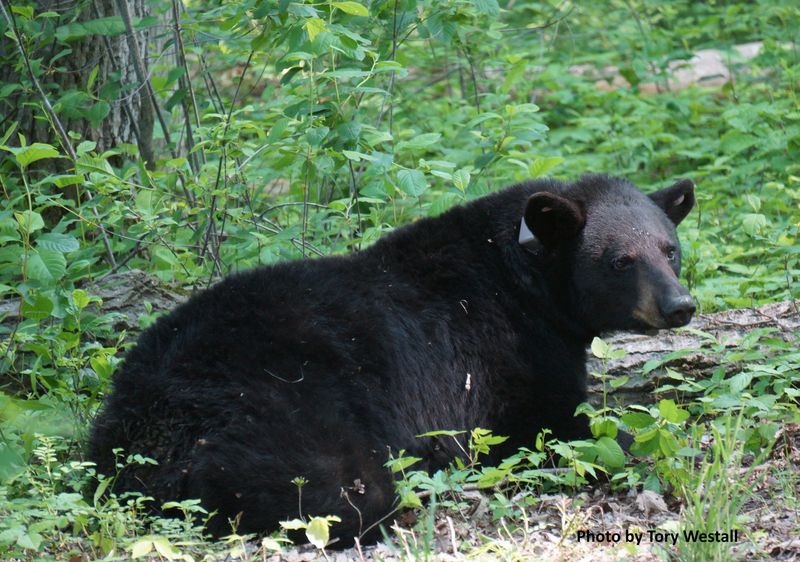
Black bears are back in Ohio to stay, and recent sightings in the Cincinnati area show how deep into the Buckeye State they have wandered.
“We typically have zero black bears in this part of the state. That’s why it’s such big news,” Brett Beatty, wildlife management supervisor with the Ohio Department of Natural Resources District 5 office in Southwest Ohio, told the Enquirer previously.

Ohio had a record number of black bear sightings in 2025. And ODNR wildlife officials recently collared a 576-pound black bear, nearly twice the average weight of 300 pounds. The collar will allow researchers studying black bears in the state to track its movement and behavior.
With all the bear activity in the state, you may wonder what you should do if you see a bear? How can you protect yourself and your property from them? Here’s what Ohio wildlife officials and others recommend.
5 steps to take if you see a black bear in Ohio
Black bear attacks are rare; they are usually fearful of people. As long as they are given space and not cornered, bears do not attack or kill children or pets. The bears are generally not aggressive and prefer to flee if they are aware of your presence.
So if you see a black bear, remain calm. If it hasn’t noticed you, back away slowly and leave the area. If it is aware of you, avoid direct eye contact and give it an easy escape route. Don’t run away or climb a tree, which may provoke a chase.
ODNR recommends remembering this using the acronym AWARE:
How to protect your house, backyard from black bears
Black bears can cause significant damage in search of an easy meal, which they can often find near human habitats. Here’s how you can protect your backyard if one is in your area, per ODNR:
If a bear is causing damage in your area, ODNR encourages residents reach out to their county wildlife officer or Division of Wildlife district office for assistance at 1-800-WILDLIFE — (800) 945-3543 — or wildinfo@dnr.ohio.gov.
Ohio Department of Natural Resources wants to help humans, black bears coexist
Wildlife officials want to help property owners coexist with bears.
The Division of Wildlife posted an advisory to Facebook on May 12 about avoiding human-bear conflict. In it, ODNR states that “the presence of desirable food sources” is the cause of many conflicts between humans and bears, and it offers suggestions on how to reduce them. The post goes on to offer the assistance of wildlife officials to help people deal with bears in the area.
“When bears are present in an area, our agency can provide education and resources to help landowners discourage nuisance behavior,” the Division of Wildlife states.
Black bear spotted near Cincinnati
Beatty told the Enquirer in a June 24 interview that black bear sightings in the Cincinnati region started about a week ago in southern Clermont County. The bear was reported in New Richmond and Bethel, then it turned west into Hamilton County and was reported in Anderson Township. Another report came from Greenhills, north of Cincinnati.
Bear sightings are are more frequent in the eastern portion of the state, where they wander in from Pennsylvania and West Virginia. Black bears in Southwest Ohio are still a rarity, with only eight reported and three confirmed sightings since 2023, according to the May 2026 Ohio Black Bear Monitoring Report from ODNR.
Beatty told the Enquirer that the bear is probably a young male trying to find a mate. When he realized there are no females around, he’ll likely leave.
Black bear mating season drives wandering
Mating season for black bears is between mid May and late June, according to the North American Bear Center in Minnesota.
Both males and females increase their movements during mating season. Adult males have a home range of 100 to 120 square miles in upland hardwood habitats, per ODNR, while females’ home range can cover 24 to 50 square miles. Movements of 125 miles from a denning site have been documented.
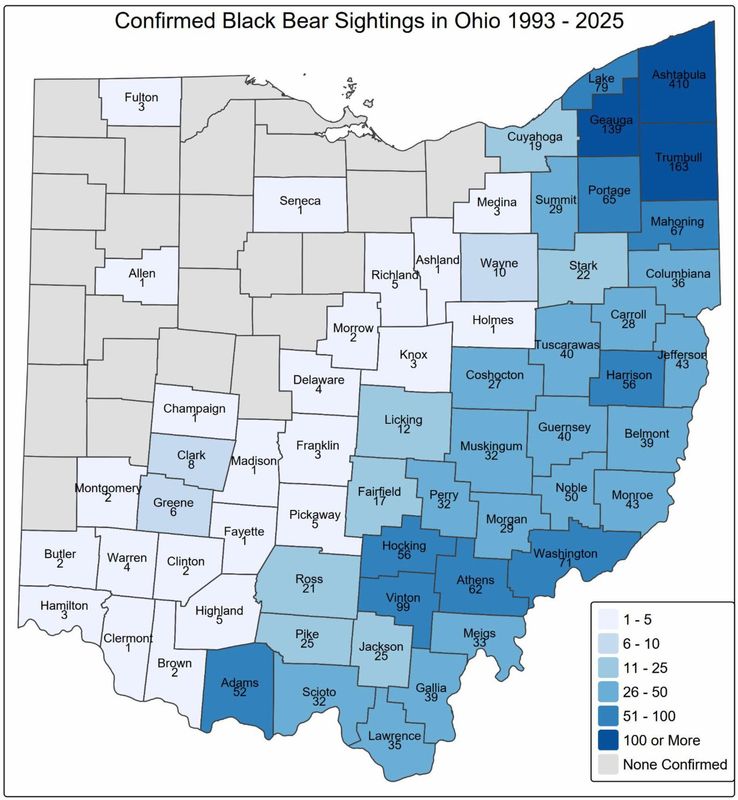
Map of Ohio bear sightings in 2026
Here’s where there have been Ohio bear sightings in 2026
In other recent bear sightings across Ohio, Justin Jacobs of Mount Vernon caught a black bear on video June 23, and again on June 24, in Danville, Knox County. He shared the videos to Facebook.
A black bear also was spotted in Licking County, WCMH News4 reported June 19.
Ohio wildlife officials collared a massive, 576-pound black bear in Ashtabula County in early June. The bear, nearly double the average weight of 300 pounds for males, will be tracked using the radio collar inform research about black bears movement and behavior in the state.
Another sighting happened in the City of Aurora in Portage County, roughly 30 miles northeast of Akron. The Aurora Police Department stated on social media June 4 that the bear was spotted in the northeast part of town. The department shared a photo of the bear along with some tips to stay safe.
Before that, black bears were spotted as recently as May 19 in Youngstown, where one was nearly hit by a pickup truck. The bear was wandering the streets on the south side of the city. Mike Montell told WKBN TV-27 he took video of the bear running across the road. It nearly got hit by a truck and then ran off into the woods.
Earlier sightings in 2026 include about four bears in a backyard in Ashtabula County, climbing to get bird feeders in April, Fox 8 News in Cleveland reported in April.
Black bears, once gone from Ohio, returning to the state
Black bears were considered gone from Ohio by the 1850s, per ODNR, due to deforestation and hunting by Ohio settlers. However, they have been spotted wandering through the state as populations in neighboring Pennsylvania and West Virginia grow, according to the bear report.
A small population has establishing itself in Northeast Ohio. ODNR estimates an in-state population between 50 and 100.
The name “black bear” can be misleading, because they can be black, chocolate brown, cinnamon brown, blue-black, and even white.
An adult can weigh anywhere between 150 and 700 pounds. Males average 300 pounds while females are smaller, averaging around 175. Males, when standing upright, measure between five and six feet tall. And again, females are smaller, measuring four to five feet.
Bears are omnivores and will eat a variety of foods; grasses, berries, carrion and insects are typical. Bears will also raid crops, if available.
Spot a bear in the wild? The ODNR Division of Wildlife wants to know
Did you see a bear? The ODNR Division of Wildlife wants to know. Report sightings online at wildohio.gov or the Wildlife Species Sighting Report. You can also contact your local county wildlife officer or regional District Wildlife Office.
This article originally appeared on Cincinnati Enquirer: 5 steps to stay safe as Ohio black bears are here to stay
Reporting by Chad Murphy, USA TODAY NETWORK / Cincinnati Enquirer
USA TODAY Network via Reuters Connect
By Chad Murphy, USA TODAY NETWORK | USA TODAY Network