From treatment to transport, the Des Moines Fire Department is increasing its fees for ambulance services to align with other regional departments.
The new costs for emergency medical services and fire prevention services will be increased effective July 1. The Des Moines City Council approved the new fees on June 8.

The increase “brings ambulance rates in line with other services in the area while minimizing impact to the community,” according to the fire department’s ambulance rate proposal.
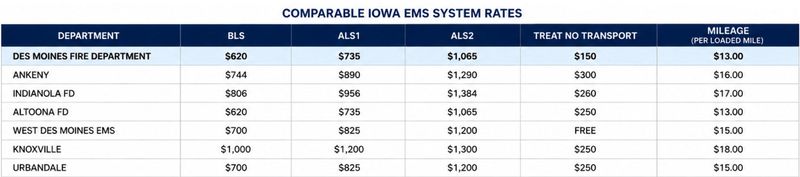
“Des Moines ambulance rates have not been adjusted since 2020 and currently fall at or near the lowest comparable Iowa EMS systems,” according to the proposal. “This is a necessary correction to maintain financial sustainability; this is not an aggressive increase.”
How much will life support and transport in an ambulance cost?
The costs for ambulance services in Des Moines will increase by approximately 20% from current rates:
Footnotes in the proposed fee increase document define basic life support as an “immediate emergency response” that includes “medically necessary supplies and services” with a focus on transportation.
Level one advanced life support includes basic life support as well as “the provision of an ALS assessment or at least one ALS intervention,” such as an IV or use of an EKG monitor.
Level two includes three or more administrations of IV medications and at least one level-two procedure such as manual defibrillation, placement of breathing tubes, or creating a surgical airway.
“As the costs incurred to provide these services rise with inflation, those fees must be updated to maintain the service level provided to our residents who expect high-quality EMS care to be available,” Des Moines City Manager Scott Sanders said in a statement to the Register.
The proposal compares ambulance fees with other cities in the Des Moines metro, such as West Des Moines, Ankeny and Urbandale, as well as Indianola, Altoona and Knoxville.
According to data in a 2025 EMS rate survey City of Des Moines provided, Iowa’s average cost for basic life support is $759.79, $959.26 for advanced life support, and $17.44 per mile for the ambulance.
The average cost nationally is $983.42 for basic life support, $1,318.53 for advanced life support, and $20.50 per mile for the ambulance.
“These changes put the city’s EMS fees in a better context of the costs incurred to the city while not rising above fees charged by neighboring communities,” Sanders said.
Emergency medical service fees had not “been updated significantly since 2018,” according to Sanders.
On average, consumers are reimbursed $855.35 for basic life support, $1,037.83 for level one advanced life support, and $1,403.71 for level two advanced life support by insurance providers such as Medicare, Medicaid, and Wellmark.
Of the $13.6 million in city EMS revenue for fiscal year 2025, the majority comes from insurance, according to city spokesperson Peter Zemansky.
Fees for fire prevention permits, inspections, and services will also increase, primarily impacting business owners. Fees include services for fire alarm systems, propane tanks, hazardous materials and sprinkler systems.
The updated fire and ambulance fees are expected to increase the total fire department revenue between $235,000 and $470,000 annually, based on the expected number of calls.
Kyle Werner is the breaking news and public safety reporter for the Register. Reach him at kwerner@registermedia.com.
This article originally appeared on Des Moines Register: Des Moines raises its ambulance fees. How much could it cost patients?
Reporting by Kyle Werner, Des Moines Register / Des Moines Register
USA TODAY Network via Reuters Connect
By Kyle Werner, Des Moines Register | USA TODAY Network