“Has anybody ever wondered what the internet looks like?”
As Alex Carroll poses this question next to a row of cages inside the former Eastgate Mall in Indianapolis, he has to shout to be heard from a few feet away. A group consisting mostly of local residents walks between rows of servers in cages that are cold to the touch to prevent the equipment from overheating. Overhead are thickly bundled wires and pipes presumably transporting water.

Carroll points to a row of black and silver servers crammed together on shelves, which have blinking green and orange lights signaling the transmission of data.
“That’s it,” he says.
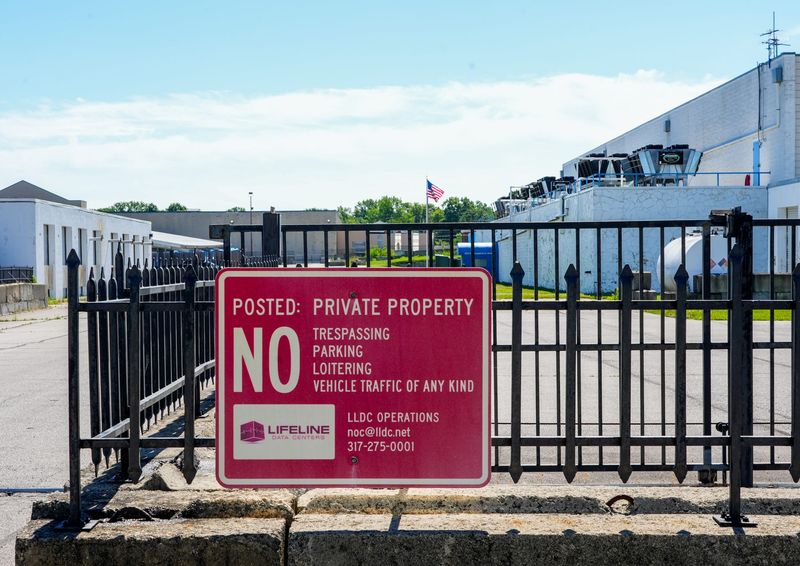
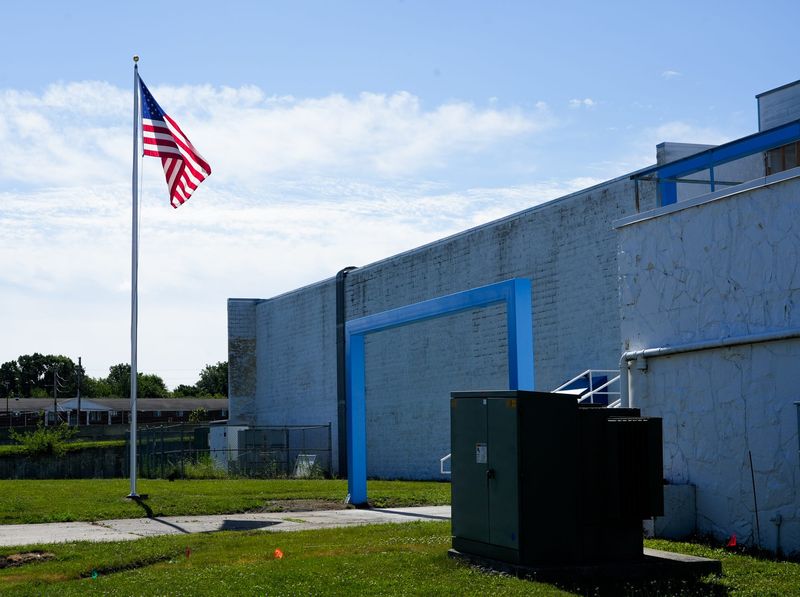
On a recent sunny Wednesday afternoon, Carroll waited outside the Lifeline Data Center on North Shadeland Avenue to greet a group touring one of the two data centers he owns in Indiana. From outside, the center is unassuming and nondescript. A constant buzz can be heard when standing a few feet from the building.
In his tan Carhartt jacket, blue jeans, dirt-covered boots and a pair of black sunglasses around his neck, Carroll doesn’t resemble the attorneys and corporate executives who have been leading data center information sessions over the past year. Carroll grew up on a Warren Township farm and proudly describes himself as a product of the area.
But the facility behind him represents the fears of many Irvington residents, who are fighting a proposal from an out-of-town developer to build a data center just across the nearest intersection.
Before the tour, one person jokingly says, “You better stay back,” as Carroll approaches. He waves off the light-hearted threat with a smile and welcomes everyone inside a few minutes later.
Just inside the door, a Lifeline worker checks government IDs for each person in the group – a strict requirement to enter. Visitors can look around and take notes, but absolutely no photos are allowed. Newspaper articles from the Wall Street Journal and the Indianapolis Star line the entryway, detailing the 2007 press conference at which then-Mayor Bart Peterson announced the new technology center.
There’s a chilly breeze inside the door, where powerful fans blast gusts of cold air. The air conditioning runs almost all the time, even if it’s “17 degrees below zero in the middle of January,” Carroll says.
IndyStar journalists took an hourlong tour of the far eastside data center alongside a group of local residents to better understand what an operating data center looks like in Indianapolis.
Cloud storage facilities have quietly powered the digital world since the 1990s, when a steady rise in technology advancement created a need for space to store the computers behind the internet. The advent of artificial intelligence in the 2020s made server space and speed even more valuable. Now, demand far outpaces supply, creating a rush to develop data centers, which have found a welcoming environment in Indiana.
This generation’s data centers resemble regional infrastructure projects rather than urban developments, said Paulo Carvão, a senior fellow at the Mossavar-Rahmani Center for Business and Government at the Harvard Kennedy School.
Still, a data center is a data center, Carvão said. Step inside even Carroll’s small center and you immediately hear the drowning noise everyone talks about.
“Exposure to some of this is valid and community exposure is good but then imagine that at a completely different scale, a much larger scale. That is what you need to start thinking about,” Carvão said. “They are specifically densely compacted. The chips are much more advanced. They consume more electricity per unit of space, and the data centers themselves are much larger.”
Lifeline data center has quietly operated on east side for nearly 20 years
Nearly 20 years since Peterson announced an IT service center would replace the run-down Eastgate Mall, the Lifeline facility powers cloud services for scores of Indianapolis clients and operates without much attention. The center is tucked behind a Chase branch, Jiffy Lube service center and Papa John’s store on Shadeland Avenue between 10th and Washington Streets.
Lifeline takes up 80,000 square feet in the building. The Indianapolis Metropolitan Police Department and Department of Homeland Security lease the rest of the property from a real estate company Carroll owns.
During the Lifeline tour in late April, Indianapolis City-County Councilor Rena Allen asked if the data center sparked controversy when it opened. As she talked, she held a small portable fan to cool down from the 75-degree heat inside the building.
Carroll paused for a moment, then said he doesn’t remember it being an issue.
Down the street, an out-of-town data center developer faces a harsher reality.
“It’s not popular to be in the data center business right now,” DC BLOX Senior Vice President of Sales David Armistead told a packed crowd inside an Irvington church in April. A few in the crowd shouted expletives at the DC BLOX officials, who represent an Atlanta-based company hoping to construct three large computing facilities at 305 Fintail Drive, just south of Irvington Community Elementary School.
Much of community members’ concerns lie in uncertainty around how this data center will impact resources in the city like power and water. Some question whether Indianapolis should welcome large developments that don’t employ many people but still receive sizeable tax breaks.
A look at some of the initial promises the Lifeline data center’s developers made shows that some of those concerns may be grounded in reality.
When the Lifeline project was announced, the developer estimated the center would employ up to 1,500 people, mainly in information technology jobs, according to IndyStar reporting at the time. In 2026, the center employs 30 people to cover shifts 24 hours a day, seven days a week.
In May 2026, the data center received a violation from the Indiana Department of Environmental Management for operating from 2009 to 2025 without an air permit. Without the proper permit, the state cannot monitor air quality from the generators, and the data center did not undergo strict compliance checks.
Carroll did not respond to specific questions asking about the air permit.
What it’s like inside, from cooling to high electricity costs
Since 2009, Lifeline has operated as a co-location center, meaning clients rent server space from Carroll, who manages the facility.
Attendees on the April tour included two Irvington Community Council members, the Warren Township Schools superintendent, a city development planner, a current and former city-county councilor, in-the-know Eastsiders and two IndyStar reporters.
Seeing inside one of the technological behemoths isn’t necessarily a revelation, but it shows what these high-powered machines look like and what services they supply. For instance, when a patient checks into Eskenazi Hospital downtown, the information goes to the cloud and then the data center, Carroll says.
That’s more information than what data center developers have shared in recent months about proposed projects.
Ron Phillips, the Warren Township Development Association president, had previously toured Lifeline and was one of several people to visit an operating DC BLOX center in Birmingham, Alabama, akin to the one the company is proposing in Indianapolis. He organized the April Lifeline tour.
“I got a lot out of the first tour and wanted to offer it to whoever,” Phillips said. “Education is key to be informed and empowered.”
Like the proposed DC Blox data center, Lifeline operates on a “closed loop” cooling system, meaning water is recycled back through the building to decrease consumption.
Carroll said his center uses 500 to 1,000 gallons of water a day when it’s above 80 degrees outside. The sound inside the facility is close to 60 decibels, he said. Every 1,000 square feet rented, he said, equates to a six-figure salary on staff.
Most of southern Indiana watches cable television thanks to this data center, Carroll said. Carroll rattled off big pharma clients, mom and pop shops, consultants, the Indianapolis International Airport, Community Hospital, the Department of the Treasury, etc. A sign in one area reads, “U.S. Government Restricted Area Warning.”
Of the work, Carroll said, “It’s wildly boring, is what you hope for every day.”
Electricity is by far Carroll’s largest expense. The center uses about 1 megawatt of electricity an hour, or 24 megawatts per day, which runs up a nearly $200,000 electric bill each month. But despite the high cost, he said, that doesn’t compare to the electric load needed to power the newest facilities that are much denser and energy-intensive than Lifeline.
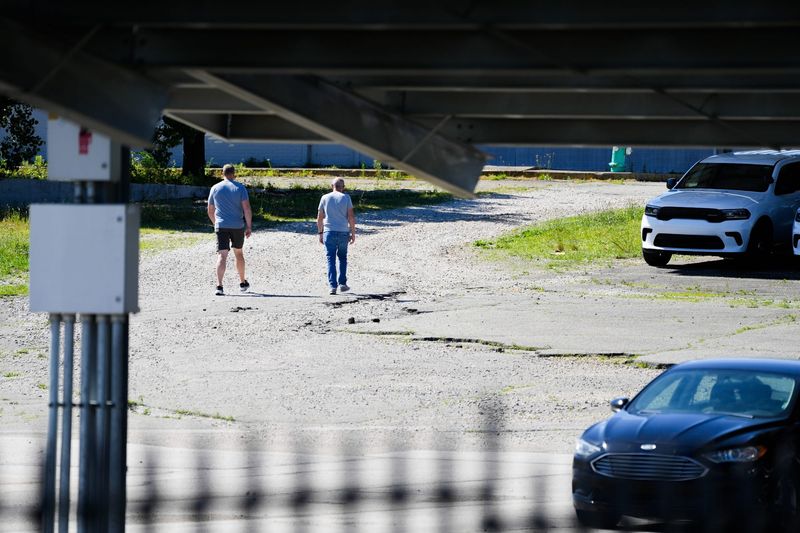
Clean energy on the site helps the electricity bill a tad. During the Obama administration, Carroll installed several rows of solar panels in his parking lot through a 40% rebate in 2015. Those panels produce a maximum output of 4 MW per hour.
Carroll pays about $20,000 a year in personal property taxes, a bill he said that “aggravates him just a tickle.”
“I have a real low opinion of working with the government, so I never asked for any tax abatement,” he said.
(City records show Lifeline was offered a more than $200,000 tax abatement in 2008 but never took it.)
Warren Township School District Superintendent Tim Hanson joined the tour out of curiosity. One positive he saw in the center: repurposing an old mall that might otherwise have sat empty.
Hanson said he’s not sure how he feels about more data centers. The school district, the second-largest employer in the area, could benefit from the flow of more property tax dollars. However, generous tax incentives could detract from that pot of money.
Moving toward a future like the Jetsons or the Terminator?
With trillions of dollars going toward data centers, Carvão sees two possibilities for the future: the artificial intelligence bubble could burst, leaving behind massive investment and broken promises. Or, the bubble could deflate and plateau over time.
“If a deflation starts, there will be winners and losers,” Carvão said. “I would expect them to finish their projects, but it’s likely that there will be projects that will be abandoned.”
Carroll said he shares concerns that the data center buildout is happening too rapidly without enough protection.
Yet, data centers are “perfect” for brownfield locations, he said. The centers also help the country stay ahead of China in the data center battles for its national security, he added.
“We love our life in America. We need data centers,” he says.
Near the end of the tour, Irvington Community Council member Dawn Cox Briggs asks Carroll, “Do you think we should be as mad at them as we are?”
“Yes and no,” he says.
Two months later, Briggs and fellow Community Council member Sue Beecher led the staunch opposition against the DC BLOX data center’s proposal to move into the area.
IndyStar City Hall Reporter Jordan Smith contributed to this report.
Alysa Guffey writes business and development stories for IndyStar. Contact her at alysa.guffey@indystar.com.
This article originally appeared on Indianapolis Star: As debates rage nearby, IndyStar toured longtime Eastgate data center
Reporting by Alysa Guffey, Indianapolis Star / Indianapolis Star
USA TODAY Network via Reuters Connect

By Alysa Guffey, Indianapolis Star | USA TODAY Network