APPLE CREEK — In today’s game of baseball, two trends have become as widespread as the sport itself: exit velocity and launch angle.
At the major league baseball level — and quickly shifting towards the college, minor league and high school levels — those two directions are at the core of what many teams now center their strategy around when stepping into the batter’s box.

Launch angle, in how high and deep you hit the baseball in the air, and exit velocity, which spotlights how hard (miles per hour) a batter hits the ball after making contact. The two are directly linked to each other and with baseball analytics taking over more than ever, the outcome most teams are looking for are home runs, which would require a more upward swing at what is said to be between a 25-30 degree launch angle.
For the Waynedale Golden Bears, the recently crowned OHSAA Division V state champions — its fourth state title in five years — their work at the plate during their 30-3 season was geared more towards keeping things as straight forward as possible.
Line drive hitting
Waynedale head coach Lucas Daugherty is fully aware of the exit velocity and launch angle presence that’s in baseball today, but that’s not how his team goes about their thinking.
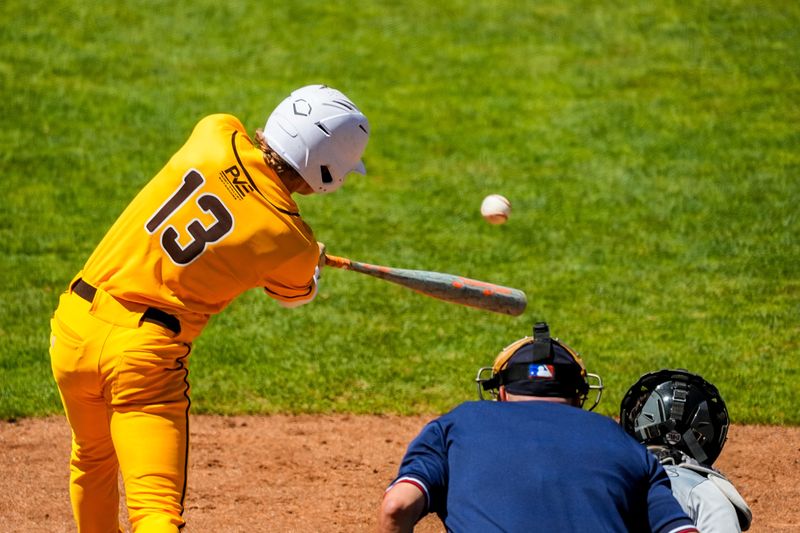
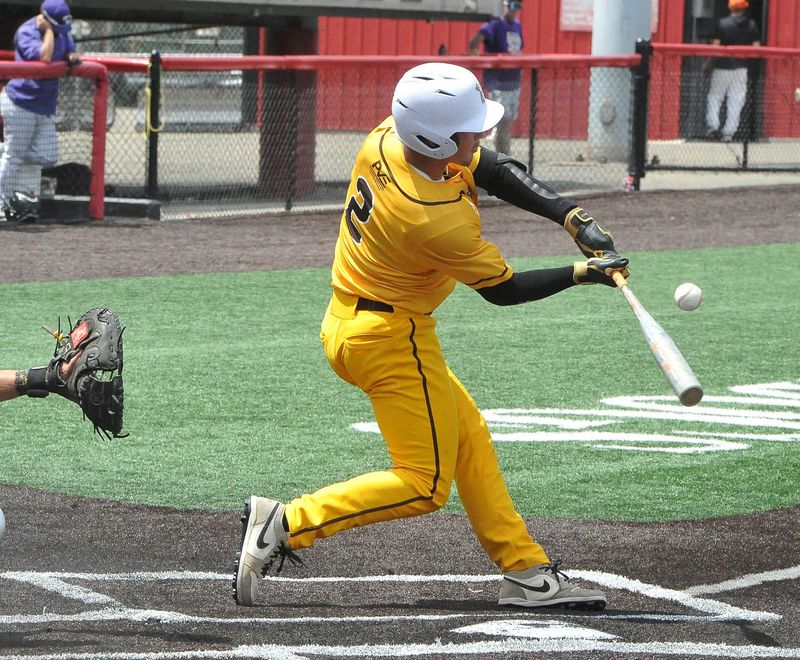
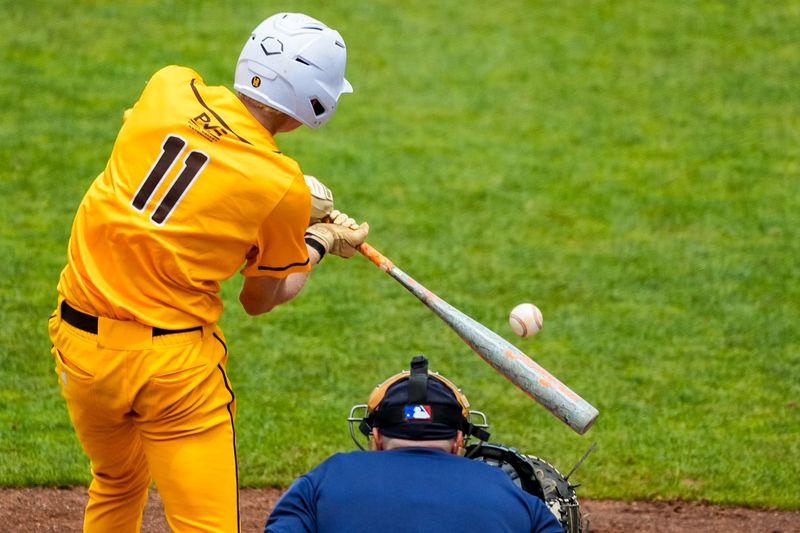
“It’s definitely a popular thing in college and pro baseball. It’s something a lot of players see and want to emulate, but to be honest, we try to get them to do the opposite,” he said. “High school baseball is about being consistent hitting the ball hard with hard line drives up the middle and hard on the ground. We really try to stay more line drives and groundballs, and let accidents be the one that get more driven in the air.”
“As far as our approach at the plate, a lot of what we focus on is hitting the ball on the line and on the ground,” Waynedale center fielder Hudson Barkman said. “That’s definitely been an emphasis when we’re in the cages.”
“Coach [Hayden] Mobley teaches us that. We try to hit line drives and groundballs. If you miss it a little bit up, that’s when line drives and home runs start coming,” said Waynedale shortstop/pitcher Jordan Miller, who described his team’s line drive swing approach as “Short two. Long through.”
To hold that line drive approach the Golden Bears are aiming for, certain hitting mechanics come into play.
“We’re very consistent with the hitting routine we do,” Daugherty explained. “Off the tee. A little bit of front toss. A consistent batpath. We’re really trying to drive the ball up the middle, hard on the line.”
“Use the tee. Low and outside. Focusing on hitting the back net and not settling for anything else,” Waynedale third baseman/pitcher Brayden Steiner said on the work his teammates do in their hitting facility.
“Our hitting coach always says, “Homeruns are accidents,'” said Barkman, a Wayne County Athletic League Second Teamer. “Hard on the line and on the ground. Whenever you miss the ball, that’s when you get your bombs. Stay backside and trust your hands. That’s what’s helped us limit those pop-ups.”
With more and more major league teams leaning more into hitting the baseball hard and far in the air, it’s in many ways a home run boom or bust approach. So in this instance, fly balls and pop-ups can be seen as a good thing as it demonstrates that the ball is flying in the air and on the right track, even if it doesn’t go over the fence.
How the Golden Bears look at it, fly balls and pop-ups are no good.
“If it’s deep when there are runners on, then no,” said Miller when asked if he felt fly balls or balls hit in the air are bad. “We will occasionally miss it, which is fine, but pop-ups in the field are absolutely a no-no. We want it on the ground rather than up top.”
Do you ever focus on how high or how hard you’re hitting the baseball?
“Hard, yes. We never do high,” Miller explained, a Division V Northeast District and WCAL First Team performer. “We do not elevate the ball because when you elevate the ball, bad things happen. Pop-ups, fly-outs are no good in baseball.”
Keeping it simple
When it comes to Waynedale tracking any kind of baseball data — which has become the norm within baseball departments tracking information on analysis, player development and on-field performance across all levels — Daugherty says for his team, it’s more about sticking to the basics.
“I think some of that is really cool. Some of of our guys in the offseason will go to a showcase where they will track that data,” he said. “In terms of a high school season, it’s just an additional piece of information. For me, it can be a hard addition to filter through and have players focus on. We try to simplify things as much as we can.”
That thought of simplification has worked in Waynedale’s favor. Offensively, going through Waynedale’s lineup 1-9, they’ve shown the ability to make hard contact going up the middle, opposite field and pullside — along with that relentlessness to keep it up whether they’re winning by five runs or trailing late — that made them arguably Ohio’s most dangerous lineup in Division V.
Through 33 games, Waynedale scored 245 runs, while conceding just 68 for an impressive +177 run differential. In 10 of those games, the Golden Bears scored 10 runs or more.
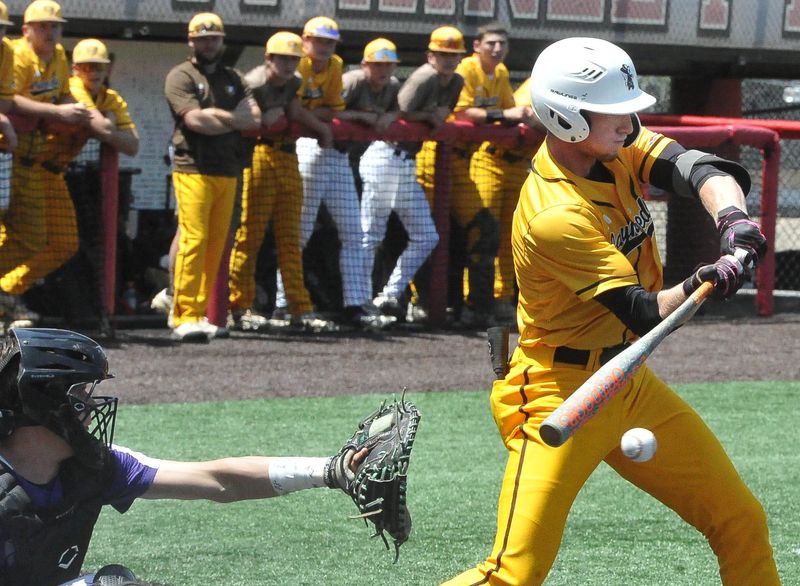
And the Golden Bears have a penchant for not hitting into many groundouts or double plays. A good solution for that they say is laying down bunts.
“I think a part of that is anytime we have a runner on first, we bunt a lot,” Miller said.
“With runners on base, the hitting approach changes a little bit. A lot of times when teams do get themselves in trouble with double play balls, they’re pulling the ball on the ground,” Daugherty said. “So pulling the ball to the third baseman or shortstop, that’s when you see the double plays happen. With runners on, we try to live middle backside or middle oppo [opposite]. It helps move runners over with hitting into double plays, so we focus on executing bunts. That can help keep us out of double play situations.”
Another reason Daugherty preaches line drive hitting to his players is that many high schools are implementing turf baseball fields across the country — with most of the playing surface covered in artificial grass and requires less maintenance — whereas a well-hit ball will flow through turf fields faster than on natural grass.
“We focus on hard line drives up the middle on the ground, especially when you’re playing on turf fields,” Daugherty said. “The groundballs are more likely to get through than a pop fly.”
“We know we can get away with it a little more on turf, especially with a real hard barrel,” said Steiner, who was named to the Division V All-Ohio, Northeast District and WCAL First Teams. “It definitely can get through easier on turf than on grass.”
Coming off four state titles in five years, Waynedale’s line drive hitting approach seems to be working just fine.
jamessimpson@gannett.com
Twitter/X: @JamesSimpson II
This article originally appeared on The Daily Record: Inside Division V state champion Waynedale’s line drive hitting approach
Reporting by James Simpson II, Wooster Daily Record / The Daily Record
USA TODAY Network via Reuters Connect
By James Simpson II, Wooster Daily Record | USA TODAY Network