

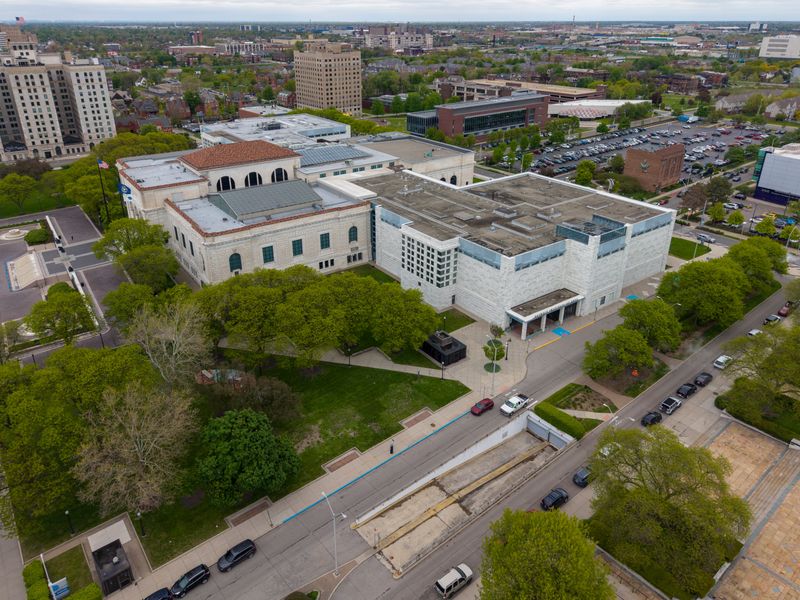
Detroit — A derelict underground parking garage next to the Detroit Institute of Arts has become a roadblock to redesigning 10 blocks of the city’s cultural district into a unified public space.
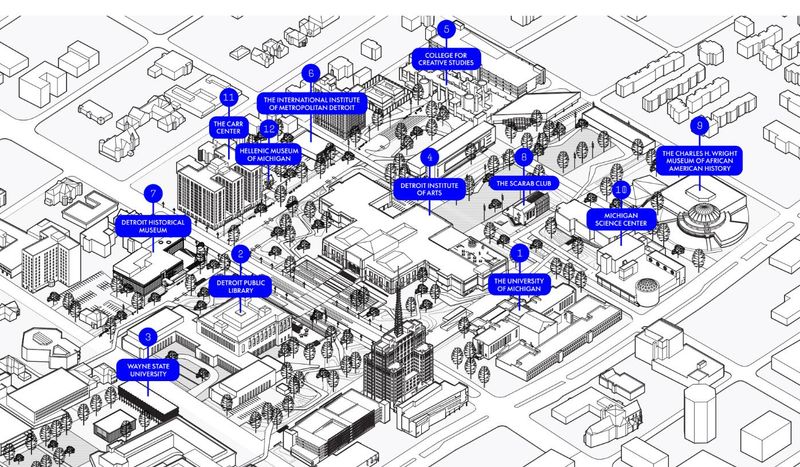
Officials unveiled a plan eight years ago called the Cultural Center Planning Initiative, aiming to transform 83 acres of streets in Detroit’s culturally rich Midtown area and open spaces around a dozen of the city’s art, cultural and educational institutions into a connected campus. The plan would link the DIA, Wayne State University, the Michigan Science Center, the College for Creative Studies, the Scarab Club and the Charles H. Wright Museum of African American History.

But the problem is the DIA’s closed parking structure on Farnsworth between Woodward Avenue and John R Street. It’s been shuttered since 2011 after the city deemed it too dangerous to use, and officials said it would cost an estimated $49 million to fix.
That’s more than half of the original estimate for the development plan, which has received international and local acclaim.
“It seems kind of unbelievable, but renovating the garage is the cornerstone for the entire … initiative,” said Elliott Broom, the DIA’s chief operating officer, during a Detroit City Council budget hearing earlier this year.
The cultural campus plan was publicly unveiled in 2018 by the nonprofit Midtown Detroit Inc., along with the participating institutions. At the time, organizers said it could take up to 15 years to achieve, and early cost estimates for the project were between $75 million and $85 million. The effort to raise money through philanthropic foundations and other sources was already underway when the project was first announced.
The concept received widespread praise from the community during public meetings around 2019 because it made the area more walkable and converted some public space into meeting and performance areas. The organizations involved contended that the plan will draw even more visitors to the area and increase the number of people who will visit multiple cultural institutions in one trip.
“While we are all in the same district, we aren’t necessarily as well-connected as we could be,” said Broom during the council hearing.
He referenced a similar initiative in Chicago to “better connect” museums and other cultural institutions, partly by changing the public spaces around them so visitors “could make their way more easily from institution to institution.”
In June 2019, an ad-hoc team of architects and landscape designers, comprised of firms from Paris, Stuttgart, Germany, Los Angeles, Ann Arbor and Detroit won the international competition to “reimagine Detroit’s cultural district,” as organizers described the effort. The contest attracted 44 entries from at least 10 countries.
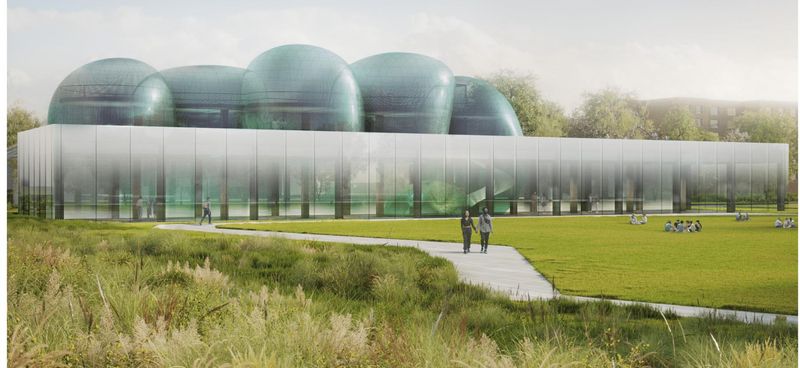
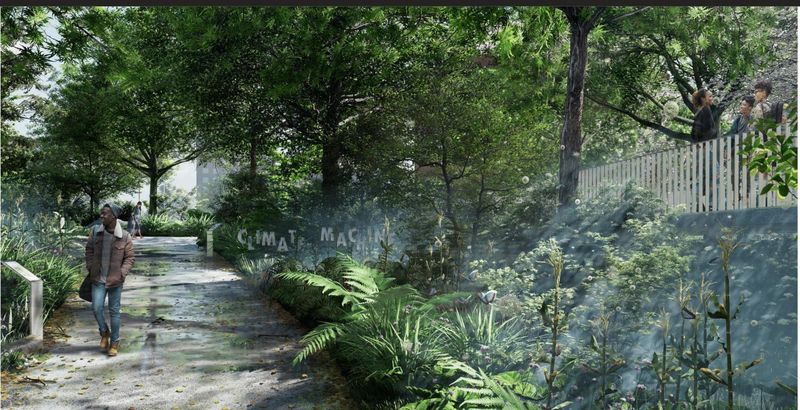
The design called “Detroit Square” envisions shrinking the number of traffic lanes on Woodward Avenue between the DIA and the main Detroit Public Library, converting other streets into occasional pedestrian-only areas, adding plenty of green space, building several outdoor cafés and outdoor performance venues.
In 2024, the Detroit Square concept won an international design competition held in part at the Guggenheim Museum Bilbao in Spain. The jury described the Detroit project as “ambitious, holistic and transformational.”
Why the underground garage is the linchpin to Detroit’s cultural district redesign
DIA officials have described a much more nuts-and-bolts challenge to the plan for the past two years: the cost of fixing the underground garage. The art museum took ownership of the blighted property from the city of Detroit in 2015 as a result of the city’s bankruptcy. The garage was closed in 2011 after the city declared it unsafe. The structure first opened in 1965.
The underground garage, which has around 250 parking spaces, is vital because it would replace the area’s largest parking lot, a 411-space surface lot on John R. The Detroit Square plan aims to convert that surface lot into a key open space.
“We can’t take away that parking, because that is the single largest area for parking … in the district without having a place for people to park if that goes away,” Broom told the City Council in March. “So that is why, if we can ultimately raise the funds to rebuild this garage, then we can begin transforming the rest of the spaces in the district.”
Early projections of the plan intended to have the underground garage situation resolved by now.
Raising money to fix the garage isn’t a new dilemma. Broom and other DIA officials told the City Council about the challenge during its 2025 budget hearing. The only thing that changed this year was the price.
In 2025, the estimated cost to fix the garage was around $35 million. The new estimate is now $49 million, DIA officials told council members. DIA officials didn’t explain why the price has jumped, but nationally and locally, construction and other development-related costs have risen as much as 25% recently due to the U.S.-Iran conflict and other national policies. The new estimate is more than half, about 58%, of the original high-end estimate of $85 million given in 2019 for the entire cultural campus plan.
Two years ago, DIA officials said it had raised around $17 million for the garage repair. Officials didn’t give a new funding amount this year.
Midtown Detroit Inc. received $12 million in state grant funding as part of the state’s 2024 fiscal year budget. Midtown Detroit said the state grant would help fund the $33 million initial phase of the plan, including the beginning work on the shuttered underground garage.
Long-term version to create a cultural campus
Many of the 12 institutions involved in the project declined to comment about the plan to link the cultural center area into one campus, referring questions to a nonprofit now leading the effort. Detroit Mayor Mary Sheffield’s office also declined to comment.
The institutions included in the initiative are the DIA, Wayne State University, the Detroit Public Library, the Detroit Historical Museum, the Charles H. Wright Museum of African American History, the College for Creative Studies, the Michigan Science Center, the Scarab Club, the International Institute of Metropolitan Detroit, the University of Michigan’s Horace H. Education Memorial Building and the Hellenic Museum of Michigan and The Carr Center.
The overall cultural campus plan has raised more than $29 million, said Annemarie Borucki, interim executive director of the nonprofit Detroit Cultural Center Association. The group formed in March 2024 to help advance the district-wide vision and related projects, including the cultural campus plan.
The $29 million “has supported master planning, engineering and design work, public Wi-Fi, district lighting, cultural programming, economic impact and visitation analysis,… and planning related to future capital projects, including the underground parking deck,” Borucki wrote in an email to The News.
“The underground parking deck is an important enabling project, but it is not the full story of the Cultural Center Planning Initiative,” Borucki wrote. The group continues “to work with Cultural Center institutions, public partners, and funders on the long-term vision for the district.”
The plan “was always intended to be a long-term, multi-phase vision for the district,” Borucki wrote. “A 15-year horizon remains a reasonable framework for understanding the scale of the work, but implementation will depend on funding, project sequencing, institutional coordination, public approvals, and construction readiness.”
Borucki added that the nonprofit is compiling data on the economic impact and visitation data of the cultural center to bolster its case for funding. The data “will provide stronger context for understanding the significance of the district and the long-term importance of this work,” she wrote.
laguilar@detroitnews.com
This article originally appeared on The Detroit News: Derelict parking garage delays revamp of Detroit’s cultural district
Reporting by Louis Aguilar, The Detroit News / The Detroit News
USA TODAY Network via Reuters Connect
By Louis Aguilar, The Detroit News | USA TODAY Network
