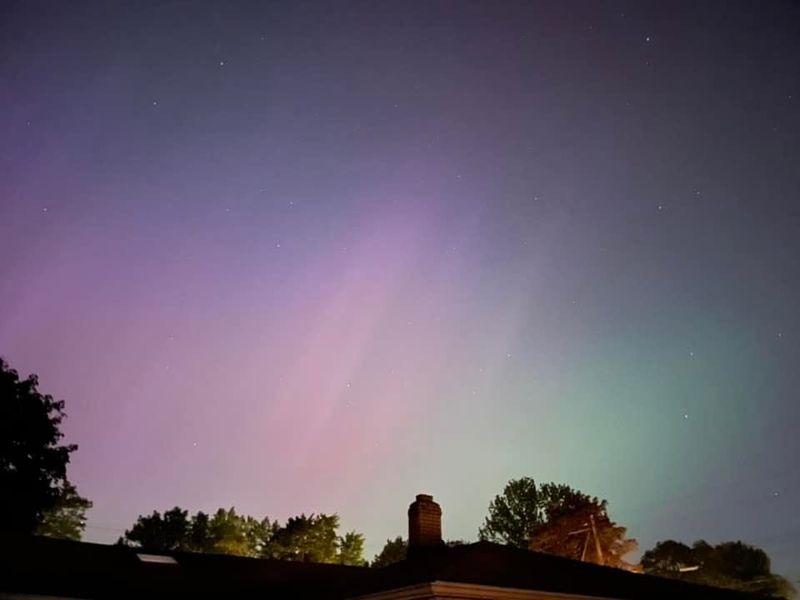
Solar storms that have fired up the northern lights recently may bring the show back to the United States and Ohio tonight, June 8.
The Space Weather Prediction Center has issued a geomagnetic storm watch for June 8 and 9. That’s when a coronal mass ejection, plasma and other solar material that erupted from the sun, is expected hit the Earth’s magnetic field. The storm tonight, June 8, is anticipated to be a level 3 out of 5, which may disrupt power systems and radio waves in places, and may push the northern lights into the United States. On Tuesday, June 9, the storm is expected to lessen to a level 2 of 5 as the CME’s passage continues.

Will the aurora borealis bring its glow to the Buckeye State? Here’s what to know.
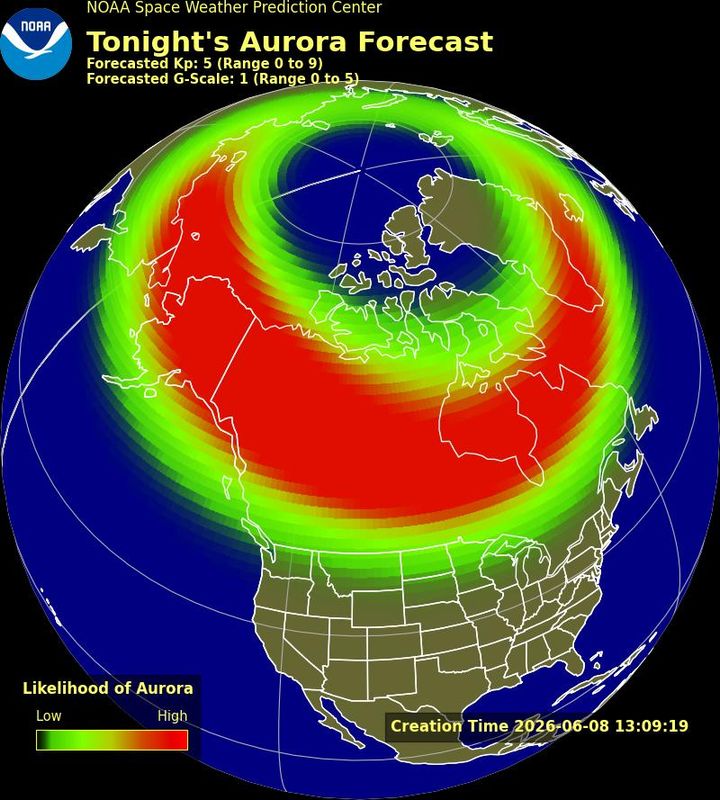
NOAA aurora dashboard forecast
The northern lights might be visible as far south as Lake Michigan tonight, June 8, according to the aurora viewline forecast from the National Oceanic and Atmospheric Administration. And that’s if the storm continues at a level G3. If it strengthens, the aurora could push farther south into Ohio. A G3 storm can push the northern lights as far south as Illinois and Oregon, according to NOAA scales. A G2 storm may bring the lights into New York and Idaho.
Will the weather cooperate if the northern lights are in Ohio tonight? Akron, Columbus, Cincinnati forecast
If the solar storm overnight is strong enough to bring the northern lights to Ohio, will the weather let Ohioans see the show?
Maybe.
The National Weather Service forecast in Akron calls for mostly cloudy skies with a slight chance of thunderstorms tonight, June 8. The forecast in Columbus calls for showers and thunderstorms skies. And showers and storms are also in the forecast tonight over Cincinnati, per the NWS.
What are the northern lights? What causes the aurora borealis?
Auroras are ribbons of light weaving across Earth’s northern or southern polar regions, according to NASA. They are caused by magnetic storms triggered by solar activity, such as solar flares or coronal mass ejections. Energetic charged particles from these events are carried away from the sun by the solar wind.
These energized particles hit the atmosphere at 45 million mph and are redirected to the poles by the Earth’s magnetic field, according to Space.com, creating the light show in the sky.
During major geomagnetic storms, the aurora expand away from the poles and can be seen over some parts of the United States, according to the NOAA.
What is a coronal mass ejection?
NASA describes coronal mass ejections as “huge bubbles of coronal plasma threaded by intense magnetic field lines that are ejected from the sun over the course of several hours.” The Akron Beacon Journal reports that the space agency says they often look like “huge, twisted rope” and can occur with solar flares, or explosions on the sun’s surface.
What are geomagnetic storms?
According to the NOAA, geomagnetic storms are disturbances in the Earth’s magnetic field caused by the energy carried along the solar wind. That energy gets transferred to the Earth’s magnetosphere, changing its currents, plasmas and fields and energizing the northern lights. The largest of these storms are caused when coronal mass ejections occur.
How to photograph the northern lights
If you’re looking to photograph the aurora, National Geographic has some advice.
The publication recommends using a tripod to keep the camera stable. Shooting at night means keeping the camera shutter open longer. That could create a blurry image if the camera is bumped or not held steady. Also, use a wide-angle lens to capture as much of the sky as possible. And, don’t just take a photo of the sky. Compose a better photograph by getting the horizon, or a tree or building, into the image with the aurora.
If you’re using a smartphone, the article still recommends a tripod. Use a remote or set the camera’s timer so you won’t have to tap the screen to take a photo. Also, turn off the flash and set the camera to night mode.
Why are the northern lights so active and showing up in Ohio?
While there’s no guarantee where the northern lights will be seen in the United States, the potential is there for them to visit to Ohio.
The sun hit its solar maximum in October 2024, meaning it is at its most active for sunspots that generate those solar storms. NASA reports that the sun was expected be at its maximum for a year. After that, solar storms will decrease and take the aurora with them.
Still, the aurora borealis can be forecast with a certain degree of accuracy. And that’s the job of the Space Weather Prediction Center. The center monitors sunspots, solar flares and plasma emissions called coronal mass ejections that could impact the electrical grid, communication, satellites and more. It also announces when these solar storms could energize the aurora, pushing it out of its arctic home and into the United States. Due to the travel time of these storms from the sun to the Earth, the center’s forecasts come with a day or two of advance notice.
This article originally appeared on Akron Beacon Journal: Northern lights could reach Ohio tonight. Will weather cooperate?
Reporting by Chad Murphy, USA TODAY NETWORK / Akron Beacon Journal
USA TODAY Network via Reuters Connect
By Chad Murphy, USA TODAY NETWORK | USA TODAY Network