You might be surprised how far back Cincinnati’s LGBTQ+ history goes.
“Before baseball was invented in this country, there were drag queens traipsing across the stage,” historian Jacob Hogue told The Enquirer.

Even in staid, conservative Cincinnati.
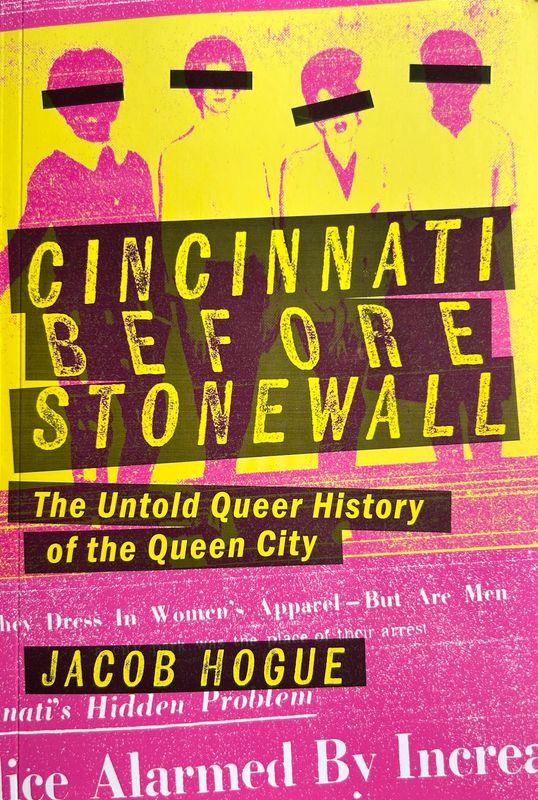
Hogue’s new book, “Cincinnati Before Stonewall: The Untold Queer History of the Queen City,” is an important work helping to attain a fuller picture of our city’s past.
Some examples. Cross-dressing in public rather in a performance was common enough in Cincinnati in the 1880s for the Commercial Gazette to say it was “getting epidemic.”
Max Fleischmann of Fleischmann’s Yeast, also a noted hunter and aviator, performed an equestrian circus act in drag for the society circus in 1897.
Julius Dexter, a civic leader and member of a prominent Cincinnati family, lived with his close male friend, Eugene Bliss, for 34 years, prompting their society friends to call them “Mr. and Mrs. Dexter.”
“Cincinnati does stand out in its Paris of America days,” Hogue said, referring to when the city was a boomtown and fancied itself a cultural mecca in the late 19th century. “I do believe that there was a strange amount of queerness happening in Cincinnati in that time.”
Hogue had planned to do a podcast about the LGBTQ+ history of Cincinnati as a project for his master’s degree in public history from Northern Kentucky University, but he found just one book on the subject.
“LGBTQ Cincinnati” by Ken Schneck covers the history starting from the 1970s. Hogue wanted to find out about the gay people who came before the Stonewall Riots of 1969 galvanized gay activism.
“I wanted to find references to homosexuality in the 19th century, before they even really had a name for what they were calling it,” he said.
‘She’s flagrantly violating … the gender norms of the day’
It doesn’t take much reading between the lines to find stories, if you know where to look. Hogue spent more than four years researching newspaper articles, diaries, medical records and oral histories.
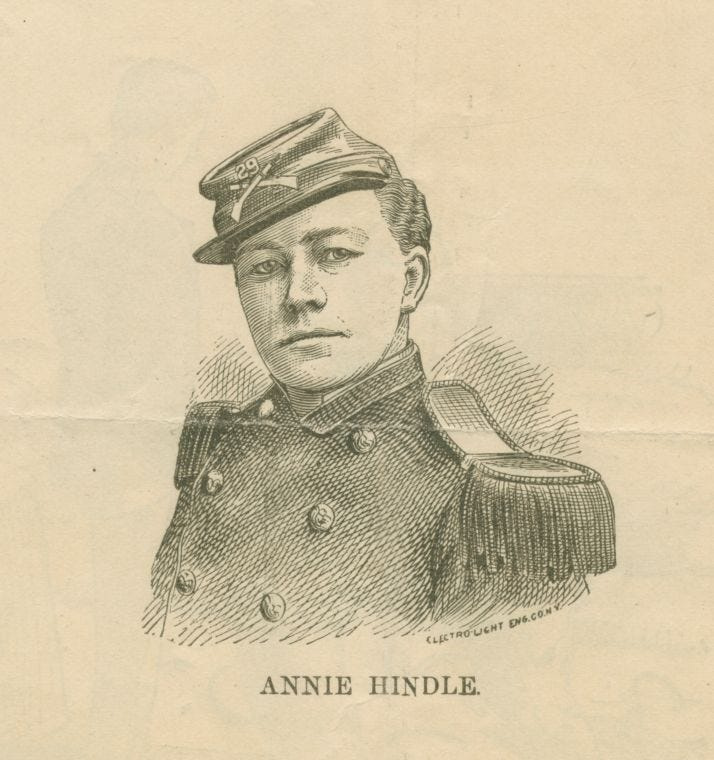
Hogue said one of the first Cincinnati stories he found was of Annie Hindle, a famous male impersonator on the vaudeville stage who “carried the impersonation beyond the footlights,” The Enquirer noted in 1897. Hindle assumed the name Charles, shaved to develop stubble and married several women.
“Once I found that story, I was like, ‘wow,” Hogue said.
“She’s flagrantly violating not only the gender norms of the day, but the law by marrying women, and nothing’s ever done to her. She’s never arrested.”
Was Hinkle a male impersonator? Transgender? Should we even apply modern terminology?
“There’s a huge ethical debate in academic circles about whether that should be done or not,” Hogue said. “Because on one hand, you risk erasing the validity of trans people, for example, who were living in Cincinnati in the 1800s. But can we really call them a name that they wouldn’t have called themselves?”
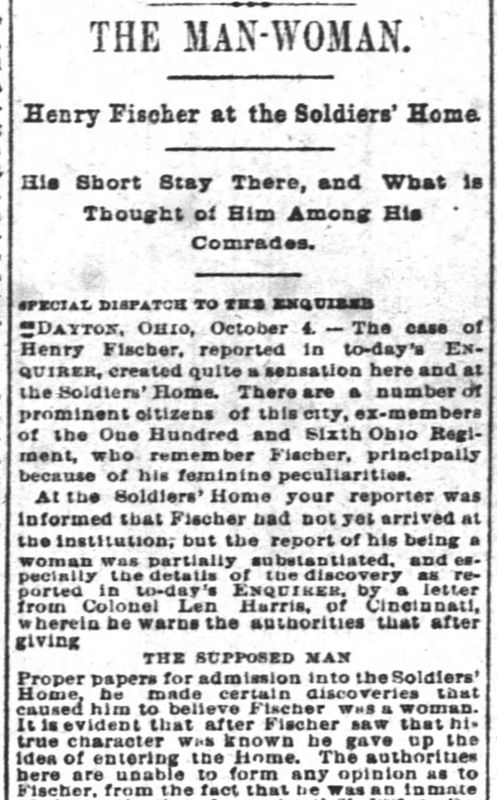
Henry Fischer, who served in the 106th Ohio Volunteer Infantry during the Civil War, was later denied refuge in a Dayton veteran’s home when he was revealed to be a woman – or perhaps intersex.
The Enquirer described Fischer as “half male and half female” with fully developed female organs, sensationalized as “The Man-Woman.”
Reporters of the day didn’t have the vocabulary to describe queer identities, and they risked violating the Comstock anti-obscenity laws. When writing about homosexuality, they wrote things like “nameless act” or “too loathsome and obnoxious to print.”
“There was no way to actually talk about two men meeting and falling in love,” Hogue said. “So, there was kind of a literary rule: In order for gay people to be introduced to mainstream society, their story had to be accompanied by a bad ending, a warning against the act.”
Such as Isadore Frauenthal and Ernest Salinger, two Hebrew Union College students in love. They both later died by suicide.
“The story of Salinger and Frauenthal could only be framed as a tragedy – a cautionary tale ensuring its acceptance in Victorian society,” Hogue wrote in the book.
There is far more to Cincinnati’s LGBTQ+ history than crime stories and suicides.
“I also wanted to show that queer people quite literally helped build the city that we love today,” Hogue said. “They helped shape its modern metropolitan identity in ways that we’re only now beginning to uncover.”
This article originally appeared on Cincinnati Enquirer: 19th century Cincinnati had ‘strange amount of queerness’
Reporting by Jeff Suess, Cincinnati Enquirer / Cincinnati Enquirer
USA TODAY Network via Reuters Connect
By Jeff Suess, Cincinnati Enquirer | USA TODAY Network