Seventy-eight middle school students and their teachers at Bloomington’s Project School have much to celebrate as their school year nears an end — their last day is June 10.
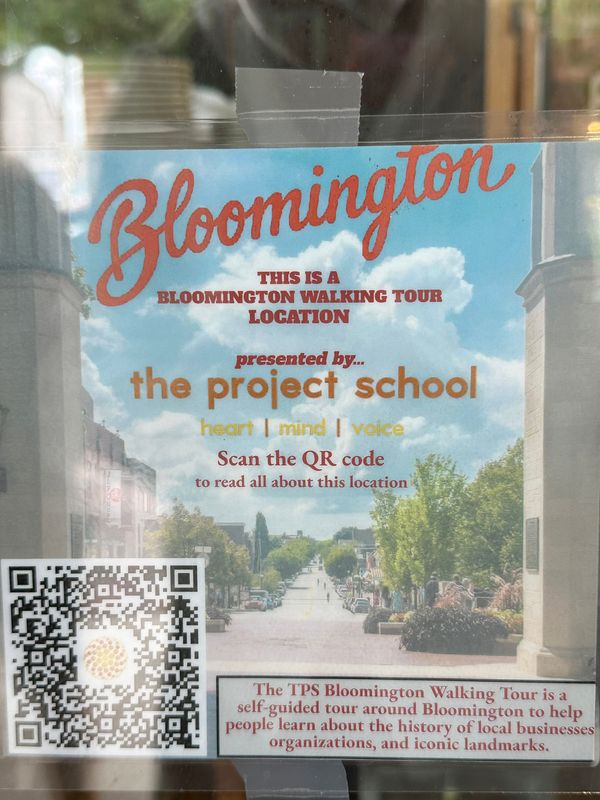
Together they created a self-guided walking tour with 57 downtown Bloomington locations. They’ve walked the area, researched each site, chosen sites that are historic or important, mapped them, interviewed business owners and designed posters with QR codes linking the sites. Each business or site has received a walking tour poster with a QR code to display, sharing information about that location.

Each year the Project School bases its studies around a compelling and generative topic. This year the theme was interdependence.
Catherine Diersing, school superintendent, explained the origin of the Project School was based on “creating projects that have impact on the community where we live and serve.” The year-long theme helps foster that ideal each year.
“Kids feel very empowered by this,” she said, adding the middle school project was student-created, with them determining which sites were included. And it was students who reached out to query if a site or business would allow them to include them on the tour.
Putting the project into action
Tim Mattingly, one of the middle school teachers, came up with the project idea last summer while at Brown County State Park. He was using a brochure explaining what he was seeing at each stop while hiking the trail.
“It’s so much more fun than a normal hike,” Mattingly said. “I thought, could we do something like this? Project School is in the heart of downtown. How would we make it work?”
Mattingly’s idea jelled with the students and other teachers. Together they determined with of the myriad downtown locations were most important either historically or to the community. In the end, there were 57 sites chosen, all of them available by scanning the QR code, going to the interactive map (https://tinyurl.com/4ty2v97c) or searching the online walking tour home page, https://tinyurl.com/4caw3ap6.
The students emailed local business owners to gather information and were excited to receive responses — many positive responses, Mattingly said.
“I think out of the 60 businesses and locations we emailed, we received 50 responses. It was really a heartwarming display of kindness from our local business owners and townsfolk.”
Besides establishing which sites would be included, the project was embedded into the classroom lessons throughout the year. Luis Silva teaches history at the school and said his students studied the history of the buildings and people, both current and past. “I taught about the indigenous people who were here before,” he said.
“The students took the lead in so much of this we were just the guides for this,” Mattingly said. “What’s so special to me about this is it’s so authentic. It has a real actual audience and a real actual purpose out in the real world.” Even without the academic components, Mattingly said it’s given the students and teachers “a sense of all the people in their community.”
Again, Mattingly talked of the business owners and community members who interacted with the students. “They took so much time out of their day to give (the students) research for the project. That was just so cool for me.”
The inaugural walk
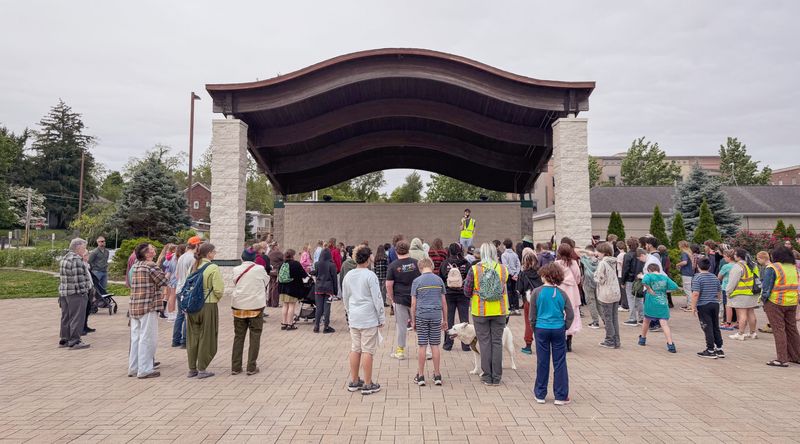
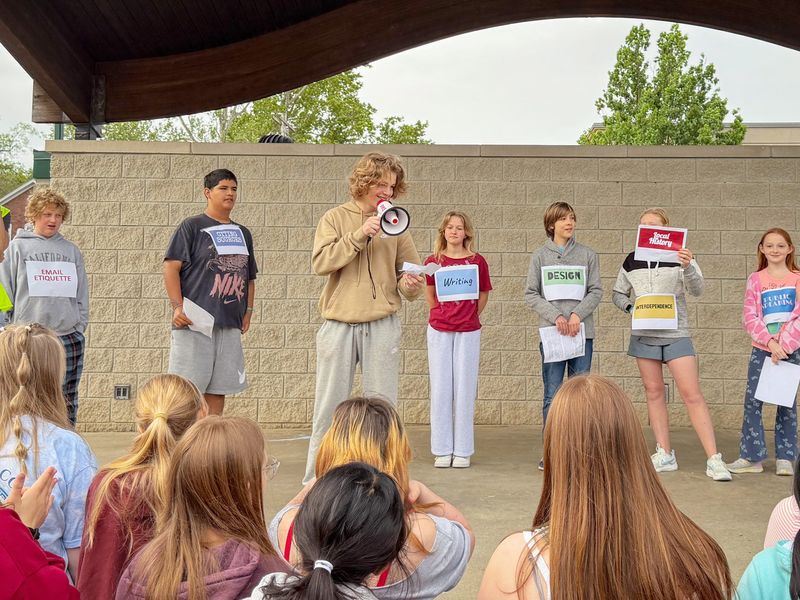
On May 21, all the middle school students, teachers and some parents and administrators met at the pavilion in Waldron, Hill and Buskirk Park in the morning. First, a small group of the students talked on stage about the various aspects included in the project: skills, email etiquette, online research, writing, citing sources, design, history of Bloomington, public speaking and interdependence.
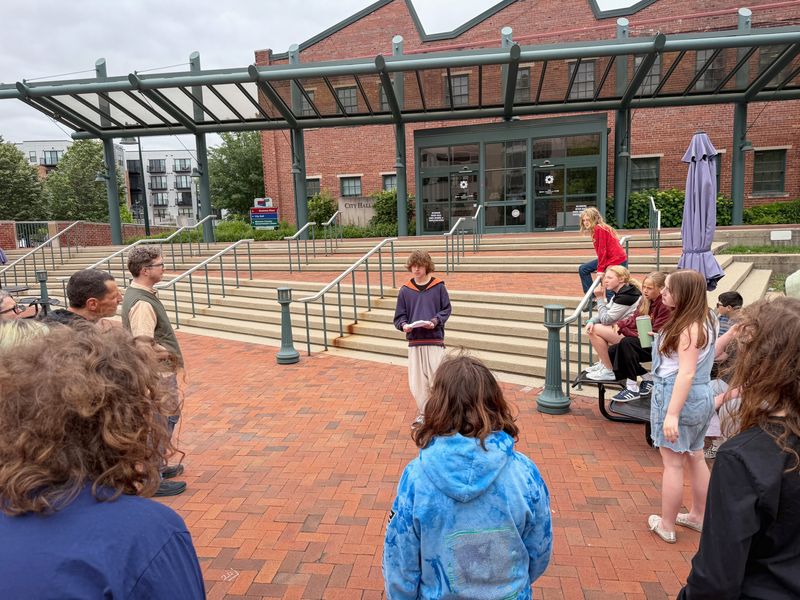
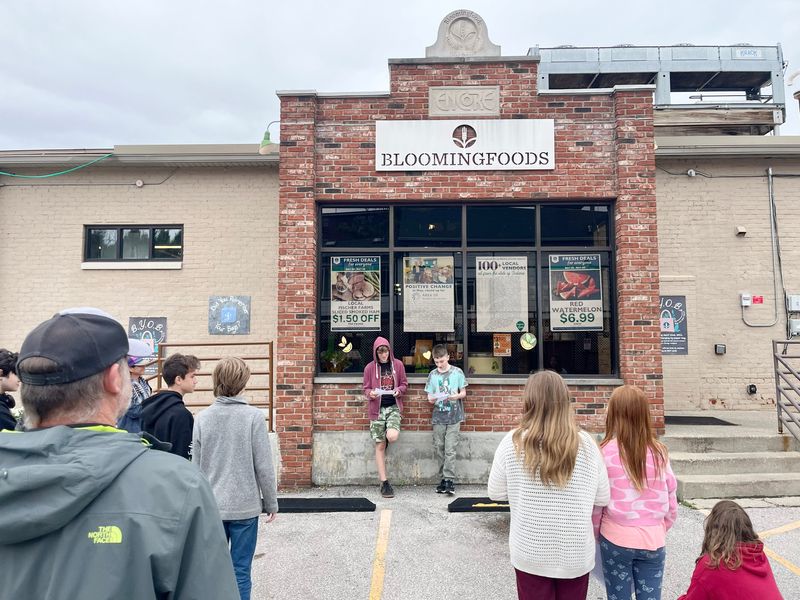
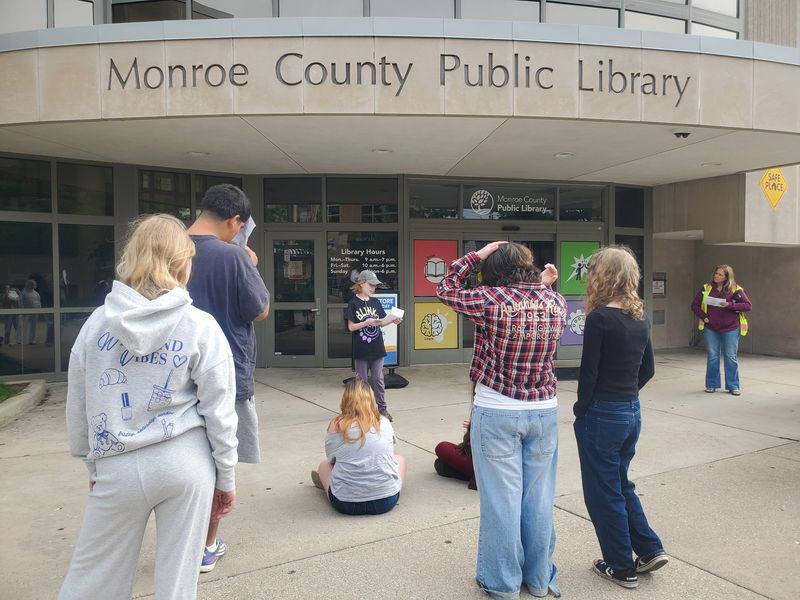
Breaking up in to six groups of about 12 to 15 students each, the groups walked through downtown, stopping at the chosen sites to have a student explain its history and role in the community.
On that day about 30 of the 57 locations had the poster with the QR code displayed in a window or door for people to see. More sites were expected to add the posters afterward.
“The QR code posters are intended to remain on display for the foreseeable future, the goal being that the Walking Tour is a permanent way for people to connect with this wonderful city,” said Mattingly.
Thoughts about the project
Four students took time one Wednesday after the inaugural walk to talk about the project.
Sixth grader Ayin Reichmann-Antes said the project changed his mind. Before he’d taken his community for granted. “Bloomington is so big and has so many companies, with such history. Bloomington is special,” he said, adding he needs to explore more of it. The project showcases the different parts that make Bloomington “special from other towns,” he said.
Ayin’s site was BuffaLouie’s. “I kind of know that the building is super old and knew it would have a history,” stating that it was “cool” the business started in 1987 by an Indiana University college students in a 1914 building that first housed the Book Nook. “I always loved history but now we’re doing this project where we have to learn the history of Bloomington.”
Charlie Rock is an eighth grader who said students learned out many parts of the Bloomington community rely on each other. “We saw that many businesses sell their peers’ products or take ideas from them, and overall it becomes this big combined concept.” He senses the growth that the collaboration provided the businesses. His site was Trojan Horse restaurant: “I wanted to pick a spot downtown on the square.”
Charlie mentioned Jordan Davis, with Chocolate Moose, who the students used as the “test location,” learning about Chocolate Moose and asking Davis questions. “He was talking about how they don’t compete with other ice cream places in town, but they share,” Charlie said. He also wanted to thank all the people who work “long, hard hours” for the project, from teachers to the business owners who took time to answer students’ questions.
Eighth grader Emiliano Silva was interested in learning about the history of the various sites. “It shows Bloomington is a place where everyone can be together and work together,” he said. Peoples Park was his site. “I thought of it as a normal park until I looked into the history and it’s pretty crazy what happened. It wasn’t even a park at first but a store. Crazy … that store got destroyed by the Ku Klux Klan.”
Sixth grader Earl Krothe chose Bloomington Fine Arts Supply for her site. “It’s a really new business but the building has quite a lot of history,” she said. “It was Hoosier Workwear Outlet until 2021,” where the business was located since the early 1950s. “It was really cool to learn about the history.” Earl said the “project really showed the whole community,” which she called a “neat town with so much history.”
Other students provided their first names and thoughts via email. Here are a few excerpts:
Seventh graders Mena and Katie both said they liked creating the website, as did eighth-grader Lou.
Wren, eighth grade, thought the research “really was very fun.”
Savannah, seventh grade: “I respect the community a lot more because I hadn’t realized how interdependent all the businesses are with each other. I also didn’t realize how much history was behind these local businesses. When I go to these places, I now think about all the research we’ve done and things we’ve learned and it changed the vibe.”
Lou, eighth grade: This project showed me that there is a lot more history all around me. Each place on the walking tour has a rich history. I wonder what other places we didn’t cover have interesting history.”
Contact Carol Kugler at ckugler@heraldt.com.
This article originally appeared on The Herald-Times: Project School middle school students create downtown walking tour
Reporting by Carol Kugler, The Herald-Times / The Herald-Times
USA TODAY Network via Reuters Connect
By Carol Kugler, The Herald-Times | USA TODAY Network