On the third floor of the New York State Museum building in Albany one recent morning, a treasure trove of American relics usually kept hidden from public view fill a seemingly never-ending room.
Up here, the mostly darkened space is quiet and warm and you can smell the age of the rarely seen pieces in every inhale. It is an escape from the shiny white marble walls and the liveliness of the visitors exploring surrounding levels where these items may one day end up on display.

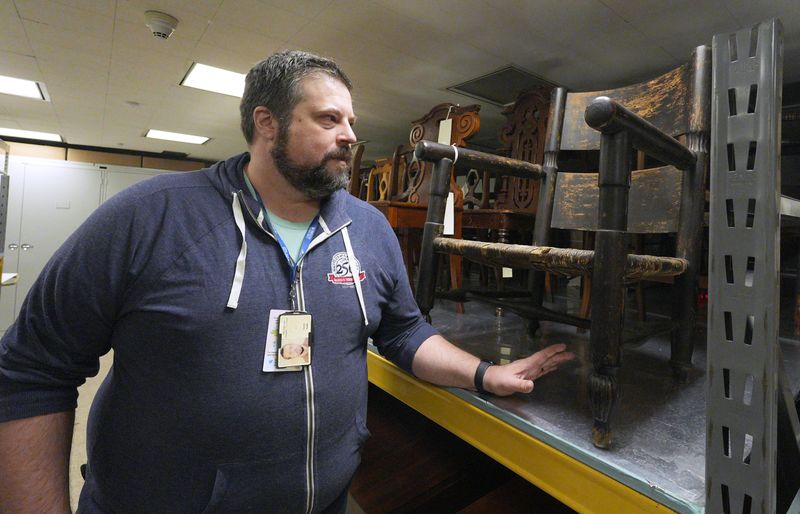
Labeled brown and blue-gray cardboard boxes line rows of metal shelving and ornate historic furniture nearly brushing the low ceiling is stacked on heartier metal racks toward the middle of the room.
At the end of one of the aisles, a battered green football helmet and tools used in the 1971 Attica prison riot are positioned neatly on the floor. Several large oxidized ice harvesting tools lie closer to the door. A few more items — chairs with ties to former New York governors — stand out.
In many ways, these carefully preserved artifacts of New York’s political and social history hold the secret story of the state’s crucial role in shaping American ideals and rights over the past 250 years.
The impact of past New York governors
A simplistic wooden chair stained dark with lighter brown swirls throughout, soft golden yellow details on the chair back and a comma-shaped platform extending from its left side probably wouldn’t catch your eye as you walked by.
The chair’s history might just grip you, though.
Originally belonging to former Gov. DeWitt Clinton, the writing desk is in great condition for being centuries old as the main sign of use can only be seen around the edges of where it opens up. Clinton was New York’s sixth governor and is known as the “Father of the Erie Canal.”
“DeWitt Clinton would probably be the one that you would have to give credit to having the biggest impact on New York state for his champion of the construction of the Erie Canal,” says New York State Museum Senior Historian and Curator of Political and Military History Aaron Noble.
“Without that construction of the canal, you don’t have the rise of New York as the Empire State. And then you could really argue that it opens the West for settlement so that has a huge impact on the nation.”
Other chairs in the space have intricate hand-painted designs, such as the blue bows on a set belonging to former Gov. Joseph Gates. Some are woven, as is a high chair with ties to former Gov. Thomas Dewey. And furniture associated with a name more familiar — Roosevelt — can be found in the form of a sturdy, well-worn wooden chair belonging to former Gov. Theodore Roosevelt’s sister.
“When it was donated, the story was that Teddy Roosevelt actually sat in this chair,” Noble said about the chair that sat in Anne Roosevelt Cowles’ house. “Family lore, but given the location of it, there’s a fairly good chance that he actually did sit in it.”
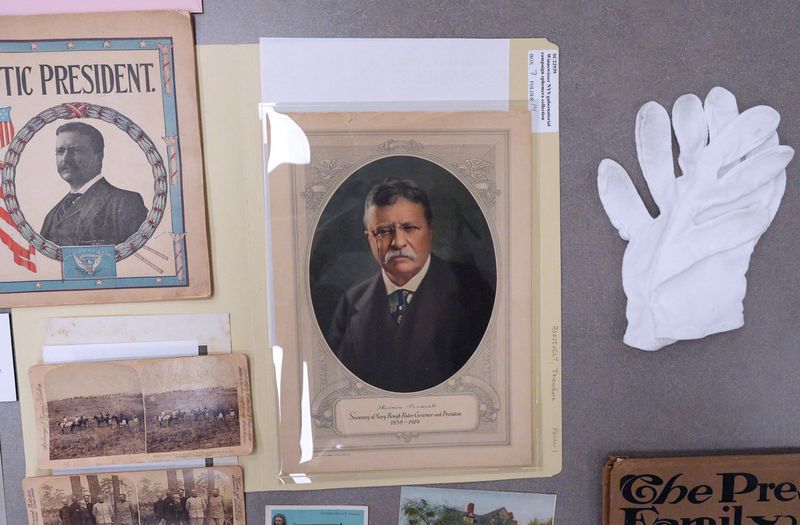
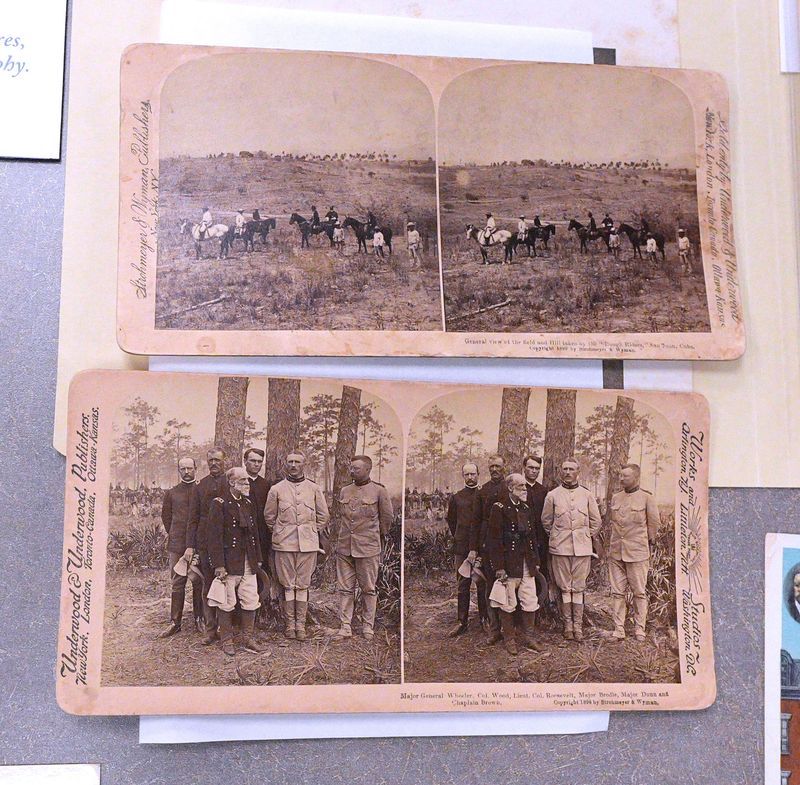
The Roosevelts, Dewey and the state’s first and longest serving governor George Clinton are all prominent figures in New York’s history. According to Noble, Theodore Roosevelt, who went on to become the 26th President of the United States, was a “dynamic figure.”
“He was that kind of prototypical kind of American at the turn of the 20th century,” Noble added. “He was very loud and boisterous, by all accounts. Very charismatic. But he really was able to capture the attention of the voters, both in New York and across the country.”
Theodore Roosevelt, the state’s 36th governor, also helped reshape the way government functions from environmental preservation to civil service reform. His cousin and the 48th governor of New York, Franklin Delano Roosevelt, was at the helm of the country through the Great Depression and Second World War as the 32nd U.S. President.
FDR’s leadership and legislation, such as Social Security, had both an immediate impact on national politics but also left a lasting legacy, Noble said. While Dewey, who served as the state’s 51st governor in the 1940s, signed New York’s Human Rights Law, making the Empire State the first to codify anti-discrimination laws.
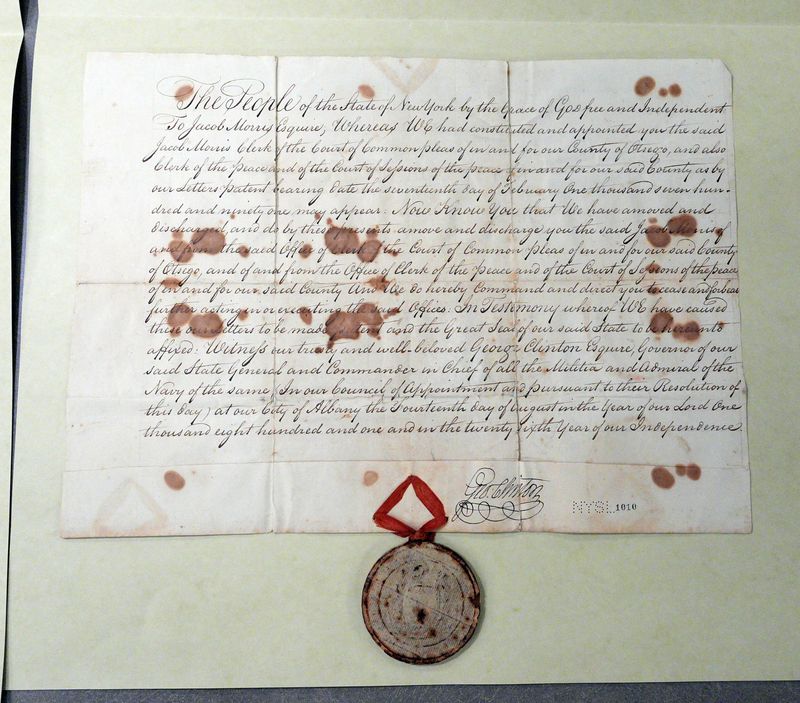
And George Clinton was “very adept at leadership,” Noble says, but was resented due to his upbringing.
“He often gets forgotten in terms of New York’s revolutionary history, but he was governor throughout the Revolutionary War,” Noble added. “He didn’t come from that kind of landed elite that we think of as our founding fathers … He was much more the champion of the common man.”
New York has led the way in civil, workers’ rights
Eight floors up from the room with the chairs, you’re greeted with a similar quietness but a chill in the air that grows the longer you’re there. The public is welcome here, and encouraged to bring a sweater, as the temperature is kept low to keep the documents the space houses in the best condition.
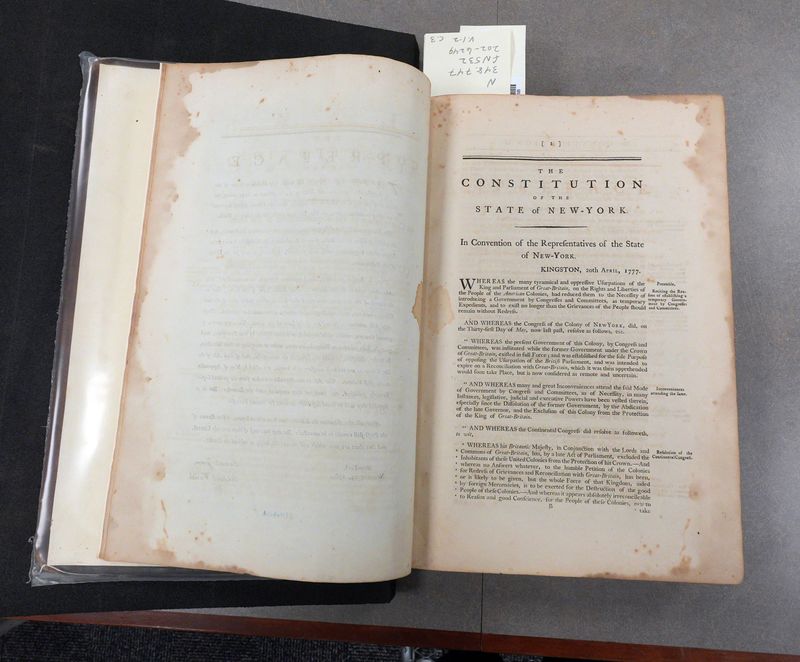
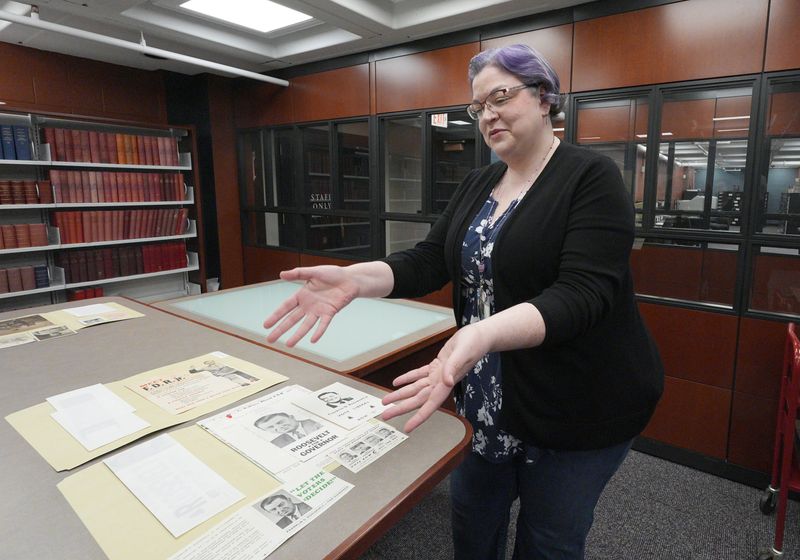
At the end of a long table in a room partially surrounded by glass windows in the furthest corner of the state Archives’ research room, a copy of the New York State Constitution published in 1779 sits open to the first page.
Red-tinged splotches line the edges of the pages; its disintegrating brown leather cover slid into a plastic covering to help keep it in tact. It signifies the foundation of our state and is a physical representation of New Yorkers’ rights, several of which have had significant impact not only on the state but on the nation.
The Dewey-signed Ives-Quinn Act, which was voted through in 1945 and named after its sponsors — Assemblyman Irving M. Ives and Sen. Elmer F. Quinn — was the first in the nation to ban discrimination in the workplace based on race, color, creed and national origin. It also created a state agency for enforcement.
Another civil rights action rooted in the Empire State includes its Civil Rights Act. According to the New York Transit Museum, a century before Rosa Parks refused to give up her seat to a white passenger on a segregated city bus in Alabama, 24-year-old schoolteacher Elizabeth Jennings Graham ignored orders to get off a streetcar in Manhattan, which led to her physical removal.
Graham won her lawsuit against the driver, conductor and the Third Avenue Railway after the incident, and the state banned discrimination on public transportation in the city 20 years later in 1873.
New York also enacted a right of privacy statute in 1903 after the Franklin Mills Company’s ad campaign including lithographic prints of a young Abigail Roberson led to a lawsuit for damages and injunctive relief. While the Robersons didn’t win, public interest kept the action front of mind and led to one of the state’s civil rights laws.
And the state’s Workers Compensation Law, the first in the nation, was upheld by the U.S. Supreme Court in 1917 after initially being found unconstitutional by the state Court of Appeals a year after it was first enacted in 1910.
A less than 10 minute walk from the entrance of the Museum, large paintings of every governor the state has ever had at its helm hang dignified along the warmly-lit Hall of Governors inside the New York State Capitol. Just below some of the portraits are wooden cases filled with items of significance — FDR’s gubernatorial inaugural fountain pen and gavel, the state’s Civil Service Law document and proof of the state’s Freedom of Information Law.
They’re all physical reminders of the work of the leaders who helped form the state of New York, while also serving as encouragement for future ones who will continue crafting and working to institute laws they hope will better the state in the same way as those who came before them.
Emily Barnes covers state government for the USA TODAY Network-New York with a focus on how policy and laws impact New Yorkers’ taxes, communities and jobs. Follow her on Instagram or X @byemilybarnes. Get in touch at ebarnes@usatodayco.com.
This article originally appeared on Rockland/Westchester Journal News: How NY state helped forge American ideals for over 250 years
Reporting by Emily Barnes, New York State Team / Rockland/Westchester Journal News
USA TODAY Network via Reuters Connect
By Emily Barnes, New York State Team | USA TODAY Network