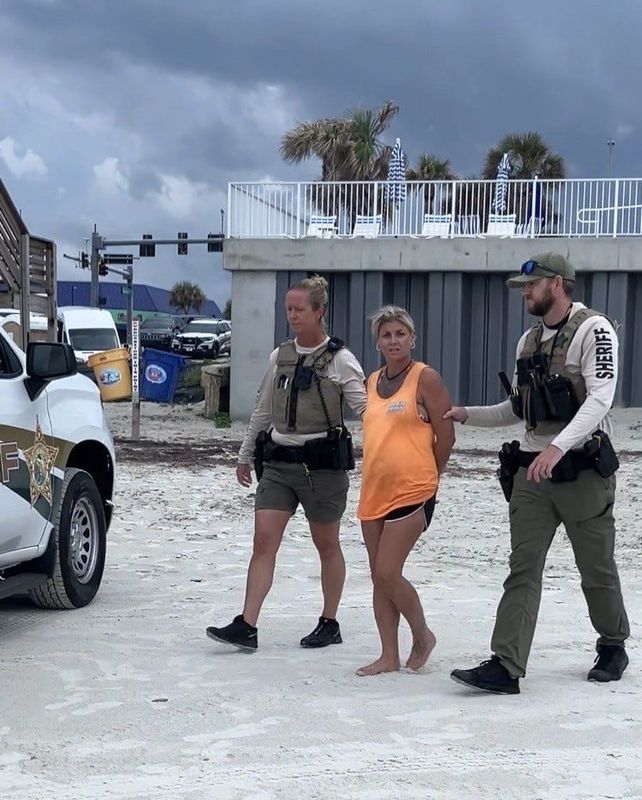
Minutes after a pickup truck smashed into a beach ramp tollbooth June 1 in Daytona Beach Shores, killing the attendant, the driver, Deanna Harrell, was confronted by a deputy and handcuffed.
Case closed? Not so fast.

Volusia County Sheriff Mike Chitwood has vowed justice for the longtime county employee, Tammie Jo Baker, 63, of Daytona Beach.
The sheriff explained at a June 2 news conference that Harrell, 35, of Ormond Beach, was not initially arrested. Instead, she was taken to a healthcare facility under Florida’s Baker Act while investigators continued to collect evidence in a suspected vehicular homicide case.
Harrell was then arrested June 3 on warrants for vehicular homicide and DUI manslaughter, according to a Chitwood social-media post.
Why Deanna Harrell arrested immediately after the tollbooth crash?
The State Attorney’s Office wanted more information about the circumstances of the crash before charging Harrell, Chitwood said.
“We’re in the process of drawing blood to determine what we’re going to charge her with,” Chitwood told The News-Journal June 1. “I don’t know if we’re going to get charges today or not. Blood normally takes 60 days to come back.”
Chitwood has since said Harrell had been drinking at Metz II Lounge, 2136 S. Atlantic Ave., and that Harrell herself had told a detective she had vodka and Gatorade.
In the meantime, she was under evaluation at a healthcare facility.
How does the Baker Act work?
Under the Florida Mental Health Act, an individual with mental illness can be taken to a care facility for involuntary examination.
This law, more commonly known as the Baker Act, lays out these requirements under which a person can be involuntarily examined in a hospital or mental-health facility:
Who can cause a person to be ‘Baker Acted’?
According to an article on the 15th Judicial Circuit website, three classes of people can petition a court for a person for involuntary examination.
First, people who are willing to swear that they have witnessed a person causing harm to themselves or others, may petition a court.
Second, a law enforcement officer may transport an individual to a facility for examination “if there is reason to believe that the individual’s behavior meets statutory guidelines for involuntary examination.”
And third, doctors, psychologists, psychiatric nurses and licensed social workers, therapists and counselors may complete paperwork stating they have witnessed behavior that meets the Baker Act criteria in the past 48 hours.
When did the Florida Legislature pass the Baker Act?
The Baker Act is named for the late state Rep. Maxine Eldridge Baker, the Miami-Dade lawmaker who pushed for its passage for seven years before it became law in 1972.
“Ms. Baker believed that Florida’s previous mental health laws deprived citizens with mental health problems of their freedom by committing them to institutions and diluting the right to due process even when there was no indication they were a danger to themselves or others,” a history posted on the Florida 9th Judicial Circuit website states.
The history notes that Florida’s laws on mental health hadn’t been updated for nearly a century before the 1972 Baker Act.
This article originally appeared on The Daytona Beach News-Journal: What is the Baker Act? How does it work in Florida?
Reporting by Mark Harper, Daytona Beach News-Journal / The Daytona Beach News-Journal
USA TODAY Network via Reuters Connect
By Mark Harper, Daytona Beach News-Journal | USA TODAY Network