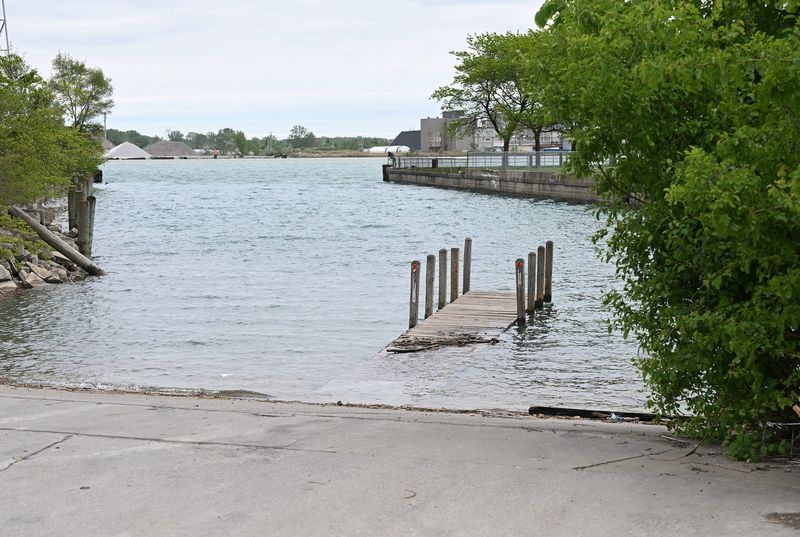
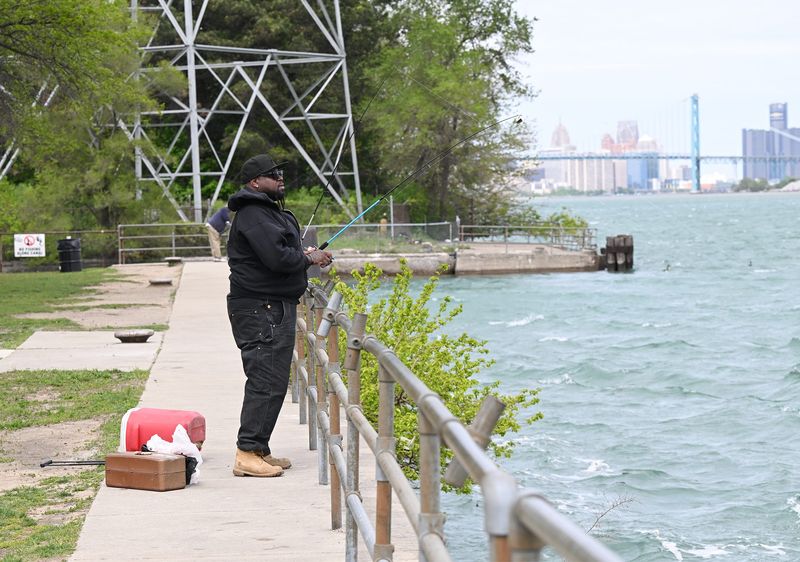
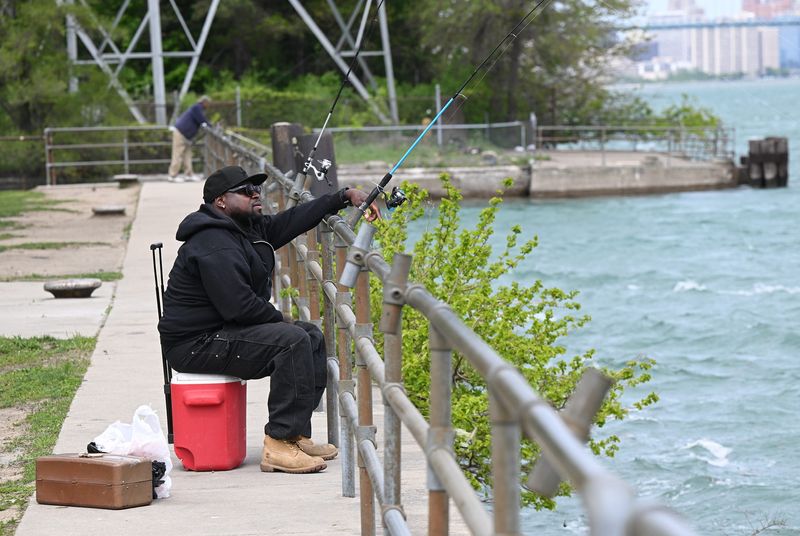
The fishing from Delray Park is prime, Gilbert Singleton says. It’s wide enough to cast from shore, where anglers can nab a prize catch of walleye, white bass or perch.
“The access is great,” said Singleton, owner of Walleye Gil’s Guide Service. “It’s outside the water that’s the problem.”

The park, owned by DTE Energy Co. at the site of its former Delray Electric Power Plant, “definitely needs some TLC,” Singleton said.
The dock has not been kept up — much of it was underwater on a recent day in late May. On fishing forums, people complain of trash and say they occasionally arrive to find the gates locked.
The Delray Park launch is one of few boat launches on the U.S. side of the Detroit River, a popular spot where anglers practically stand shoulder-to-shoulder on busy days. Its future is uncertain, adding a potential complication to the statewide effort to increase fishing access in Metro Detroit.
The Michigan Department of Natural Resources and DTE Energy Co. are negotiating the future of Delray Park, which was built by the company because of a major 1995 legal settlement over fish kills at the Ludington Pump Storage Plant, a northern Michigan energy facility co-owned by DTE and Consumers Energy.
DTE continues to open the gates at Delray, but is no longer required to maintain the facility after the parties renegotiated that agreement in 2017. The second agreement did not include provisions about the four fishing access sites DTE built and operated under the first agreement.
“Detroit Edison has been a very engaged partner, and they’re interested in trying to maintain this site,” said Randy Claramunt, DNR fisheries chief. “They’re working with us on a solution that will hopefully not only keep the Delray site as a boating access site and a shoreline access site, but also open the door for ways we can improve it to make it higher capacity, safer and cleaner.”
DTE will manage the Delray site as it negotiates with the DNR on a long-term plan, Corporate Communications Strategist Jessica Watson said in an emailed statement. The company declined to answer specific questions for this story or make an employee available for an interview.
“We know the Detroit River is an important asset for our community, and we’re committed to keeping it open and safe for public use,” Watson wrote.
The DNR is not seeking to own the site outright, Claramunt said. “The site needs a lot of work,” he said, but because it is on the site of the former coal-fired Delray Power Plant, pollution likely would complicate construction projects.
“There’s just a lot of issues,” Claramunt said. “If we were to move forward with any kind of agreement on how to improve this long-term, we would want to make sure that DTE follows their commitments as the property owner… to make sure no one is accepting liability for any kind of environmental cleanup or anything along those lines.”
Detroit River boating access limited
Detroit-area anglers, boaters and DNR officials agree there are not enough ways to get boats on the Detroit River. Singleton added there also is a lack of public fish cleaning stations, which he said are common in west Michigan, and parking for popular shoreline spots such as the Detroit RiverWalk.
“Fishing and boating access on the Detroit River, Lake St. Clair and western Lake Erie is very limited and in high demand, especially this time of year,” said Claramunt, who also chairs the Great Lakes Fisheries Trust, a nonprofit founded as a result of the Ludington Pump Storage Plant settlement agreement.
That doesn’t stop the die-hards. Singleton has waited in line for 90 minutes to launch his boat. Once he’s on the river, the fishing is “phenomenal.” He recently caught his limit of walleye — six — in just half an hour.
The DNR has been working for decades to improve access to fishing, boating and other outdoor activities in Metro Detroit, the most populous and developed part of the state.
Gov. Gretchen Whitmer included a line item of $271,000 for a long-term lease at St. Jean Boat Launch in her proposed 2027 budget. The DNR seeks to take over operations at the city-owned launch, which is leased through August to ABC Professional Enterprise LLC, the same contractor that operates Riverside Marina and Reid Memorial Park.
How a Ludington energy plant led to Detroit fishing spots
Some of the area’s popular fishing spots came from the settlement of a lawsuit the state of Michigan, some tribal governments and environmental groups filed against Consumers and DTE over damage their Ludington Pump Storage Plant caused to Lake Michigan fish.
The plant functions like a big battery. When there is an excess of energy or prices are low, the companies pump water from Lake Michigan into a reservoir. When demand or prices rise, they release the water, which turns turbines and generates electricity on its way back to Lake Michigan.
The storage facility was the largest in the world at the time it was built in 1969. In 1977, DNR staff started researching the impact it was having on Lake Michigan fish.
Douglas Jester, now managing partner at the clean energy consulting firm 5 Lakes Energy, was a fisheries research biologist at the time.
“In the end, it was apparent there were significant fish mortalities, fish killed, by the plant,” Jester said. Many, especially large fish, including the salmon stocked in nearby rivers, couldn’t survive the change in pressure between Lake Michigan and the reservoir.
The state sued in state and federal and also pursued a request to the U.S. Federal Energy Regulatory Commission to address the problem, Jester said. In 1995, the parties signed a consent agreement that required the companies to:
Metro Detroit fishing spots were a ‘compromise’
The state didn’t want to compromise on the payments Consumers and DTE would have to make on future fish kills because they wanted the utilities to avoid killing more fish, Jester said.
Instead, state lawyers compromised on the two pieces of the settlement meant to repay state residents for pre-1995 fish kills — Consumers’ land transfers and DTE’s fishing access sites. Jester estimated the value of those parts of the settlement were only about half of what the actual damages were worth.
“We attributed value to those access sites based on how anglers value the opportunity,” Jester said. “It did not cost the utilities as much to create and maintain those sites as the value that we attributed to them. That was another way in which we compromised. We got value for the people of Michigan without the companies spending as much as we claimed it was worth.”
The sites also helped open public access to the shoreline that in the 1980s was more dominated by power plants and industry, Jester said. They also gave the company some community goodwill, since they are clearly labeled as owner.
“We had this notion of opening up the waterfront and their power plants were kind of in the way, but at least you could go around the power plant and go to the fishing access site,” Jester said. “It was also part of a concept of converting the waterfront to public use, oriented around the river.”
Jester was not involved in the 2017 renegotiation of the settlement agreement. He said he expected DTE would be required to maintain those fishing access sites as long as the Ludington Pump Storage Plant was licensed to operate.
Claramunt also was not involved in the renegotiation, but said he has been told the access sites “were not deemed applicable in the new agreement.”
“The approach we want is for everyone to come together and make sure we don’t lose this boating access site,” he said.
Singleton was not aware of the settlement agreement that led DTE to build Delray Park, but said it seems like an oversight not to include maintenance of Delray.
“I don’t know how they missed it, but somebody did,” he said.
Claramunt said the Great Lakes Fisheries Trust is coordinating the conversations between DNR and DTE about the future of the Delray site. He said DTE may seek funding from the trust, which is funded by the utilities to compensate for fish killed at the pump storage plant, to pay for future work at Delray.
“Assuming the agreement goes through and the fisheries trust puts money back into this site, it won’t be for the benefit of DTE, it will be for the benefit of the anglers, both boating and shoreline, and it will be under an agreement that helps us as managers of the site to allow that access, not as the property owner,” he said.
ckthompson@detroitnews.com
This article originally appeared on The Detroit News: State, DTE negotiate future of neglected Detroit River fishing spot
Reporting by Carol Thompson, The Detroit News / The Detroit News
USA TODAY Network via Reuters Connect