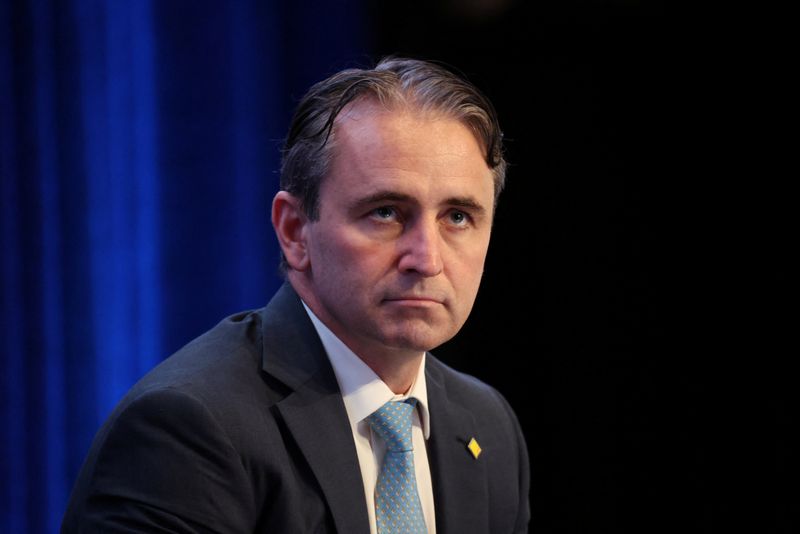
SYDNEY, June 2 (Reuters) – The cost of using AI will rise in less predictable ways as companies deploy the technology for complex tasks, the head of Australia’s biggest bank said on Tuesday, calling the expense a key emerging management challenge.
Commonwealth Bank of Australia CEO Matt Comyn said businesses globally are likely to tighten scrutiny of artificial intelligence-related spending through 2026 as adoption accelerates and pressure mounts to demonstrate returns on investment.

His remarks highlight a growing constraint on AI rollouts in corporate Australia, alongside managing workforce disruption and the heavy energy and water demands of the data centres powering the surge in computing.
“I won’t be surprised if over the course of this year, companies will be really scrutinising that,” Comyn said at an Australian Financial Review conference in Sydney.
Unlike most consumers, who use free or fixed-cost AI services, corporate users pay by the amount of text processed, referred to as tokens. In early rollouts of AI in companies, token costs stayed modest because tasks were relatively simple.
However, as models have evolved, with more “reasoning, the access to tools, the amount of context that you can put into it – your token costs do not scale on a linear basis,” Comyn said.
CBA, Australia’s second biggest company which writes a quarter of the country’s mortgages, has been positioning itself as a keen AI adopter. Last week, it hosted its own AI summit featuring OpenAI CEO Sam Altman and hired what it said was the country’s first chief AI scientist at a bank.
On Tuesday Comyn said rising AI costs may have one upside – curbing the spread of low-value output, or what he called “work slop.”
“The scarcity is not around analysis or the preparation of information or PowerPoints or Word docs,” he said. “You can be exponentially increasing them if you want to.”
(Reporting by Byron KayeEditing by Shri Navaratnam)