It’s a typical class day for the students at GEO Next Generation Academy, who, like any other high school students, chat with their backpacks slung off their shoulders as they shuffle to class. But at this charter school, which claims to have “radically altered the trajectory of impoverished students” when it comes to college and career, classical music plays during each passing period.
The students, who school leaders say are predominantly Black and come from low-income backgrounds, swarm the hallways as Beethoven’s Symphony No. 5 swells to a crescendo. The drama feels out of place for a high school hallway but could serve as the soundtrack for the politics behind it: after decades of tinkering with public education in Indianapolis’ urban core, school reformers, public officials, teachers and parents now find themselves at the tipping point.

A new era for Indianapolis public education, where charter schools are now firmly a part of the IPS education ecosystem, is beginning.
GEO first opened at its Gary, Indiana, location in 2002, before expanding to Indianapolis and Louisiana. It was one of the state’s first forays into the charter experiment, premised on the belief that nontraditional public schools, held accountable by their charter authorizer but free from so-called government bureaucracy, could improve student achievement while lowering costs.
Traditional public schools in urban areas are often underfunded even as the schools educate children dealing with poverty and even homelessness. School choice advocates contend charter schools can do better for even less money, with a focus on education that leaves out the bells and whistles. GEO, like many other charter schools, does not have a choir, a football field or even a track.
But that’s likely to change. Thanks to a 2025 law that required all traditional public schools to share property tax revenue with charter schools beginning in 2028, the sector will get more funding each year until 2031, when the law is fully phased in. That will only further strain Indianapolis Public Schools, which is already sharing some revenue with charter schools under an earlier, more targeted law and announced a multimillion-dollar budget cut earlier this year.
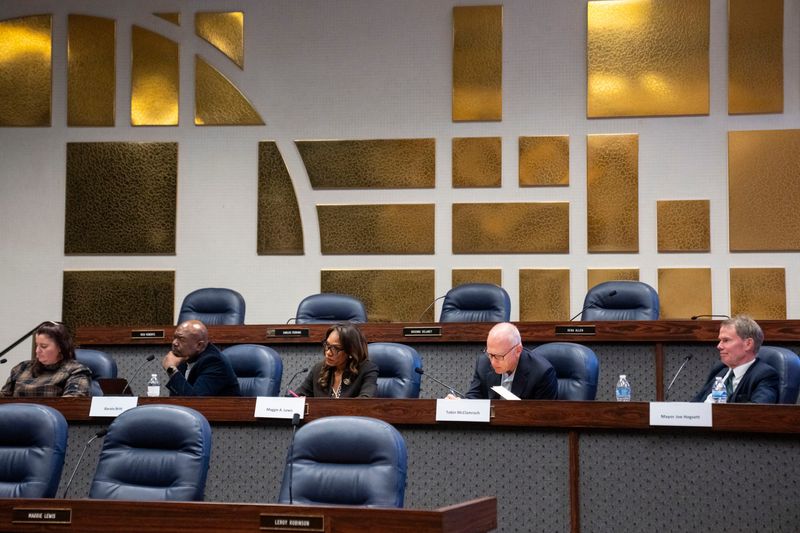
Both school types within IPS boundaries are now governed by a seemingly first-of-its-kind framework: a mayor-appointed board called the Indianapolis Public Education Corporation, which will oversee transportation and facilities for both school types and wield influence over closures. While the tens of thousands of students attending IPS and charter schools leave for the summer, the IPEC will meet to discuss the possibility of a critical funding referendum that is now out of the elected IPS school board’s hands.
The new board has been heralded by charter school advocates, who see it as a way to create equity between the school types and relieve tight budgets. But IPS parents view it as undemocratic, worrying that the charter lobby money already influencing Indy’s education landscape will now flow to shape the board, whose nine members all share connections to the charter sector.
With the district facing a fiscal cliff and in dire need of referendum money, the calculus of the IPEC, including how much money to request from taxpayers and for how long, will decide the future of their children’s schools. For some parents from charter schools, it could mean increasing educational offerings and smoother transportation for their children. But some traditional public school parents fear the gains could be one-sided, and that it might instead increase instability within the public school system.
“I don’t have a lot of hope for the future of IPS,” Jonelle Chalmers, whose child attends an IPS elementary school, said.
The executive director and board chair of the IPEC did not return a request for comment. IPS initially agreed to an interview but did not follow up by publication.
IPS budget cuts loom
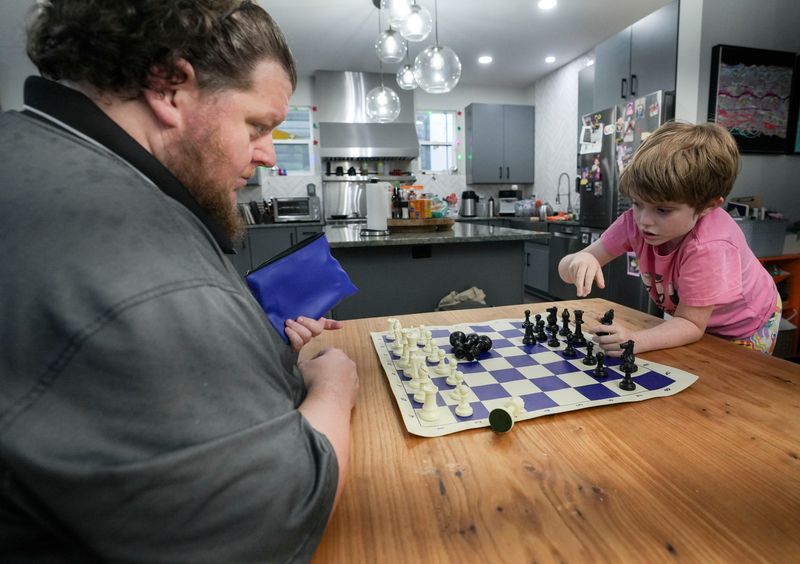
After school on a rainy day, Matilda Chalmers and her neighbor, fellow IPS Center for Inquiry 27 third grader William Hawk, play chess in her home. Chalmers, who participates in chess club at her school, is preparing for the state chess championship.
“Stuck a feather in his cap and called it macaroni…” one kid absentmindedly sings.
The classic American protest song “Yankee Doodle” was a feature of the day’s “specials” classes, like art or physical education that will soon be different for some IPS schools as the district looks to cut costs. Some specials teachers will now be shared by multiple IPS schools, a controversial expansion of what the district tried at some schools this year.
The district will also cut 87 staff members, at least 36 of them teachers, as part of $24 million in budget reductions.
But while IPS is modifying specials and cutting staff to adjust to an impending fiscal cliff and prepare for an uncertain referendum outcome, some charter schools are gearing up to enhance their athletics and music offerings as they enjoy an increasingly greater share of public funding. GEO, for example, plans to add choir, band and theater with some of the anticipated financial relief from the IPEC.
Both IPS and charter schools have faced financial and enrollment challenges in a district often described as oversaturated, contributing to closures across both sectors. But the problem is different at IPS, which oversees a larger footprint of school facilities that have not kept pace with falling enrollment.
“Making Indianapolis into a hotbed of school choice…squeezes IPS,” said Bryan Duarte, a critic of IPEC who lost a bid to fill a vacant IPS board seat and assistant professor of educational policy at Purdue (his views do not reflect the views of the university, he said).
That squeeze includes having to share the same amount of property tax revenue among more schools, thanks to the recent charter school revenue-sharing requirements. There is also a statewide crunch on schools from the legislature’s property tax overhaul in 2025, which aimed to provide taxpayers relief but is also eating into schools’ expected revenues.
It’s especially difficult to figure out how to right-size when the losses are spread out across different classrooms and facilities, said Huriya Jabbar, a University of Southern California professor who researches K-12 education, because not much can be done to reduce operational costs. When enrollment drops past a certain level, some IPS schools have closed, often an unpopular and disruptive decision that can fuel further enrollment issues.
But while critics of the new framework blame legislative intervention, such as the expansion of school choice, for IPS’ financial woes, the lawmakers driving education policy say they are trying to help the district.
“This is not a state takeover, again, or some sinister plot,” Senate Education and Career Development Chair Jeff Raatz said ahead of the passage of House Enrolled Act 1423, which established the IPEC.
School closures likely
The central concern for IPS parents and advocates is the prospect of more school closures. For some of IPEC’s proponents, it appears to be by design, fixing the crowded school environment by closing the ones that underperform.
But for parents and kids caught in the mesh, it can be heart-breaking. MaryAnn Ruegger, a lawyer who once served on the Indiana Charter School Board, remembers thinking of the classrooms full of teachers and kids that would be crushed by the decisions before her. It evoked difficult memories from when Ruegger discovered, just weeks before her daughter’s fourth grade year at a charter in 2012, that the Project School in Indianapolis would be shuttered.
Ruegger is now on the board for the Indiana Coalition for Public Education, a statewide group that advocates for traditional public schools.
“What will probably happen with (the legislation that created IPEC) in a couple of years” Ruegger said, “is we will have the closing of quite a few IPS schools, and some charter schools.”
While the IPS board is granted three seats on the board, Mayor Joe Hogsett chose three members who have all received donations from charter school-supportive groups. One, Deandra Thompson, rents space from an Indianapolis charter school for her childcare business, according to the school’s CEO (Thompson told IndyStar that sharing spaces in childcare is a necessary part of the business and that the partnership does not affect her decision-making or “commitment to IPS students, families, and educators.”) Four members of the board currently lead charter schools, and two others currently serve, or have served, as charter board members.
Emily Kaufmann, a spokesperson for the mayor’s office, said there was an “extensive review process” to choose who sits on the IPEC board, and that all members live within the district’s boundaries.
“While varying backgrounds of Indianapolis’ education structure was vital,” she said, “the determining factor in selecting all board members was their willingness and commitment to put aside any perspective other than what is in the best interest of all the families and children living in the Indianapolis Public Schools boundary, regardless of the type of public school those families choose.”
IPS parents worry for the future of their children’s schools
IPS parents who spoke to IndyStar had only good things to say about the quality of their children’s schools. They gushed about the opportunities offered, from ice skating lessons to engineering club, and the freedom to choose from the many learning models IPS offers.
But for Lindsey Cornett, who moved to Indianapolis in 2019, the positive reality she saw was much different from the narrative she’d heard about IPS.
“Nobody I talked to had anything good or encouraging to say about Indianapolis Public Schools,” she said.
Negative narratives of traditional public schools can create a cycle of disinvestment, Jabbar said, where enrollment declines or poor test scores are used as proof of failure to justify further disinvestment, often without accounting for broader education trends or the connection between poverty and academic achievement.
But for some charter school advocates, there’s a belief that disparities within the public education system can only be solved through a charter model. Kevin Teasley, the GEO Next Generation Academy CEO, attended a robust traditional public school himself but said he began advocating for school choice when he saw door-less bathroom stalls and barbed wire fences at urban public schools in California and Washington, D.C.
“Everybody who could leave had left, and the ones who couldn’t were stuck,” he said.
Some parents share a similar view. Ayanna Hall, a school bus driver, said that after dropping out of an IPS high school, she was able to graduate by switching to a charter school, which she credited to smaller class sizes and personalized instruction. Now 35, she enrolled her son in GEO after the IPS school he was attending stopped offering middle school.
“I think that had I went to the charter the whole time…” she said, “I probably would have never dropped out.”
Hall doesn’t understand the pushback to the IPEC, which she hopes will help provide better transportation for her 13-year-old son, whose charter school bus stops a little more than two blocks from their house.
While transportation was a sticking point for charter school advocates supporting the IPEC, IPS parents said they were worried about the politics driving the board’s other decisions, such as building closures and the school referendum.
Quynhanh Nguyen, who has two kids who go to George Washington Carver School 87, compared the IPEC board to what she experienced growing up in Vietnam, where there are no elected school boards. She worries the appointed model could lead to nepotism or favoritism.
“Especially with the mayor, who (doesn’t have a) good track record in terms of transparency and accountability,” she said.
Hogsett, who has awarded no-bid city contracts to former staffers and donors, did not comment to IndyStar on parents’ concerns about his record.
Indianapolis hopes to be the blueprint
For both IPS parents, education experts and charter school leaders, the verdict is still out on IPEC.
Though much of its impact will be decided in the next year, Duarte said, any concrete analysis of its outcome is likely years away. It could unite Indianapolis’ fragmented education ecosystem by promoting collaboration, one expert, Jabbar, said. It could also fuel charter expansion and become a hotbed of corruption, as some parents and scholars have speculated.
But it could also shake up how charters have operated in the city for the past 20 years. Sacha Sharp, a parent whose kids attend IPS 55, said she hopes that includes enhanced accountability measures for a system that she sees as opaque.
“I would actually like to take this as an opportunity to see how those charter schools function,” Sharp said. “Because I think it’s kind of a black box right now. “
It’s hard to tell for a framework that has no precise blueprint: IndyStar asked three education experts if they were aware of a similar model, but none were. Teasley also sees IPEC as a first-of-its-kind model.
While he ultimately sees it as a net positive for his school, he is cautious of the details yet to be worked out, such as how robust transportation will be and how school buildings will be acquired. And with a multitude of competing interests, he’s skeptical the new body will be able to present a single solution without conflict, even among other charter schools.
“Choice is messy,” he said. “It’s organized chaos. But that doesn’t mean it’s a bad thing.”
Contact breaking politics reporter Marissa Meador at mmeador@indystar.com or find her on X at @marissa_meador.
This article originally appeared on Indianapolis Star: The future of IPS is in the hands of a first-of-its-kind board. Parents are worried
Reporting by Marissa Meador, Indianapolis Star / Indianapolis Star
USA TODAY Network via Reuters Connect