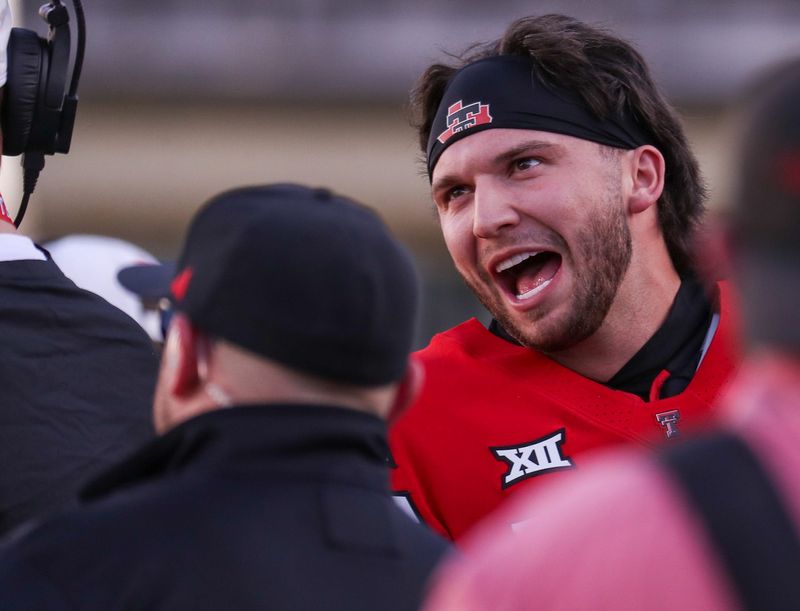
Brendan Sorsby made at least 40 impermissible wagers on his Indiana football team or teammates during the first two months of the 2022 season, according to a new court filing, and continued sports gambling at IU and during his subsequent time as a member of the Cincinnati and Texas Tech football teams.
The filing by Sorsby’s legal team on Friday, May 29, in a Lubbock court show the Red Raiders’ new quarterback bet at least $90,000 over the past four years, including at least $5,000 since he transferred to Tech in January.

The NCAA has ruled the Red Raiders’ quarterback permanently ineligible for violations of its gambling rules. An injunction hearing has been set for Monday, June 1, at which Sorsby’s attorneys are expected to ask a judge to prevent the NCAA from barring him during the 2026 season.
“I acknowledge and take responsibility for my years long struggle with gambling,” Sorsby wrote in a May 16 letter to the NCAA reinstatement staff. “I have been a compulsive gambler since I was 18 years old, when I first logged onto a gambling app and made an initial $5 deposit to take advantage of a promotional offer for a free $100 credit. What began as a seemingly harmless and fun activity gradually developed into a daily habit and compulsion that I could not control.”
Sorsby recently completed a monthlong inpatient treatment program in Goodyear, Arizona. He has acknowledged using his cell phone to wager via online platforms including Hard Rock Bet, FanDuel, Underdog and Prize Picks. He wagered on accounts registered to him or to a family member or friends whose names were redacted in the filing.
The NCAA prohibits gambling on college sports with a punishment range that includes a permanent ban for wagering on one’s own team. Wagering on another sport at one’s school is punishable by loss of one year of eligibility.
The filings provide new details on the amount of documented wagering Sorsby did at each of his schools, all agreed upon by Sorsby, his legal team and NCAA investigators. Investigators found no evidence that he attempted to manipulate games.
While enrolled at Indiana from June 2022 through December 2023, the filing documents, Sorsby made at least 2,900 bets — taking all legs of parlays into account, at least 8,600 impermissible wagers — totaling more than $30,000. Many of Sorsby’s wagers during that period were parlays that included between two and 22 separate events or legs.
The at least 40 wagers on Indiana football during that time added up to at least $850 with the amount per wager ranging from less than $1 to $114. Specifically, he placed at least two straight bets and 32 parlay bets that included at least one leg on the Indiana football team.
Between Oct. 15, 2022, and Nov. 20, 2023, Sorsby placed at least 50 impermissible bets totaling more than $1,400 on Indiana men’s basketball or individual team members. From September 2022 through December 2023, he placed about 300 bets totaling at least $6,500 on college football games and-or individual player performances not related to Indiana football.
Sorsby never placed a bet against the Indiana basketball team but placed four parlay prop bets on Indiana basketballplayers that also included prop bets on an opposing player in three games against Indiana in 2023. The four prop bets were for the opposing player to exceed the point or rebound totals.
Sorsby was on the Indiana football team in 2022 and 2023 and the Cincinnati team in 2024 and 2025.
Between December 25, 2023, and June 23, 2025, Sorsby provided more than $60,000 to an unnamed individual to deposit in a FanDuel account registered to an individual whose name is redacted in the filing that was accessed and shared by Sorsby and another individual whose name is redacted.
From Jan. 7, 2024, through Sept. 30, 2024, Sorsby placed at least 165 impermissible bets — counting parlays, about 500 permissible wagers — totaling at least $38,000. On Feb. 10, 2024, three wagers were placed on the shared FanDuel account on Cincinnati men’s basketball for a total of $3,500. Sorsby acknowledged placing one or two of the wagers. All the bets on Cincinnati basketball were for the team or players to exceed the odds.
Between Jan. 7, 2024, and Sept. 30, 2024, Sorsby placed at least 10 bets totaling more than $2,500 on college football games or player performances not involving Cincinnati.
In the five months since he enrolled at Texas Tech, the filing says Sorsby has not wagered on Texas Tech sports but continued betting on pro sports such as the PGA Tour, the NBA and Major League Baseball. It says the bets were through a sports wagering account belonging to an individual whose name is redacted. During this time, he sent $5,000 via Venmo and Zelle to an unnamed individual who then used the money to place bets on Sorsby’s behalf.
The NCAA recently rejected Sorsby’s offer to serve a two-game suspension this season while paying his penance in other ways, including warning others the dangers of gambling. Several individuals sent letters to the NCAA asking for leniency on Sorsby’s behalf, including Texas Tech officials and a gambling counselor at his Arizona treatment center.
Scott W. Tompsett, a member of Sorsby’s legal team, made a multi-layered argument to the NCAA. Among his reasons for leniency: Gambling addiction is widespread among college athletes; Sorsby has a gambling disorder for which he’s sought treatment; and the NCAA constitution requires a mental-health first approach over purely punitive measures.
Tompsett also said Sorsby should not be punished more harshly than an Indiana volleyball assistant who recently was assessed a suspension of 30% of the 2026 season for making 700-plus bets for more than $327,000 on college and pro sports.
Texas Tech filed for Sorsby’s reinstatement on May 19, and the NCAA denied the request on May 22. Texas Tech filed an appeal on Friday, May 29.
In its May 22 decision, the NCAA wrote, “In assessing SA’s [student-athlete’s] culpability based on all facts and circumstances presented by SA and institution in this case, staff noted the significant integrity concerns associated with SA wagering on his own football team. Additionally, staff noted SA engaged in sports wagering activities involving other sports teams at two of his institutions and participated in sports waging [sic] activities involving his own sport atanother collegiate institution.
“Staff also noted the large amount of money wagered and high volume of bets placed. Finally, SA received rules education specific to sports wagering on multiple occasions from Institution Nos. 1 [Indiana], 2 [Cincinnati] and 3 [Texas Tech]. Staff did not find any circumstances that warranted reinstating SA’s eligibility.”
In his letter to the NCAA reinstatement staff, Sorsby said because of his relatively small bets and his earnings from NIL deals, he viewed his losses as no big deal financially. He recognized losing control, though.
“My betting became a compulsion which made it virtually impossible to resist the constant notifications I received from the betting apps,” he wrote. “I lost complete control of my addiction. I now realized the apps controlled me and I did not control them.”With the support and concern of my parents, my girlfriend, and my agent, it has become clear to me I cannot continue living this way. I am a high-level student-athlete with responsibilities both on and off the field. I recognize the seriousness of my actions and the need to make meaningful change.”
The filing includes 14 exhibits, one of which is 46 pages of material showing the lengths to which Texas Tech goes in warning its athletes to refrain from gambling. They received presentations, reminders and education about abstaining from gambling seven times between Jan. 12 and April 21 this year.
There is a sports-betting acknowledgment form in which an athlete attests to the following:
∎ I understand per NCAA rules, I may not knowingly participate in sports wagering or provide information to individuals involved with or associated with any type of sports wagering activities. [This] includes all sports sponsored by the NCAA (amateur, college, professional).
∎ I understand that Texas Tech Athletics will monitor, via ProhiBET, sports betting activity of Texas Tech studentathletes, coaches, and staff.
∎ I understand I am responsible for the NCAA sports wagering rules and am on the list of prohibited bettors.∎ I understand that a violation of NCAA sports betting rules or Texas Tech policy may result in discipline up to loss ofscholarship and permanent ineligibility.
Sorsby signed the form on Jan. 13.
This article originally appeared on Lubbock Avalanche-Journal: Brendan Sorsby betting continued into time as Texas Tech football QB
Reporting by Don Williams, Lubbock Avalanche-Journal / Lubbock Avalanche-Journal
USA TODAY Network via Reuters Connect