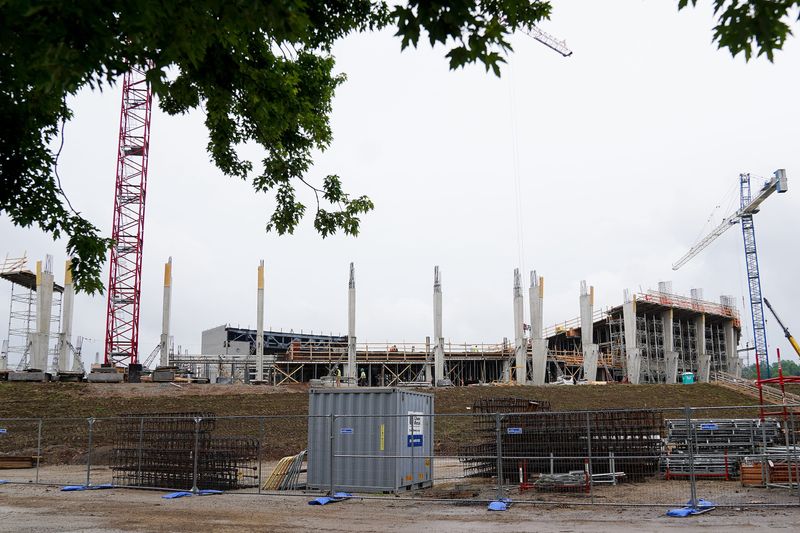
The Enquirer recently published construction photos of the Farmer Music Center rising where Sunlite Pool and the Coney Island amusement park once provided entertainment to generations of Cincinnati families. The $160 million project is scheduled to open in spring 2027. The City of Cincinnati was not part of its original conception or financing structure – until now.
With construction underway and financing incomplete, the CSO and its for-profit subsidiary have come to City Hall seeking $8 million in public support. The request comes as the city faces a $29.5 million budget shortfall.

Council member Anna Albi introduced a resolution with four co-sponsors – enough votes to ensure it bypassed committee review and advanced before public debate. The source of the $8 million request was not fully detailed in the public record. The vote was 5-4.
What passed was not an appropriation. It was a nonbinding resolution directing the administration to include $8 million in a future fiscal year budget. No money has been committed. The final decision will come when Council votes on the full budget, which must be adopted by the end of June.
The Farmer Music Center was conceived without City of Cincinnati participation. The anchor gift – $60 million from the Farmer Family Foundation – was the largest philanthropic commitment to the arts in recent Cincinnati history. The state of Ohio has since pledged $8 million. No city funding was part of the original structure.
The project was originally conceived without City participation through the Symphony’s for-profit subsidiary, Music and Event Management Inc., known as MEMI. Construction began before the financing structure was fully resolved in publicly disclosed terms. CSO and MEMI later returned to City Hall seeking public support.
At this point, any party asked to contribute and declines may be framed as responsible for slowing or halting construction.
At the time of the March vote, the CSO stated that 76 percent of the capital stack had been “accounted for” through public-private funding partnerships. The organization did not publish a breakdown of funding sources or define what categories were included in that figure. It did not distinguish between binding commitments, conditional pledges or fundraising projections.
Without that breakdown, the public cannot independently verify how the financing is structured, so the composition of the reported funding remains unclear.
When the public is asked to contribute capital to a private project, it becomes an equity participant. Equity participants are entitled to see the complete financing structure – not a summary percentage, but the actual breakdown of sources, commitments and contingencies. That standard has not been met here.
Reporting has also indicated that the $8 million city contribution was described as necessary to help prevent construction disruption rather than complete the project. Earlier reporting identified a near-term funding need of roughly $31 million to avoid delays and maintain the construction schedule. The city’s portion appears to address part of that short-term need, not the overall financing.
Mayor Aftab Pureval signaled a lower level of support than his administration’s initial $6.5 million recommendation, indicating $2 million as the more appropriate figure, and conditioned even that amount on MEMI securing guaranteed admissions tax revenue.
City Council has not yet taken a final vote. Before it does, several questions remain unanswered in the public record: what is included in the 76 percent figure; how funding sources are categorized; what portion is firm versus conditional; what the timeline is for receipt of funds; and what contingency plans exist if projected financing does not materialize as scheduled.
Construction began before those questions were fully resolved in publicly available detail. The City of Cincinnati was not part of the conception of the project and should be fully informed before making a decision.
Public dollars should follow facts that can be independently verified, not summary figures that do not disclose their underlying structure.
Dennis Doyle lives in Anderson Township and is a member of the Enquirer Board of Contributors.
This article originally appeared on Cincinnati Enquirer: Farmer Music Center funding structure still not publicly detailed
Reporting by Dennis Doyle, Opinion contributor / Cincinnati Enquirer
USA TODAY Network via Reuters Connect