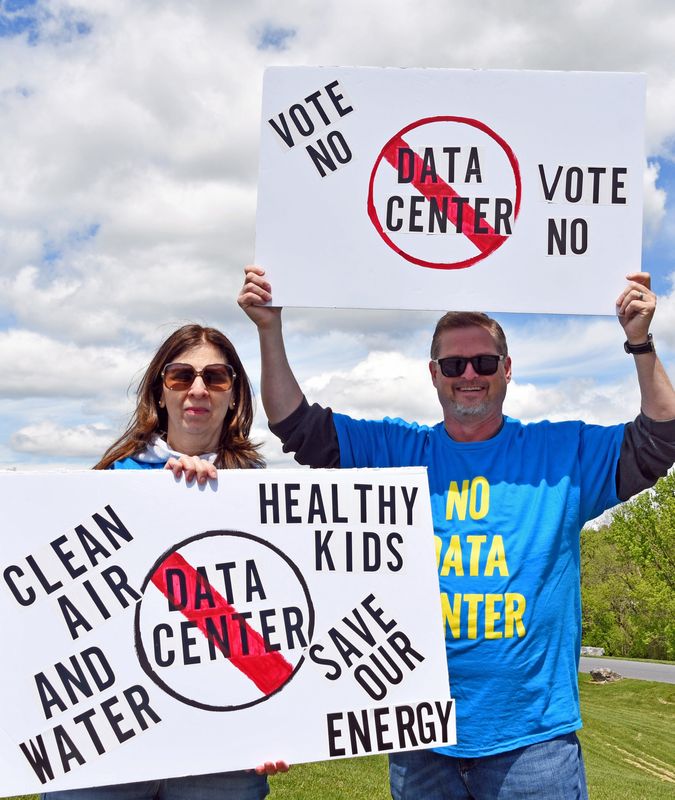
Escambia County residents have been quick to push back against the first sign of a data center, as Americans across the country stand firmly united against an exponential expansion of facilities.
Reacting to reports that FloridaWest was in “active negotiations” with a company to build an AI data center in Escambia County, residents quickly spun up opposition in the form of an online petition and protests.

FloridaWest confirmed that a defense company approached the organization about building a “smaller” AI data center, in the “north” part of the county, and “not in a populated area.” Executive Director Chris Platé says the entities aren’t actively negotiating.
FloridaWest has signed a non-disclosure agreement with the business, which is a common practice that limits public access to information about project scale, resource needs and other potential impacts.
Data centers have existed for decades. The first, built in 1945, housed the ENIAC, which was the world’s first programmable, electronic, general-purpose digital computer.
More than 3,000 data centers operate in the United States as of April 2026, according to Pew Research. More than 1,500 more data centers are in various stages of development.
Despite their 81-year existence, community pushback to data centers seems sudden and explosive. Is the concern warranted or exaggerated? Here’s what the numbers say.
How AI data centers impact energy demand
Energy-hungry servers that operate within data centers are one of the primary complaints communities have, and data shows that those concerns are well-founded.
A typical AI data center can use as much power as 100,000 homes, according to the International Energy Agency (IEA), an organization that works with governments and industry to adopt affordable and sustainable energy policies.
The largest data centers being built today are expected to use up to 20 times that amount.
A Lawrence Berkeley National Laboratory study found that data centers could represent up to 12% of all U.S. electricity consumption by 2028. Up to 90 gigawatts worth of data centers could come online by 2030, according to another study by Grid Strategies. That’s about nine times New York City’s peak summer demand.
How does this impact you?
Higher energy demands mean higher energy rates. In a worst-case scenario, companies that own the data centers strike a deal with utilities that give them subsidized rates, leaving residents and other businesses with a larger financial burden.
How to mitigate?
Some states have implemented legislation to shield residents from rising costs by introducing new billing classes and rate structures for companies that use large amounts of energy.
Florida Governor Ron DeSantis signed SB 484 into law in May, which prohibits utilities from passing data center costs onto residential and small business customers. It gives local governments the authority to set their own standards, deny projects and preserve local zoning, permitting and land use.
RMI, a nonpartisan nonprofit that supports clean energy, laid out common safeguards being implemented across the country, which include minimum contract term lengths, minimum monthly billing demand, collateral requirements, exit fees and capacity reassignment.
What about using renewable energy sources? That idea is just a pipe dream, according to the Ford School of Science, Technology and Public Policy (STPP) at the University of Michigan.
“Renewable energy sources like solar and wind are inconsistent and cannot meet the uptime,” wrote the authors of a paper titled “What Happens When a Data Center Comes to Town,” which was published at STPP.
“To ease concerns about environmental impact, data center operators frequently pledge that their facilities will eventually run on clean energy, including next-generation nuclear sources such as small modular reactors (SMRs). However, these SMRs remain largely theoretical, with no commercially viable models yet in operation,” they wrote.
How AI data centers impact water supplies
Servers that run nonstop tend to run hot, which can lead to performance issues and increase the risk of hardware failure. That leads us into the massive volume of water needed to keep data center hardware running at safer temperatures, which experts say isn’t too far behind the power demand.
A mid-size data center consumes about 300,000 gallons of water per day, about as much as 1,000 homes, Arman Shehabi, a research scientist at Lawrence Berkeley National Laboratory, told NPR in a 2022 interview. The largest facilities can exceed 5 million gallons per day, which is nearly equivalent to a small town.
Data centers are on course to require up to 32 billion gallons of water annually by 2028, which is enough to support about 360,000 homes, and many of those data centers are being built in drought-prone areas.
How does this impact you?
Data centers can consume a sizable portion of a town’s drinking water because minerals in untreated water can damage hardware. When that happens, it runs the risk of creating local shortages of clean drinking water, reduces water availability for local farmers and runs the risk of depleting freshwater from local aquifers.
An increase in wastewater produced by data centers can also overwhelm local wastewater treatment plants, which in turn runs the risk of excess runoff polluting local water sources.
How to mitigate?
Local governments can mitigate the impacts of data center impacts to their water supplies by enacting greater oversight through water-use monitoring, drought contingency planning and conducting site-specific water risk assessments that evaluate impacts on local water sources, says the World Resources Institute, a global nonprofit think tank that works to protect the environment and people’s livelihood.
Companies can consider alternative cooling methods like traditional air cooling, liquid immersion or using reclaimed wastewater from utilities rather than drawing from local supplies. As of January, only an estimated 10 to 25% of data centers are completely water-free, according to the Florida Water and Pollution Control Operators Association.
How noisy do data centers get?
Noise is another important impact on communities. Smaller diesel generators, which data centers rely on for backup power sources, can reportedly reach 85 decibels, which is loud enough to harm hearing, according to WRI. Larger industrial units can approach 100 decibels, which is equivalent to a motorcycle or jackhammer—and that noise can last for hours to days at a time.
How to mitigate?
Local governments can address potential noise issues during the permitting process by requiring projected decibel levels, noise mitigation plans and ongoing monitoring commitments, says WRI.
Mitigation plans can include the use of natural acoustic barriers and improved insulation for backup generators. Local governments can require greater setbacks from homes and more.
What economic benefits do data centers bring?
Job creation from data centers is limited and mostly temporary. Constructing a data center requires hundreds of well-paying jobs for skilled trade workers, but those are temporary. While data centers require staff for operation, the volume of workers is vastly outsized by the facility’s physical footprint. A review of more than 1,200 U.S. data centers found that even the largest employ fewer than 150 permanent workers, and sometimes as few as 25.
Potential revenue generated for local or state governments by data centers through property, sales and use taxes is often offset by the lopsided tax incentives used to attract them.
This article originally appeared on Pensacola News Journal: Are AI data center concerns just hot air? What the numbers say
Reporting by Brandon Girod, Pensacola News Journal / Pensacola News Journal
USA TODAY Network via Reuters Connect