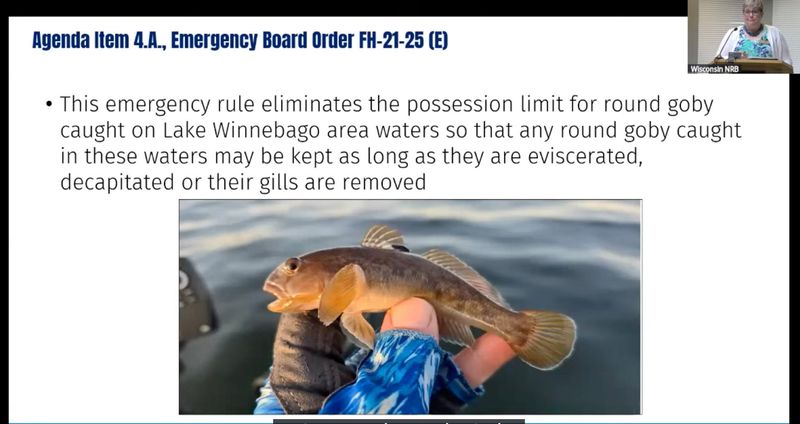
Lake Winnebago anglers will be able to keep and kill an unlimited number of round gobies under an emergency rule approved May 27 by the Natural Resources Board.
The goby is an aquatic invasive species found in Lake Michigan for at least two decades but documented for the first time in June 2025 in Lake Winnebago.

The Department of Natural Resources hopes the new rule will help limit the spread of gobies in Lake Winnebago. The DNR is also asking anglers to report locations of goby catches to help monitor the species’ distribution in Wisconsin’s largest inland lake.
The previous regulation limited anglers to possession of one round goby and only if the fish was dead and intended to be brought to a DNR office. The measure was part of a plan to prevent movement of gobies and to notify the DNR of findings of the unwanted species.
However after an angler found a round goby June 2, 2025 in Lake Winnebago while fishing near the Bowen Street Fishing Pier in Oshkosh, several dozen more were found in the area, including through DNR sampling efforts and angler reports, according to data from the DNR’s Winnebago Fisheries team.
The emergency rule not only allows anglers to keep and kill as many gobies as they wish but also makes clear anglers are not required to return any gobies to the water, according to the DNR.
Specifically, the emergency rule says anglers may keep an unlimited number of gobies if the fish are “eviscerated or decapitated or their gills are removed.”
The round goby is a small, aggressive, prolific, bottom-dwelling fish, according to the DNR. It is classified as an aquatic invasive species in Wisconsin.
The species is native to Eurasia and is believed to have been transported to North America in the ballast tanks of transoceanic ships.
Where it has become established, it has displaced small-bodied native fish, changed the invertebrate communities through predation and preyed on game fish eggs, according to the DNR. Gobies have also been documented to carry botulism and are suspected in contributing to deaths of other fish, including lake sturgeon, as well as birds during botulism outbreaks.
On the other side of the ledger, some native species have adapted to the presence of gobies and readily prey on the small fish. Native fish known to eat gobies include smallmouth bass, walleye and lake whitefish.
Round gobies are typically from 3 to 6 inches in length, have a blotchy gray appearance with a black spot on the front dorsal fin and feature frog-like raised eyes and thick lips. In addition, they have a single, scallop-shaped pelvic fin on the belly of the fish.
No native Great Lakes fish has such a pelvic fin.
The round goby has been in the Great Lakes region since at least 1990, according to a paper in the Journal of Great Lakes Research. Gobies have been commonly caught by anglers in Lake Michigan and Green Bay for the last 25 years.
However the Menasha and Neenah dams and the 2015 closure of the Menasha Lock helped stop or slow the spread of round gobies up the Lower Fox River and into Lake Winnebago.
It’s not definitively known how round gobies made their way into Lake Winnebago.
Results thus far do not indicate round gobies are widespread in Winnebago System waters, according to the DNR.
“Protecting this valuable ecosystem and the fisheries it supports is a high priority and the department would like to take immediate steps to help control their spread within this system,” the DNR wrote in its documentation supporting the emergency rule. “At this time, anglers will be an integral part of the control measures to counter the spread of round goby into the Winnebago system since there are no good alternative control measures and angling is an effective tool.”
Prevention remains the best way to help protect Wisconsin’s waters, according to the DNR. It reminded anglers to never use round gobies as bait, never transfer fish from one lake to another, always drain all water from live wells and never throw unwanted bait into the water.
To take effect, the emergency rule requires Gov. Tony Evers’ signature and publication in the state newspaper of record, the Wisconsin State Journal.
The DNR also plans to hold a public hearing on the emergency rule in June and working on a similar, permanent rule in fall 2026.
Kari Lee-Zimmerman, DNR fisheries regulations and policy specialist, said she expected the emergency rule would be in place in the coming weeks.
This article originally appeared on Milwaukee Journal Sentinel: Round goby findings in Lake Winnebago prompt emergency rule | Paul A. Smith
Reporting by Paul A. Smith, Milwaukee Journal Sentinel / Milwaukee Journal Sentinel
USA TODAY Network via Reuters Connect