Editor’s note: The story was updated to add new information.
Alligator Alcatraz, the immigration detention center located in Big Cypress National Preserve, remains open six months after it was built under protest and mystery.

Families of those detained, journalists, the public and many legislators are just as in the dark as they were in July about how the facility is run, who is there, who has been there and been deported and who works there.
Lawsuits and open records requests are in various stages. Some cases and records requests have been denied; other cases have been appealed. Some records have been supplied but more have not. Some access requests from the Naples Daily News and Fort Myers News-Press have been outright ignored.
A first-of-its-kind facility, run by the state of Florida instead of the U.S. Immigration & Customs Enforcement agency, Alligator Alcatraz (yes, its official name) can hold as many as 3,000 people on what was a Dade County-owned airport training field at the eastern edge of Collier County.
So, who’s in charge?
The Florida Division of Emergency Management (FDEM), which plans for and responds to both natural and man-made disasters, is in charge of the immigration facility that helps house people arrested by the U.S. Immigration and Customs Enforcement agency known as ICE.
Gov. Ron DeSantis took control of the Dade-Collier Training and Transition Airport in Ochopee – abutting Big Cypress National Preserve and Everglades National Park – by invoking emergency powers under a 2023 state of emergency declaration related to immigration. This allowed the state to seize the land owned by Miami-Dade County to establish Alligator Alcatraz. The facility was built in eight days and started housing detainees on July 3, 2025. President Donald Trump made a visit two days before.
The 39-square-mile site, on the edge of The Everglades and in the middle of Big Cypress National Preserve, was home to the Miami-Dade Collier Training and Transition Airport prior to its rapid transformation. Collier County deeded the land in 1968 to Miami-Dade County, which had plans to build an airport five times the size of JFK that could handle planes of the future — supersonic jets, carrying more than 1,000 passengers. The property encompasses 24,960 acres, which is about the size of Fort Myers.
Construction on the jetport didn’t get very far. It was halted in 1970, with only a single runway built, after a signing of the Everglades Jetport Pact, according to the National Park Service. The pact was driven by a coalition of conservationists, environmentalists and Native American leaders, who fiercely opposed the mammoth project, with concerns it would severely damage the fragile Everglades ecosystem.
The one 10,500-by-150-foot runway that was built was used “to provide a precision-instrument landing and training facility in South Florida for commercial pilots, private training, and a small number of military touch-and-goes,” according to the training center website.
In August 2025, a federal judge ordered a temporary stop to construction of the detention center, a win for environmental group Friends of the Everglades, whose lawsuit was the basis for the ruling.
In her order, U.S. District Judge Kathleen Williams said the facility could continue to operate and hold detainees for ICE, but workers would be barred from adding any new filling, paving or infrastructure for 14 days, while attorneys argued about environmental requirements.
The state immediately appealed the ruling, and a federal appeals court on Sept. 4 stayed the judge’s order, allowing Alligator Alcatraz to remain open.
Who are the detainees? What are they accused of? Who works at Alligator Alcatraz?
Who exactly built Alligator Alcatraz, who is working there, providing food, shelter, security, toiletries, toilets and the like and how much is the state is spending are all information the Naples Daily News has requested via Freedom of Information requests.
Reporters and USA Today Co. attorneys have received only partial responses. Among them are a list of contractors and some executed contracts but without details – all show general terms and general contracts without the attachment of price proposals so it is impossible to say which companies are doing or have done what work. They are arguing for more information to be released.
Open records requests from the Naples Daily News for lists of detainees, why they were arrested, who has been released or deported, when and to where have been acknowledged but not been completed by FDEM.
Multiple requests to visit the detention center have been denied or ignored. Florida Democratic lawmakers had to fight for a visit as well.
“When those doors opened, what I saw made my heart sink,” said Rep. Maxwell Alejandro Frost, 28, the first Millennial elected to Congress and the son of a Cuban immigrant.
“I saw 32 people per cage, about six cages in the one tent. I saw a lot of people, young men who looked like me, and people who were my age,” Frost, of Orlando told Naples Daily News reporter Phil Fernandez in July after a tour of the facility July 14.
In November, DeSantis’ administration responded to a lawsuit filed by Democratic lawmakers seeking access after they were turned away on an unannounced visit in July. saying, they don’t have a legal right to enter the facility without permission or notice.
A Leon County circuit judge on Jan. 2, agreed and rejected the lawsuit, saying laws about access to state prisons and local jails do not apply to the Everglades facility, according to The News Service of Florida.
Judge Jonathan Sjostrom in a five-page ruling, wrote that the laws allow access to facilities such as state prisons and county jails — but not to the immigrant-detention center run by the state.
“The (immigrant detention) facility does not meet the statutory definition of a state correctional institution because no prisoner is housed in the facility under the jurisdiction of the Florida Department of Corrections,” Sjostrom wrote. “Likewise, the facility does not meet the statutory definition of a county or municipal detention facility because there is no allegation that the (immigrant detention) facility is operated by any county or municipal government or related entity.”
“When it cannot be accountable to the people, we’ve passed out of the democratic framework and we’re in the authoritarian framework, and we can’t have that in this country,” Noelle Damico, who is head of social justice nationally for The Workers Circle, a Jewish activist group with about 200,000 members, said in an interview Dec. 31.
Lawsuits filed regarding environmental concerns, Sunshine Law, detainee rights
The legislators’ lawsuit was filed at the Florida Supreme Court on July 10 seeking what is known as a “writ of quo warranto” directing DeSantis and FDEM Director Kevin Guthrie to allow lawmakers unannounced access to the facility. The Supreme Court, without offering an opinion about the lawmakers’ arguments, sent the case to circuit court.
Amid the controversy, state lawmakers and members of Congress were allowed to visit the facility, though Democrats said the visit was tightly controlled and left unanswered questions.
At least four other federal lawsuits have been filed challenging practices at the immigration detention center, including one by the American Civil Liberties Unions, which argues it’s illegal for Florida to run its own immigration detention facility, circumventing federal law.
Environmental nonprofit group Friends of the Everglades, joined by the Center for Biological Diversity and the Miccosukee Tribe, sued in June to stop Alligator Alcatraz.
Concerns include the sewage from thousands of detainees plus the staff needed to guard them, pesticide spraying, truck traffic and light pollution that makes the night sky “like Yankee Stadium, visible from 15-miles away,” the nonprofits wrote in their lawsuit. Defendants are the U.S. Department of Homeland Security, U.S. Immigration and Customs Enforcement, the Florida Division of Emergency Management, and Miami-Dade County.
The groups suing argue state and federal agencies rushed the project without the environmental review required under the National Environmental Policy Act and the Endangered Species Act, which became the law of the land in 1970 and 1973, respectively. Those two laws have saved habitat destruction elsewhere, from sections of the Appalachian Trail in the east to Alaska’s Tongass National Forest in the west, in the case of NEPA.
Friends of the Everglades also filed suit for the release of public records, and civil rights advocates are working on a potential class-action lawsuit alleging that officials at the facility aren’t complying with federal immigration-detention standards requiring confidential legal phone calls and correspondence and allowing unannounced lawyer visits.
The facility’s defenders have maintained the project is purely state-run, which cuts out federal oversight. Yet the state of Florida applied for reimbursement with federal dollars, receiving $608 million from the Federal Emergency Management Agency, the Executive Office of the Governor confirmed Oct. 2. That should trigger the environmental reviews Florida officials said they could disregard.
“Alligator Alcatraz was planned in secret, built in secret, and has been operated in secret — in defiance of Florida’s public records laws,” said Eve Samples, executive director of Friends of the Everglades. “Government officials in Florida have misled the public they are supposed to work for, and the Everglades have been harmed as a result. We will not rest until this one-of-a-kind wilderness is protected, as required by law.”
The group’s case is scheduled for oral arguments before the Eleventh Circuit Court of Appeals the week of April 6.
“We’re eager to get back in front of the court after the defendants sought to delay proceedings due to the government shutdown, Samples wrote in an email to the Naples Daily News.
Recent legal ruling favors state of Florida
In a Dec. 18, 2025 ruling, U.S. District Court Middle District of Florida Fort Myers Division Judge Kyle C. Dudek denied a request by an inmate for a preliminary injunction “enjoin[ing] Defendants from detaining Plaintiff and class members” at the facility.”
Dudek also wrote that “the ICE tracking system now identifies inmates at Alligator Alcatraz.” A review of the ICE website by the Naples Daily News shows that to be false. The detention center is not listed as a facility in Florida in the searchable database.
Dudek said the detainee, known as M.A. in court papers, hadn’t met the high burden required for a preliminary injunction while his challenge to the facility is litigated in federal court in Fort Myers. Among the requirements was to show irreparable harms.
“The parties spend considerable labor disputing whether Alligator Alcatraz is operating outside the bounds of federal law. But the Court need not reach that issue now because, even accepting Plaintiff’s position, he has not shown the irreparable injury needed,” Dudek wrote in the order. “Plaintiff must show that his confinement at Alligator Alcatraz, and not the detention itself, constitutes irreparable injury.”
A Dec. 4 report from Amnesty International alleges inhumane treatment of detainees at Alligator Alcatraz, and said some detainees are subject to what they say is “torture.”
The report claims detainees are being mistreated at Alligator Alcatraz and at the Krome North Processing Center, a federally-run immigration detention and processing center in Miami.
The report also says immigrants detained at Alligator Alcatraz are also experiencing “unsanitary conditions including overflowing toilets with fecal matter seeping into where people are sleeping, limited access to showers, exposure to insects without protective measures, lights on 24 hours a day, poor quality food and water, and lack of privacy — including cameras above the toilets.”
Lawsuits, protests, vigils, news about facility continue in 2026
Heading into 2026, protestors say they will continue to keep signs, hold protests and stage vigils outside Alligator Alcatraz.
On Sundays, a coalition of faith leaders and social justice organizations, primarily led by The Workers Circle, hold what they call peaceful gatherings against “inhumane” treatment and “violations of constitutional rights”.
“We’re there every single week” since Aug. 3, said Damico of The Workers Circle. “Thousands of people have been down. We have about 100-300 people in a given week.”
Damico organizes the weekly vigils on Sundays that attract people from every faith and no faith, she said. People in their 90s and people in their 20s attend the peaceful demonstrations, she said.
Why?
“We are there first and foremost to say to everybody who is detained and everyone who is frightened that they will be the next to be detained, you’re not alone,” Damico said. “There are people here with you. And we’re going to stand shoulder to shoulder with you and fight back peacefully.”
The group’s goal is to see Alligator Alcatraz closed.
To do that, stories are shared in the circle created across Tamiami Trail from the detention center. Sometimes the stories come from family members of those detained and sometimes from those detained themselves, who will call during the vigil, Damico said.
One week, the Amnesty International story was shared and discussed. Detainees confirmed the information, the torture, she said.
Damico coordinates with Betty Osceola, a member of the Miccosukee Tribe of Indians of Florida, who lives just a few miles from the entrance to the detainment facility, and who has been part of a 24-hour-a-day community surveillance of Alligator Alcatraz.
Each week, Osceola or another member of the tribe are asked to say a few words at the start of the vigil.
“We invite Betty to say a few words of welcome because we know we are on their land,” Damico said.
Osceola has been fighting for decades to maintain conservation lands and water quality in the historic Everglades. She has become an outspoken critic of the detention center.
“The state put it in the middle of preserved Everglades lands – people in Florida have worked to preserve the Everglades forever – it’s such a dismissal of all of that,” Damico said.
Osceola and the Miccosukee Tribe’s opposition to Alligator Alcatraz put the tribe on the president’s bad side. On Dec. 29, Trump vetoed a bill that would have extended the Miccosukee Reserved Area to include a portion of Everglades National Park known as Osceola Camp. That designation would have allowed for flood protections from the federal government.
“The previous administration developed a plan to protect and replace unauthorized infrastructure at the Osceola Camp, which could cost up to $14 million,” Trump wrote. “But despite seeking funding and special treatment from the Federal Government, the Miccosukee Tribe has actively sought to obstruct reasonable immigration policies that the American people decisively voted for when I was elected.”
Another reason for the facility’s remote location, Damico speculates is to put it out of people’s minds.
“They put it there and then it’s out of the way so to speak. It’s an hour and half from the nearest population center. It makes it remote, but we can’t let it become remote in the minds of people what’s going on,” she said. “Every single day, this horror continues.”
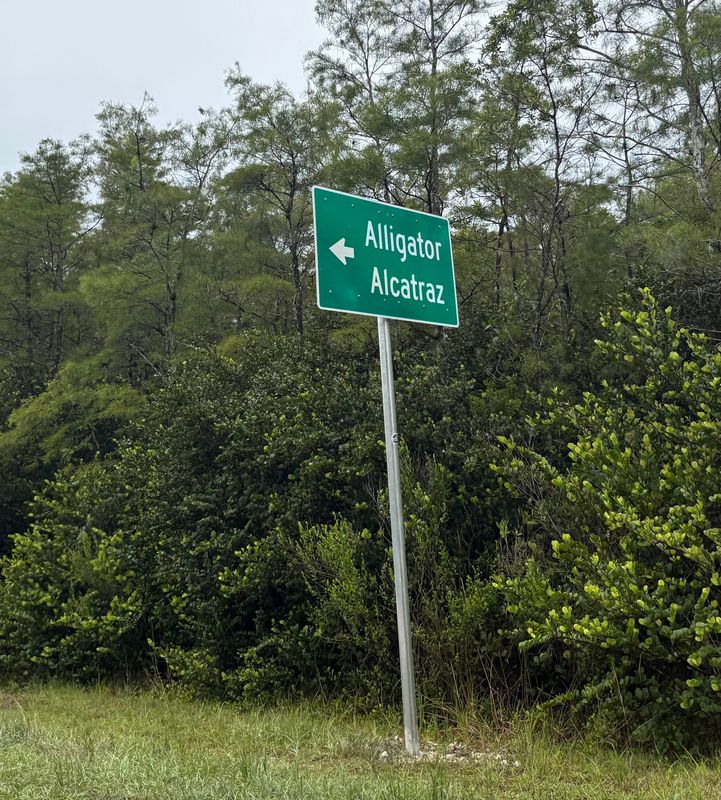
For some, they find the name and novelty intriguing enough stop for pictures at the signs, whether at the Alligator Alcatraz road entrance or at a sign pointing visitors in the detention center’s direction when heading out of Everglades City on State Road 29.
“Alligator Alcatraz, of course, it looms so large,” Damico said. She called the name cruel.
Initially, it seemed DeSantis and Trump were using the name as a nickname, however, in mid-July a spokesman for Florida Attorney General James Uthmeier, said in an email to the Miami Herald/Tampa Bay Times Alligator Alcatraz “is the official name.”
Official highway signs declaring “Alligator Alcatraz” went up not long after the president’s visit.
USA Today Network-Florida, which includes the Naples Daily News and The News-Press in Fort Myers, will continue to pursue records and visits to the detention center.
J. Kyle Foster is a senior growth & development reporter for The News-Press & Naples Daily News. She has more than 30 years of experience as a journalist, covering healthcare, education, government and finance, among other topics. Reach her by emailing jfoster1@usatodayco.com.
Please support local community journalism and stay informed about Southwest Florida news by subscribing to The News-Press and Naples Daily News; download the free News-Press or Naples Daily News app, and sign up for daily briefing email newsletter, food & dining and growth & development newsletters here and here.
This article originally appeared on Naples Daily News: Alligator Alcatraz remains a mystery because state won’t talk about it
Reporting by J. Kyle Foster, Fort Myers News-Press & Naples Daily News / Naples Daily News
USA TODAY Network via Reuters Connect