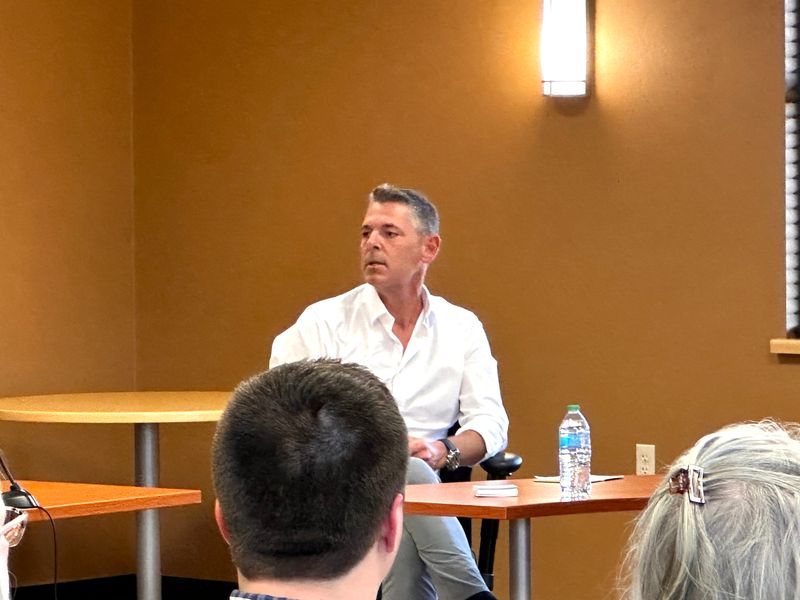
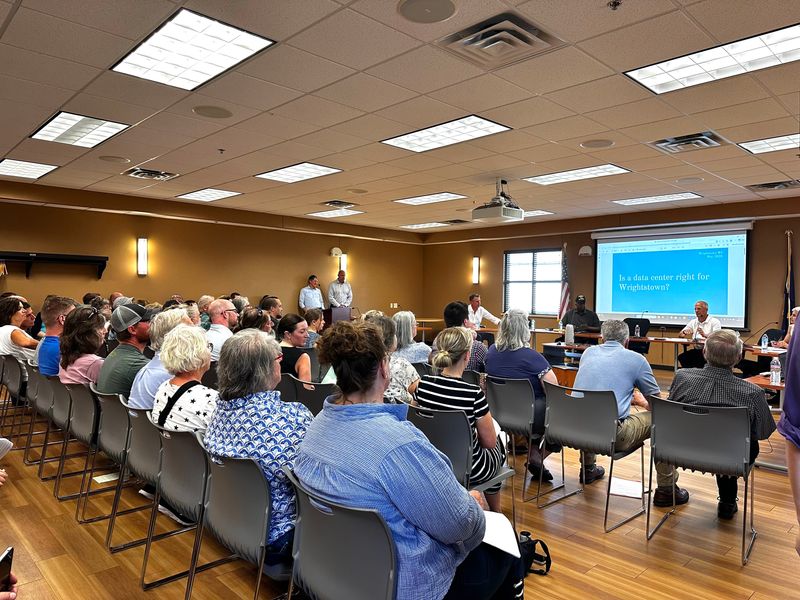
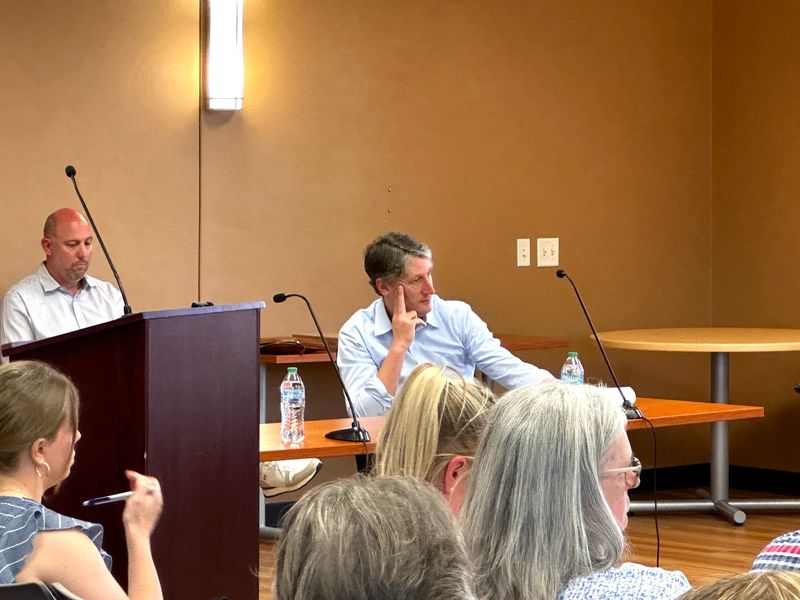
WRIGHTSTOWN – Cloverleaf Infrastructure publicly defended its interest in an AI data center in northeastern Wisconsin to a largely critical audience on May 26 at a listening session at the Village Hall.
The company, which is trying to find land for an over 1-gigawatt facility in northeastern Wisconsin, has drawn heat in recent months over its discussions with officials in the villages of Greenleaf and Wrightstown. This was the first time company officials have defended their interest.

Many residents have expressed distrust with their village officials, citing a lack of information about the extent of discussions with the data center developer and saying they objected to any considerations of a data center.
The public opposition in Wrightstown has been so great, its Village Board will convene a special meeting on May 27 to consider a referendum gauging residents’ support for a data center, though has stopped short of pursuing a moratorium.
Aaron Bilyeu, chief development officer for Cloverleaf Infrastructure, and Nur Bernhardt, vice president of power and utilities, framed their company as an ethical player in the growing AI industry under scrutiny over its socioeconomic impacts and transparency concerns.
They acknowledged challenges of ongoing data center development in Beaver Dam and Port Washington, though argued any development in the state’s northeast will be different as a result.
Bilyeu said he didn’t think the decision to have around-the-clock construction of Port Washington’s data center was “a right decision.”
And to fund any data center development, Bilyeu said the company would not ask for any tax increment financing, a mechanism that communities use to incentivize development that would otherwise not happen. He was addressing comments made by Prescott Balch, a former senior vice president at U.S. Bank, who had told the audience that Beaver Dam and Port Washington “made some really big mistakes” in spurring data center construction in a way that residents would not see tax benefits for years because of the decades-long nature of tax increment financing.
Cloverleaf Infrastructure also gave several promises for any future development in the area to mitigate environmental, health and economic risks while also denying that such impacts were as severe as many perceive them to be.
Bilyeu said cooling systems in new data centers using recirculated water would not need to discharge at some point into the environment, as some residents said. He also said data center construction wasn’t to blame for what some residents said were reports of contaminated well water in Beaver Dam, saying the correlation was a coincidence.
He also downplayed some residents’ concerns about noise pollution, saying a typical decibel reading beyond the perimeter of a data center falls between 55 and 65 decibels and would not be disturbing to neighbors.
“The negative things you hear about data centers are based on things that were true in the past,” Bilyeu said.
The company has not proposed a data center in northeastern Wisconsin but would commit to enough landscaping around any future facility to block it from exterior view, Bilyeu said.
He said the company would work with any community to ensure road infrastructure was adequate to manage construction vehicles and would cover the costs of damaged roads following construction.
Bernhardt said the company’s approach to data center development had been refined following lessons learned from its experience of “some real examples of where this has gone wrong in Wisconsin.”
He said Cloverleaf Infrastructure would press forward in finding a site for a data center in the region and that all costs incurred would be covered by the company.
“This isn’t going to happen unless you want it to happen,” Bernhardt said, adding, “If you prefer to ridicule and do other things, you can do that, too. But I really want to encourage you to lean in and see this as an opportunity for your community.”
Their arguments were met with skepticism by the 21 audience members who spoke during public comment about their worries of a data center on their livelihoods, from effects on the water supply to their kids’ futures. Many said they did not trust the developer or village officials to have their best interests at heart, which they said would be to oppose any talk of a data center.
To the question projected at the front of the Village Hall – “Is a data center right for Wrightstown?” – many testified in the negative.
Scott Griep, a physician assistant in cardiothoracic surgery who lives in the Town of Wrightstown, criticized Bernhardt’s characterization that the company’s future assurances in the region were being informed from its developments elsewhere in the state.
“If you had a heart disease, and you came to my clinic, and I said, ‘We have the cure for it. We’ve done this surgery four times. Nobody’s survived this, but we’ve learned something each time,’ you probably wouldn’t do it,” Griep said.
Sherry Van Rossum, a village resident, said her mother had been one of those approached by Cloverleaf Infrastructure “with a very insane offer” for her land that her mother ultimately turned down. She said she could not trust company representatives on anything they were saying, nor her village officials who have expressed their interest in a data center to boost the village’s tax base.
Addressing Travis Coenen, the village administrator, Van Rossum said, “I understand you’re trying to get revenue and keep our community going, and I appreciate all you’ve done. This is not the solution. This is not it.”
Jesse Lin is a reporter covering the community of Green Bay and its surroundings, as well as politics in northeastern Wisconsin. He also writes a weekly column answering reader questions about Green Bay. Contact and send him questions at 920-834-4250 or jlin@usatodayco.com
This article originally appeared on Green Bay Press-Gazette: In Wrightstown, Cloverleaf Infrastructure defends AI data centers
Reporting by Jesse Lin, Green Bay Press-Gazette / Green Bay Press-Gazette
USA TODAY Network via Reuters Connect