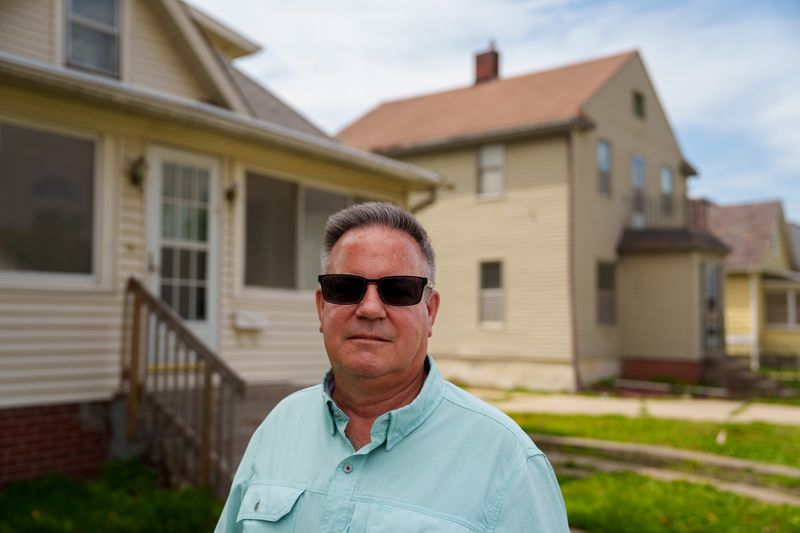
In less than a decade, the median home price in the Des Moines metro has shot up more than $100,000 to $315,000, a surge that’s made finding starter homes increasingly difficult.
But in Valley Junction, a historic enclave of homes, shops, small businesses, galleries, eateries and bars, homes remain relatively affordable. The median assessed value of a home there is $204,000 versus $340,100 for wider West Des Moines, according to the Polk County Assessor’s Office.

Still, over the last few years, maintaining that affordability and Valley Junction’s quaint identity has required a fight.
This year some longtime residents have been worried about a proposed 12-plex townhome or condo development along Fourth Street, adjacent to the heart of Valley Junction’s main commercial strip on Fifth Street. A successful developer with sway among metro leaders bought up three existing homes with the hope of turning the land into one big development.
That stirred concern of more gentrification in the homey district whose roots date back to the mid-1800s. Folks fearing it would displace existing affordable housing sounded the alarm on social media, contacted city officials and planted protest signs in their yards.
As of the week of May 17, the residents appeared to have won ― at least temporarily.
In a brief phone call, developer Ryan Wiederstein confirmed his development is on hold indefinitely. The homes he purchased at 304, 308 and 312 Fourth St., rentals that were sitting empty, had been scheduled for demolition. Now Wiederstein isn’t sure what he’s going to do.
“It doesn’t sound like the city is supporting it. I think it’s dead,” he said.
But Wiederstein, owner of WB Realty, is not the kind of dealmaker who would easily walk away. In 2024, his firm cinched the purchase of the former Wells Fargo Mortgage Corporate Office campus at 7001 Westown Parkway, valued at the time by the Dallas County Assessor’s Office at just over $73 million, for $16.5 million. The firm also worked a deal to build South Branch Business Park, including a 76,800-square-foot warehouse, at Southwest 42nd Street and Army Post Road on Des Moines’ southwest side.
To seal the deal in Valley Junction, his company would need a zoning change converting the three residential lots into one big one and for the City Council to finally decide what to do about proposed “transition zones” in Valley Junction.
The transition zoning had been proposed years ago to allow Valley Junction’s business district to expand into existing residential neighborhoods. The new category was suggested to allow an existing house in a residential area to be turned into a commercial property, as have many in the retail district. It would also allow replacement of an existing house with a business, though it would still have to look like a single-family residence.
Wiederstein hopes any eventual zoning provision also would allow developments like the one he wants to build. He said that while it doesn’t sound like the current council wants a transition zone where he bought the homes, he’s not going to do anything with the homes until it makes up its mind on the issue.
Residents fight to preserve Valley Junction’s sense of place
In the next couple months, council member Kevin Trevillyan wants to resolve the matter and help bring residents closure, ensuring the 12-plex project and others like it won’t ever happen ― at least not where Wiederstein envisioned.
At the crux of a coming discussion, expected in June or July, before the West Des Moines City Council is the future of a neighborhood that has long felt like a small town but has been changing ― some think too much, he said.
“It’s absolutely a debate about the future look of Valley Junction,” said Trevillyan, who has represented the area for 17 years. “And about affordability. The more residential that goes away, the harder it is to find.”
Nick Waage is the Valley Junction resident behind the signs in many yards that say: “No apartments or transition zones in Valley Junction.” He said he’s lived in the district for almost 40 years and “right now, it has never looked better.”
Waage, who lives near the Theatrical Shop, a Fifth Street landmark, said what Wiederstein has proposed ― a 12,000-square-foot complex ― is “way” outside the city’s master plan for Valley Junction.
He said homes for sale in Valley Junction go fast and he wants to keep it that way. While change is constant, he said, he also wants to maintain the unique identity and atmosphere people love about Valley Junction.
Scale, affordability are major concerns in West Des Moines neighborhood
Founded in 1846 by settler and abolitionist James Jordan, a wealthy cattle farmer who helped people fleeing slavery in the Underground Railroad, Valley Junction was originally its own town. It became part of West Des Moines in 1937. Once home to many railroad workers, it has long been a diverse neighborhood with dozens of historic buildings. The commercial district was placed on the National Register of Historic Places in 2017.
While many historic downtown areas in Iowa have changed completely, Valley Junction’s has remained largely intact, even with new development in recent years. After a moratorium on new construction sunsetted in 2021, city officials, residents and business owners established a steering committee meant to set design guidelines for future development, as well as provide feedback on construction plans.
In 2022, the steering committee recommended the transition zones should be scattered through Valley Junction to expand the existing commercial space. But residents widely opposed them near Fifth Street and the zones were never acted upon by the council, Trevillyan said.
Chris Kavanaugh, who works at Kavanaugh Art Gallery on Fifth Street and lives on 10th Street between Vine Steet and Grand Avenue, said Valley Junction has managed to maintain its character with a mix of mostly small businesses while greater West Des Moines, which extends into Dallas and Warren counties, “tries to be too many things.”
But the 67-year-old said while some residents would prefer little change at all, “We’re not a small town and we do need to have money and businesses coming in.” He said he’d like that growth to continue to be in keeping with small, entrepreneurial spirit that has long been part of Valley Junction’s history.
Renae Johanningmeier, a resident who lives in Valley Junction and owns rental property in the neighborhood, is among those who oppose transition zones or any development that would take away affordable housing. She said costs are rising, services are shrinking and people who have lived in Valley Junction their whole lives now wonder if they’ll be able to stay, given rising property taxes.
She said developers promised affordable housing when they converted an existing school to the Phenix School Apartments across from her home. But rents there are higher than developers initially said they would be, she said, and the units are not drawing young families.
“We want (homes) left alone,” she said. “We want our small houses so we can stay in them and they remain affordable.”
Trevillyan said he hopes that this summer the council can finally decide on what to do about the transition zones. The residents he’s talked to, he said, strongly opposed converting more residential property near Fifth Street to a transition zone.
“People were very vocal. They said, ‘Why would you expand it out when the demand’s not there?’” he said.
Trevillyan said there’s land south of Railroad Avenue around Lincoln Street that could be developed, even if Wiederstain doesn’t own it.
“The single most affordable housing we’ve got in West Des Moines is in Valley Junction,” he said. “It makes no sense to convert these homes or bulldoze them.”
Lee Rood’s Reader’s Watchdog column helps Iowans get answers and accountability from public officials, the justice system, businesses and nonprofits. Reach her at lrood@registermedia.com, at 515-284-8549, on Twitter at @leerood or on Facebook at Facebook.com/readerswatchdog.
This article originally appeared on Des Moines Register: Valley Junction wins round against Des Moines metro development surge
Reporting by Lee Rood, Des Moines Register / Des Moines Register
USA TODAY Network via Reuters Connect