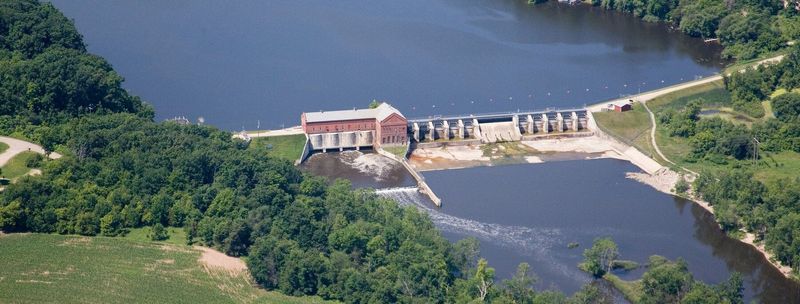
Consumers Energy is seeking state regulators’ permission to sell 13 hydroelectric dams on some of the most iconic rivers in Michigan’s Lower Peninsula to a Maryland-based private equity firm.
While some support the move as a way to potentially stave off losing the dams and the life built around them over a century, others oppose the sales, saying it will offload dam liabilities − some of them already needing hundreds of millions of dollars in repairs and upgrades − to a less accountable private owner whose long-term commitment and motives can’t be guaranteed.

Consumers Energy seeks to sell the 13 dams to Hull Street Energy LLC, a private equity firm based in Bethesda, Maryland, and its wholly owned subsidiary, Confluence Hydro LLC, for $13. The sale would include a power purchasing agreement by which Consumers would commit to buy back power from Confluence at a starting rate of $160 per megawatt-hour − approximately double the going market rate for comparable hydropower. The 30-year agreement includes a 2.5% annual price increase.
The dams proposed for sale include:
The dams were built between 1905 and 1936 and have generated power for Consumers Energy customers for more than a century on average, according to the utility’s filings with the Michigan Public Service Commission. But aging dams need ongoing, expensive maintenance, and the costs of generating hydropower have increasingly become uncompetitive.
The proposed sale to Confluence Hydro “allows Consumers Energy to transfer substantial future operational and environmental liabilities and risk to Confluence,” utility officials stated in their MPSC filing, adding that it “is the lowest-cost option for the future of these plants.”
“The transaction also benefits the state of Michigan and numerous local communities where the facilities are located by preserving the dams and related impoundments, which provide important economic and recreational benefits in those communities and to the state.”
Confluence Hydro spokeswoman Natalie Joubert provided an emailed statement to the Free Press: “Confluence Hydro specializes in the safe and efficient operation of hydroelectric dams. We plan to own, operate and relicense all 13 dams to ensure they continue to provide safe, clean power, recreation, and economic benefits for local communities for decades to come.”
A key part of the sale is the 30-year power purchase agreement with Consumers, Joubert said.
“This agreement provides a long-term incentive for us to invest in, own and operate the dams safely long into the future,” she said.
‘They are not a dam operator; they are a dam flipper’
But Howard Learner questions Confluence Hydro’s commitment to the long-term operation of hydroelectric dams. Learner is the CEO of the Environmental Law and Policy Center, a Chicago-based nonprofit representing five fishermen’s and conservation organizations in Michigan opposed to the Consumers Energy dam sales.
Hull Street Energy, Confluence’s parent company, has acquired 47 dams since 2017 − and sold 46 of them within five years or less, Learner said.
“They are not a dam operator; they are a dam flipper,” he said. “They buy the dams, then they flip the ownership to someone else. There is no track record of Hull Street Energy being a long-term dam operator.”
Learner noted the “Russian nesting doll” corporate structure for the proposed Michigan dam buyer. Hull Street Energy created Hull Street Energy Portfolio 3 limited liability corporation, which created a partnership with Confluence Hydro LLC, which in turn is creating 13 separate LLCs, one for each dam.
“The obvious purpose of doing that is to ring-fence the liabilities, so that if there is ever a problem at Dam Number 6, whichever of the dams that may be, they can declare bankruptcy for LLC Number 6 and it doesn’t affect LLC Number 7 or any of the others,” Learner said. “The costs will get dumped onto the public.”
Confluence Hydro did not respond directly to Free Press questions regarding its corporate structure for the dams in Michigan.
Other private dam owners evaded liabilities through bankruptcy
Bob Stuber, a Traverse City resident and executive director of the nonprofit Michigan Hydro Relicensing Coalition, a group of fishermen’s and conservation groups that intervene in the relicensing of hydropower projects, believes dams on public trust rivers should not be owned or managed by private equity groups or interests.
“There’s not a good history of it in Michigan,” he said.
Stuber cited the May 2020 failure of the Edenville and Sanford dams on the Tittabawassee and Tobacco rivers in Midland and Gladwin counties. The private owner of the dams, Boyce Hydro LLC, had its power generation license revoked by the Federal Energy Regulatory Commission less than two years earlier for repeated compliance violations, including the Edenville Dam’s inadequate spillway capacity to handle major probable maximum flood events.
After nearly 5 inches of rain fell within two days in May 2020, the Edenville Dam failed, sending a wall of water that also caused the Sanford Dam downriver to fail. Widespread flooding that ensued in Midland and Gladwin counties forced the evacuation of tens of thousands, and the flooding caused more than $200 million in damage.
Boyce Hydro Power LLC filed for Chapter 11 bankruptcy in mid-2020, shortly after the dam failure. A U.S. District Judge in November 2023 found Boyce principal Lee Mueller liable for $119 million in environmental damage caused by the dam failure. A U.S. Bankruptcy Court judge in Nevada denied Mueller’s attempt at a personal Chapter 13 bankruptcy in February 2024, finding he misrepresented facts before the court and that his effort “smacked of bad faith.” Boyce and Mueller’s liabilities to creditors remain unresolved.
“They essentially sought refuge in bankruptcy,” Stuber said. “Even though there’s a $120 million judgment against them, good luck ever getting it. Who ends up footing the bill for that, for the rebuild? The public, the taxpayers.”
In another incident, UP Hydro LLC, a subsidiary of Wisconsin-based Renewable World Energies, filed for Chapter 11 bankruptcy in early 2023, but had the bankruptcy dismissed by a judge in August 2025 because the company failed to complete required financial filings. This allowed creditors to foreclose on the property surrounding the Au Train Dam in Alger County in Michigan’s Upper Peninsula. The dam had its hydroelectric generation license terminated by FERC in December 2025, transferring safety and decommissioning oversight of the properties to the state of Michigan.
“We just don’t feel it’s a good idea to sell 13 hydropower projects to a private equity group,” Stuber said. “Equity groups always claim they are coming in with a better idea − ‘We’re going to be more efficient; we’re going to wring more profit out of these;’ − and generally they strip the assets, and then they often flip whatever it is, a project, a property, a business. I mean, that’s the business model.”
Stuber added that private equity groups have a fiduciary responsibility to their shareholders or investors to maximize profits. “That’s different than a publicly regulated utility like Consumers,” he said.
Consumers Energy spokesman Brian Wheeler said the utility does not overlook what happened in the Edenville and Sanford dam failures and their aftermath.
“Without strong ownership, we understand why some may worry,” he said. “But the sale of our dams to Confluence Hydro shows the other side of that story. When you have a private owner with the right track record, expertise, finances and desire to carry on the tradition of serving our communities, you have a recipe for success.”
Some who live around the dams support their sale
Many who support the Consumers Energy dam sales do so because they fear the utility’s stated alternative if the sale doesn’t go through.
“We would proceed to the next lowest-cost option, which is decommissioning and removal of the dams,” Wheeler told the Free Press.
Newaygo County resident Paul Mack, in a comment submitted to the MPSC, said he strongly supports the sale to Hull Street Energy.
“I am convinced that this is the best, safest long-term course of action,” he said. “I live on Croton (Dam) and decommissioning the dams would be crushing to property values, the township tax bases and all of the businesses on these bodies of water.”
Ryan Wilson, executive director of the Ionia County Economic Alliance, also registered his support for the sales in a letter to the MPSC.
“Consumers Energy spent years engaging communities on the future of these hydro dams and found a vast majority of residents wanted the dams to remain, as they provide important economic, recreational and cultural opportunities for communities,” he said.
“If the sale is not approved, Consumers Energy has pledged to remove the dams. Decommissioning the dams would have devastating effects on Ionia County and the communities that have been built around the dams, and saddle ratepayers with higher utility rates at a time they can least afford it.”
Removing at least some of the dams has its fans, too
But among the intervening groups before the MPSC, many fishermen’s groups would be supportive of at least some of the dams being removed and naturally flowing rivers and habitat restored.
Bryan Burroughs is the executive director of Michigan Trout Unlimited, an intervener before the MPSC opposed to the Consumers Energy sale.
“On cold-water trout streams in Michigan, dams warm the rivers up,” he said. “They prevent aquatic organisms of all types, but especially fish, from moving up and down the river, accessing all the different habitats they may need at different times of the year or different phases of their life.”
Burroughs said people often express confusion about it, noting that the fishing is great just below Tippy or Croton dam. But that’s because of the Michigan Department of Natural Resources fish-planting, “because the water is warmer and they can’t do it on their own,” he said.
“If you are looking at what is best for cold-water fisheries, if the dam is sitting there warming up a trout stream, yeah, of course, if you advocate for the trout, you would want to see that impairment to that river removed,” he said.
“We have reached a point where the (utility) that owns the dams is saying these are such bad money-losers, these are the most expensive form of electricity, and we just want done with it. Well, if that primary benefit is no longer presented where we have to absorb the negative cost environmentally of it, is now an OK time to talk about removing the impairment that they cause and going back to what the river was supposed to be without them?”
Administrative law judge’s recommendation coming soon
Testimony and legal briefings ended in the Consumers Energy sale proposal case before the MPSC in late April, and an administrative law judge has targeted June 10 to issue a proposal for decision with a review of the case and recommendations for the public service commission’s three members appointed by the governor with advice and consent of the state Senate.
An administrative law judge’s recommendations are not binding, and a decision from the commission is expected later this year, MPSC spokesman Matt Helms said. It could accept the sale, reject it, or impose conditions.
“Under law, the commission has to weigh factors including whether the deal will have an adverse impact on customer rates; the provision of safe, reliable energy service; or a utility’s ability to raise capital and maintain it; and whether the transfer is in the public interest and consistent with public policy,” he said.
Learner noted the necessary repairs to the Hardy Dam on the Muskegon River are estimated at $350 million, including major spillway upgrades to handle changed maximum flood capacities. Those costs moving from a publicly regulated utility that can impose cost-recovery fees on ratepayers to a private company that cannot only further cloud how such an expense can be met.
“MPSC should reject the sale proposal, and people of goodwill should be able to sit down together and reach reasonable solutions on the future of each dam,” he said.
If Consumers Energy retains dam ownership and moves forward with decommissioning and removal of the dams, the MPSC would continue to have oversight and public processes and input would be involved, Learner said.
“That is a good thing in terms of protections for Michigan ratepayers, taxpayers and the public interest in Michigan,” he said.
Consumers Energy not only has a form of accountability to the public through being a publicly regulated utility; it also has a track record, Burroughs said.
“Whether we want these dams kept or whether we want them removed, we trust that Consumers can navigate that process,” he said. “But we don’t know the company they are going to sell them to, and we don’t have a lot of trust for them. And we know that structurally, there will be less accountability for that company. It poses much more risk and uncertainty.”
Stuber noted that Consumers Energy, in its MPSC filing, stated it wants to be out from under the environmental and other liabilities from the dams, but still buy power from their new owner.
“You still want the power, but you want someone else to take on the liability,” he said. “We in Michigan have seen how that goes. It’s not a good thing for us.”
Contact Keith Matheny: kmatheny@freepress.com.
This article originally appeared on Detroit Free Press: Consumers Energy seeks to sell 13 dams statewide to private equity firm
Reporting by Keith Matheny, Detroit Free Press / Detroit Free Press
USA TODAY Network via Reuters Connect