The lone major void in Kyle Busch’s career was victory in the Daytona 500, though he won several other races in every manner of stock-car (and truck) that competed at the World Center of Racing.
But it’s the one Daytona 500 he missed entirely that made a lasting impact on Daytona International Speedway, and the entire sport in general. It came due to an unfortunate physical impact.

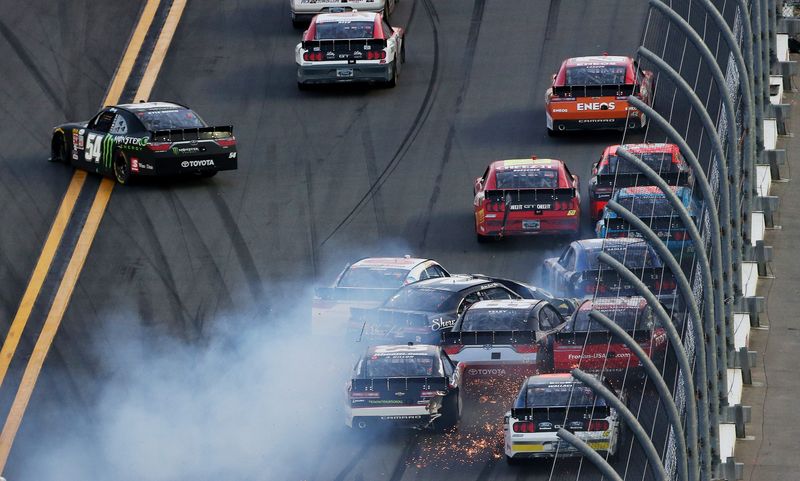
During the 2015 Xfinity Series race, the Saturday 300-miler preceding Sunday’s Daytona 500, Busch was part of a multi-car crash just past the start-finish line with nine laps remaining.
Kyle Busch after 2015 Daytona crash: “Man, I’m done”
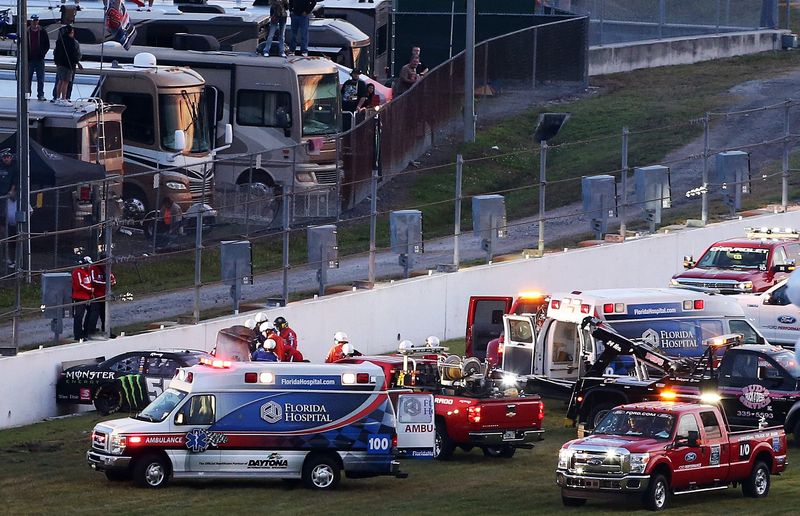
While other cars careened off each other and the outside wall, Busch’s No. 54 Toyota, with broken steering, was sent on a high-speed angle directly toward the concrete wall bordering a grass field inside the entrance to Turn 1.
The head-long crash left Busch with a double compound fracture to his right leg as well as a broken left foot. He not only missed the next day’s 500, but the first 11 races of the season as he recovered.
Later, he recalled his immediate thoughts as he awaited the rescue crew.
“I’m thinking to myself, ‘Man, I’m done. There’s no way I’m going to be able to come back from this. This hurts.’”
At that time, “soft wall” technology, in the form of SAFER Barriers, had become common throughout auto racing, but was mostly relegated to the outside walls. Many tracks still had exposed concrete walls on the inside of the track — including inside Turn 1 at Daytona.
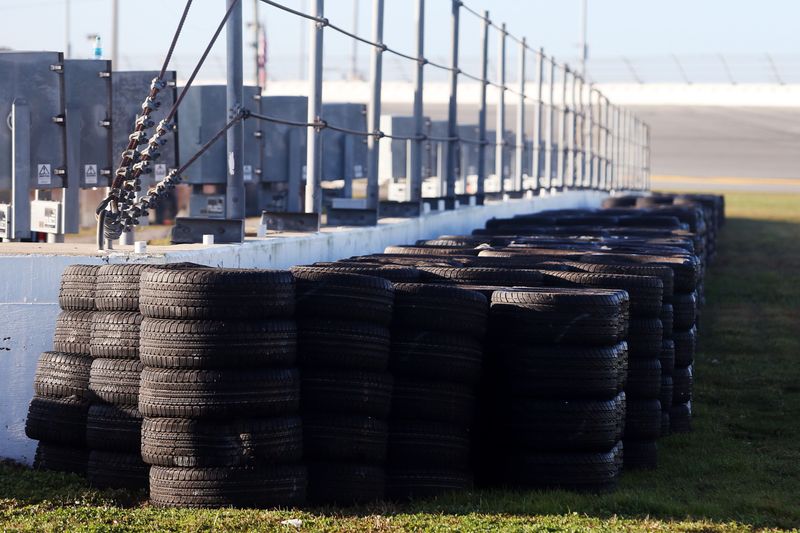
That changed immediately, though in rudimentary fashion, when tire barriers were placed against that section of wall prior to the next day’s race.
Changes at Daytona and throughout NASCAR followed the crash
“The thing us drivers have a hard time getting these people to realize or recognize or understand is that anything can happen,” Busch said later that spring when recapping the incident. “We can hit any wall, any way. They just don’t believe it until they see it.”
A SAFER Barrier replaced the makeshift tires in front of that wall, and asphalt replaced the grass in that area of the Speedway.
Drivers had become more vehement in their desire to get rid of grass alongside race tracks, because their slick tires couldn’t gather any grip on the grass and therefore there was no way to scrub off speed and, in a perfect world, steer the car away from a worst-case scenario.
So Kyle Busch never won a Daytona 500, but he helped — in unfortunate fashion — make it safer for himself and all others.
Oh, by the way, he also came back after 11 weeks and won that year’s Cup Series championship, the first of two he’d win in his Hall of Fame career.
This article originally appeared on The Daytona Beach News-Journal: Kyle Busch’s 2015 Daytona crash was a big impact that made a big impact on NASCAR
Reporting by Ken Willis, Daytona Beach News-Journal / The Daytona Beach News-Journal
USA TODAY Network via Reuters Connect