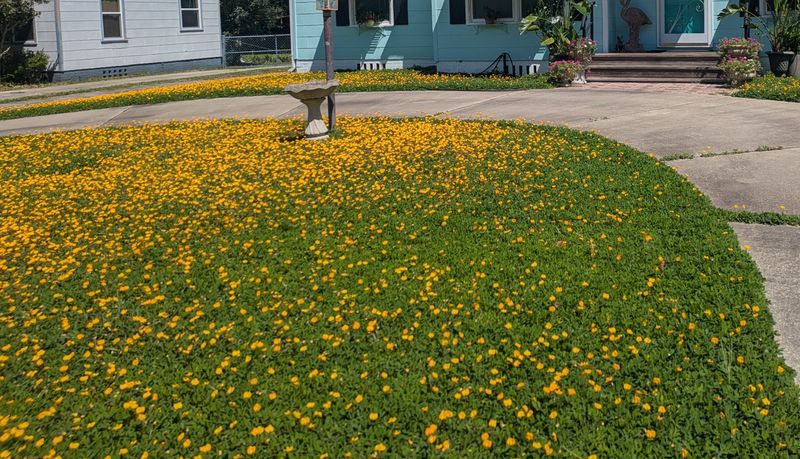
It has already been a very stressful growing season for St. Augustinegrass lawns, and we’re just getting started. Some lawns struggled to green up and get growing after the freezes last winter. Chinch bugs have been active, leaving lawns with large areas of dead grass.
Now we’re under extreme water shortage restrictions put in place by the St. Johns River Water Management District. Irrigation systems can only be used one day per week due to the severe drought. Hopefully, we will start getting afternoon rain again soon. But then fungal diseases like take-all root rot will come into play. It’s not surprising if your St. Augustinegrass doesn’t look its best and resodding is in your future.

Before you order that pallet of sod, consider perennial peanut. Perennial peanut is a great alternative to turfgrass for Florida lawns. It grows in a wide range of soil pH, as low as 5 and as high as 7.5. It tolerates salt spray and occasional saltwater flooding. It thrives in full sun to part shade. Sandy soil is not a problem, and it can handle low foot traffic. Perennial peanut prevents soil erosion on slopes. And its edible yellow flowers bloom all summer long.
But here’s the best part about perennial peanut: it is ultra-low maintenance once established. Imagine for a moment that you have a lawn that never needs to be fertilized, watered, or sprayed for insects or diseases. It rarely even needs to be mowed. Think of the time you would get back to do other things! Think about all the money you would save!
Your water bill would likely be cut in half. Any cash you were putting towards fertilizing and treating your St. Augustinegrass lawn is now yours to spend on other things. Does this sound too good to be true? I’m sure it does, but I can tell you with confidence that perennial peanut really is this tough. We have two areas of perennial peanut growing at my office, and I have watched them thrive for the past five years with very little care. They are unfazed by the drought, and they just look great.
So, what are the downsides? There are a few. The most significant one is the start-up cost. You will spend much more money on perennial peanut plants than you will on squares of sod. The plants can be installed on 12”-18” centers, and they do fill in quickly. After the plants are established, you will get that return on investment.
The second downside, which I think is minor, is that it will go brown and dormant in winter. It does come back, even after the freezes of the last cold season. If you must have a green lawn year-round, you can always overseed with rye grass in the fall. The rye will die out when the weather warms up, and by that time, the perennial peanut will be back.
The third downside is that weeds must be controlled until the peanut fills in. There are some things you can do to reduce the weed competition, though. A few herbicides are available that will control grassy weeds and won’t hurt your perennial peanut.
Before planting your perennial peanut, make sure to kill all the existing vegetation first. You can do that with a non-selective herbicide such as one with the active ingredient glyphosate. Or rent a sod cutter and remove the vegetation. Don’t delay planting after you get the area cleared; weed seeds in your soil are always ready to germinate and fill in any bare spots. After the plants fill in, weeds can be easily controlled using a mower. Simply mow when the weeds are taller than the peanut by setting your deck height just above the plants, cutting off the tops of the weeds. If you mow the perennial peanut, it just encourages more blooms and a flush of new growth.
When you are ready to replace some St. Augustinegrass and all its problems with perennial peanut, start small. Maybe you have a patch of dead grass next to the driveway post chinch-bug infestation. Perhaps convert the strip of grass between the sidewalk and the street. Start small so that you don’t get overwhelmed with controlling the weeds during establishment. Starting small also spreads out the start-up cost, so it isn’t such a hit to the wallet. Give the area a year to grow in, and next spring, make it a little larger or move on to a second section. You can even dig and transplant your own plugs from the established perennial peanut. Make sure to keep the plants watered during establishment, just as you would do with any other new plant.
Want to have a lawn that turns heads and has people slowing down to take photos? Want a yard that’s free of chemicals? Want to conserve water and save money? Perennial peanut is the answer.
Tonya Ashworth is an extension agent and environmental horticulture and Master Gardener coordinator with UF/IFAS in Duval County.
This article originally appeared on Florida Times-Union: Frustrated with St. Augustinegrass? Try this low-maintenance option
Reporting by Tonya Ashworth, For the Jacksonville Florida Times-Union USA TODAY NETWORK / Florida Times-Union
USA TODAY Network via Reuters Connect