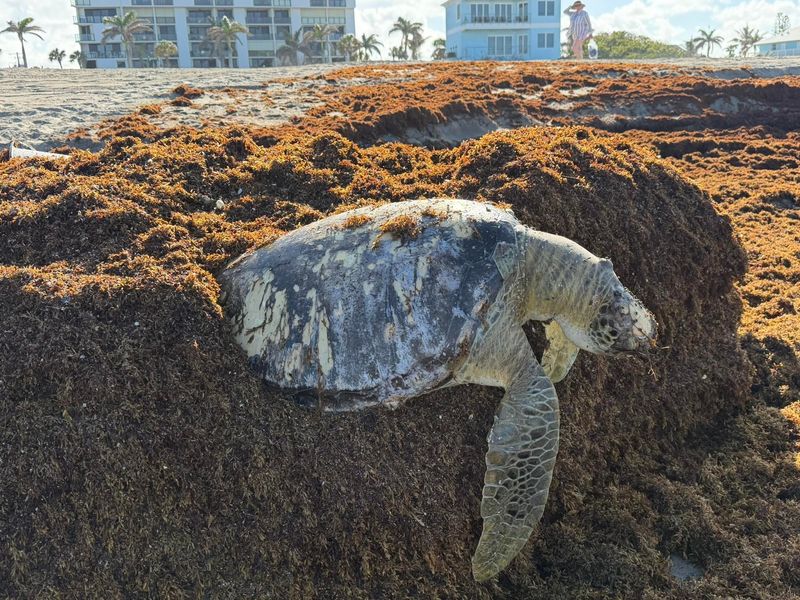
A sea turtle was found dead in a sargassum seaweed patch on the beach south of the Fort Pierce Jetty on May 20. Its death came as Florida is seeing an unprecedented amount of seaweed wash up for this time of year.
There are many reasons the turtle could have died and washed up with the seaweed. TCPalm is waiting for the Florida Fish and Wildlife Conservation Commission to respond to its questions posed May 21.

Fort Pierce resident Adam Locke found the turtle in a large clump of seaweed on the beach shortly after 4 p.m. and called FWC, who said wildlife officials would come get the turtle that night, Locke told TCPalm. He did not see a nest nearby.
“This is really a problem for sea turtles,” Locke said. “It’s dangerous when it’s (sargassum) this thick.”
Tons of sargassum seaweed head for Florida beaches
Historic amounts of seaweed bloomed in the Atlantic Ocean this winter and spring, which is generally the slower time for growth and development.
For the entire Atlantic, the total sargassum biomass was 9.5 million tons in January and 19.1 million tons in March, according to University of South Florida oceanography professor Chuanmin Hu. It was 28.7 million tons in April, nearly breaking the historical spring record of 30.5 million tons in 2025.
That’s the weight of nearly 100 Empire State Buildings.
Historically, the biomass has averaged 8.5 million tons in January and 16 million tons in March.
Sargassum is a yellowish-brown floating macroalgae that crabs, shrimp, sea turtles and other marine life depend on, but large amounts on beaches can deter people because of the smell when it rots and how it feels on their skin while swimming. Some Florida governments spend millions of dollars to remove it from the beach.
Since sea turtle nesting seasons runs from March 1 through Oct. 31, removal must be approved by the Florida Department of Environmental Protection in coordination with the FWC.
Why is sargassum seaweed a problem?
Seaweed in small amounts should be left in place because it is beneficial to wildlife and the environment.
It provides a building block for dunes by helping them trap sand, and it provides nourishment to the dune plants.
On the beach, little critters live in it, and shorebirds eat them.
In the water, a healthy amount of sargassum, called “weed” or the “weed line,” is beneficial for offshore fishing, as it can house the baitfish that brings in prized gamefish such as mahi-mahi, sailfish, wahoo and triple tail.
But sargassum is washing up on Florida’s shores in record amounts. It’s becoming a serious threat to vulnerable sea turtle hatchlings during a critical journey that determines their chances for survival, , according to a study by Florida Atlantic University and Charles E. Schmidt College of Science.
Florida sea turtle hatchlings harmed by seaweed
Every year, sea turtles hatch on Florida’s beaches and start their journey from the sand to the ocean. But sargassum seaweed is looming as these hatchlings navigate other obstacles such as artificial lights, beach debris and predators such as birds and crabs
The Sargasso Sea is a vast patch of the Atlantic Ocean named after the free-floating sargassum, according to the National Oceanic and Atmospheric Administration, according to hea study published in the Journal of Coastal Research.
There are many different types of algae found floating in the ocean across world, but the Sargasso Sea is unique in that it harbors species of sargassum that are “holopelagic.” That means the algae not only freely floats around the ocean, but it also reproduces vegetatively in the open ocean.
It creates new plants through its non-reproductive parts, such as roots, instead of through seeds or spores. Other seaweeds reproduce and begin life on the floor of the ocean.
Tim O’Hara is TCPalm’s environment reporter. Contact him at tim.ohara@tcpalm.com.
This article originally appeared on Treasure Coast Newspapers: Florida sea turtle found dead in sargassum seaweed amid historic bloom
Reporting by Timothy O’Hara, Treasure Coast Newspapers / Treasure Coast Newspapers
USA TODAY Network via Reuters Connect