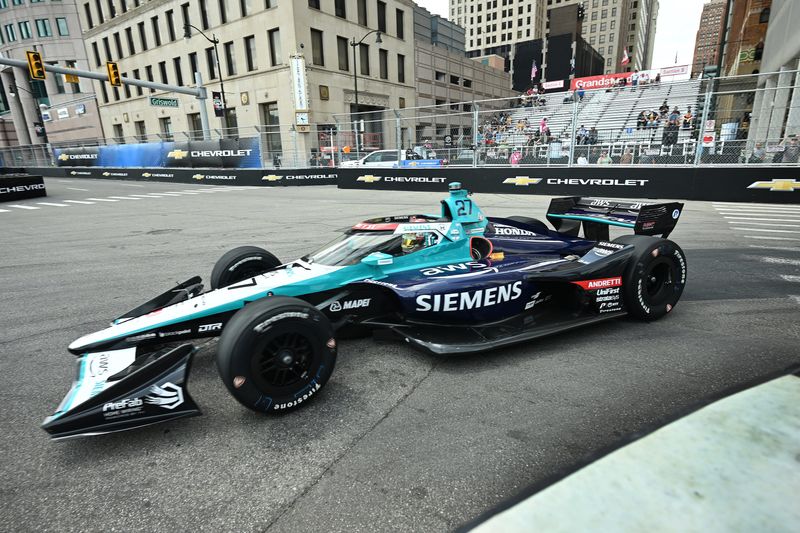
Kyle Kirkwood, the defending champion of the Detroit Grand Prix, is known around the series as the “Street Course King” for good reason. Kirkwood has six career IndyCar series victories, five coming on street courses.
While Kirkwood continues preparations for the upcoming Indianapolis 500 on May 24, with qualifying this weekend, he and the rest of the IndyCar series will turn their focus to the Detroit Grand Prix, May 29-31, on the 1.7-mile, nine-turn street circuit downtown. Kirkwood, who drives for Andretti Global, currently is second in series points behind Alex Palou and will be a favorite to repeat as Detroit champion.

He has one win this season among five top-five finishes. Kirkwood spoke with The Detroit News about his season, the Indianapolis 500 and returning to Detroit as defending champion.
Question: How are you feeling about the Indy 500 and your chances?
Answer: We feel really good. The past few years we’ve been kind of at the front in the races, but in qualifying, we haven’t been phenomenal. So that’s a lot of our focus this year, and we feel like we have some stuff given everything goes accordingly and according to plan. Never really does, but you learn a lot of stuff through the two weeks. That’s really the goal of all this practice before we get into the big race.
Q: How would you explain the Indy 500, the spectacle of it, to someone who’s never been there?
A: Well, it’s unlike anything else. It’s absolutely incredible that you have 400,000 people in one place at one time, and the whole city shuts down for one event. It’s hard to explain. Just the whole hype of the race, all the traditions that come with it, the event.
People have to get in here at 7 a.m. sharp to make sure that they get to their seat in time to watch the race. We have to stay inside the track the night before, because if not, we have to wake up at 4 a.m. to get to the track just to make sure that we beat the traffic to get in. It’s a crazy event. It’s definitely its own.
When you look at motorsports, you have big races and championships and stuff like that, but for us, it’s our own championship just as one race, because all the other races just don’t add up to what the Indy 500 does. It’s absolutely incredible. We all love it. We all want to win this race more than any other. And pretty sure anybody that etches their name in history by winning this race is forever a different person.”
Q: How are you feeling about your season as a whole so far?
A: It’s been really good. We led the championship for a couple races. We finished ninth this past weekend (at the Sonsio Grand Prix in Indianapolis), which felt like the worst race ever for me, but it was still a top 10, which is not an easy thing to do in IndyCar racing. So it’s been really good, and things are looking up for the rest of the season. We’ve been really good on every type of circuit, whether it’s a road course, street course, oval, short oval. Hopefully, these couple weeks coming up, we’ll be really good on the long oval, which is the only one that’s a speedway trim. So things are looking up at the moment.
Q: How do you manage going from this intense speedway experience to a tight street course in Detroit?
A: You have to be able to adapt and adjust to different conditions and circuits. Quite honestly, it’s very hard on everybody, especially with it’s pretty much six weeks in a row for us where we’re going nonstop. There’s no breaks even after the race, with the meetings, turning the cars over, getting ready for the next event. You have to leave the last race in the past, leave each test day in the past, learn from where you can and then move on and keep digging.
It’s not an easy thing through these six weeks. We go through the 500, which is an extremely stressful event in the hardest part of the year, and then it’s, guess what, we’re straight into Detroit, and then after Detroit, we go to St. Louis for an oval. It’s a tough turnaround, but they all pay the same points, so that’s the way we have to look at it. The Indy 500 pays the same amount of points as Detroit does that the Indy GP does and any other circuit out of the 18 races that we race. That’s really the focal point.
Q: Some athletes say a rival brings out the best in them. You and (current series points leader) Alex Palou seem to be developing a rivalry. Do you see it that way?
A: In some ways, yes. But “rivalry” might come across as a little harsh, just that word itself. We’re competing against each other very seriously, and I think we’re pushing each other along. I’m probably pushing him along on the street courses; he’s pushing me along on the other courses, and we’re kind of head-to-head at a lot of places that we go to now. It always feels like no matter which weekend it is, it’s always either one of us, and I always either see his gearbox or he sees mine, because we’re running first and second. It’s a cool thing because we’re both pushing each other very hard, and we’re taking each other to new levels, in a sense. Obviously, he’s taken the whole IndyCar championship to a new level the past few years, but I feel like I’m hot on his heels this season, putting a little bit more pressure on him than maybe he’s had in the past.
Q: You’ve been crowned the “King of the Street Course.” How do you feel about that crown?
A: It’s easy to point the finger at the driver (and give him all the credit), but quite honestly, our cars are just really good around street courses. That’s why we excel at them. So it’s great, because we’re really good on street courses. That’s our thing. It’s been incredible. Most courses that we go to, we’re always in the top five. We want to change that narrative and be good at all courses, which I think we’re on the track of doing. So it’s a work in progress, that’s for sure. In some ways, (the nickname is) good. In some ways, we want to change it.
Q: What makes the Andretti car so good on these street circuits?
A: It’s the only area of development that IndyCar is really able to play with is the dampers. Some of it is set-up and just a long history of doing well. They have really good baseline cars that come out of the trailer that you know are going to be good at street courses, and then we just compound on that with other development items that we can piece together. It typically ends up being really good for us. That’s really all it is, and it’s just stuff that we have figured out, and maybe they don’t.
Q: You and your new teammate, Will Power, who was with Team Penske last season, he pushed your car during practice last year at Detroit. Do you joke about that now?
A: Quite often, actually. He’s a funny guy, and we all know that he has his things that he does. Every time he tells me about it, I’m like, I wasn’t even mad. It’s not doing any damage to either one of our cars, and he’s like, “I’ll just continue to do this,” which makes no sense to the average human. But I think it’s part of the reason why he’s still in this sport, and he’s still so good at it, because he has a couple screws loose up there sometimes. He’s been a phenomenal teammate for us, and he’s a big reason why we’ve been pushing forward.
Q: Detroit has limited passing areas, so when you go into the Detroit Grand Prix — and maybe this is dependent on qualifying — how aggressive do you need to be early in the race?
A: Every circuit, you got to be pretty aggressive. Detroit, I’m not sure if it’s more or less, it’s hard to say, because that circuit can do anything. In some ways, it can turn into a bit of a lottery based on when yellows fall, what position you’re in, what strategy you’re on. But I’d say it’s been advantageous for most people to be pretty aggressive from the beginning, because given the nature of the street course, the various forms of asphalt don’t make a lot of tire temp. So being able to race hard in the beginning and get by some cars and catch people off-guard when tires are still cold is typically when you want to do it.”
Q: You want to win every race, but is winning Detroit still important to drivers because of the manufacturers here?
A: Detroit is a very historic race for IndyCar racing, and coming back to downtown is another historic moment for it. Being able to race around the GM building there and having a title sponsor like GM is a really big deal for any sport, so it brings some weight to it, and typically, I’d say street courses are bigger events. If you look at the history of Long Beach, St. Pete, Detroit, Toronto, outside of the (Indy) 500, those are the races that we pack full of people, and it’s accessible. It’s great racing. So (Detroit) is always one we want to win.”
achengelis@detroitnews.com
@chengelis
This article originally appeared on The Detroit News: Q&A: Kyle Kirkwood on Indy 500, and why Detroit Grand Prix is ‘always one we want to win’
Reporting by Angelique S. Chengelis, The Detroit News / The Detroit News
USA TODAY Network via Reuters Connect