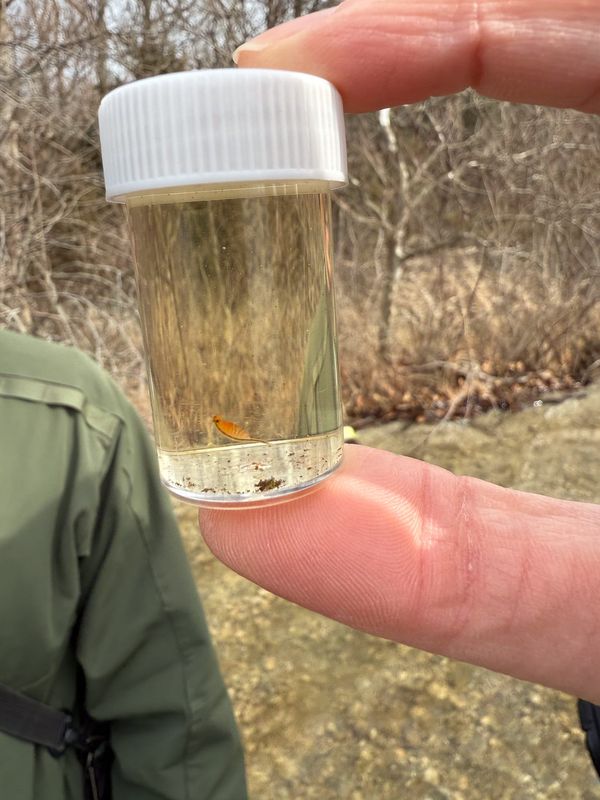
The window to lay your eyes on one of Indiana’s most obscure forest crustaceans — and, yes, Indiana does have forest crustaceans — is closing fast.
Eastern fairy shrimp (Eubranchipus vernalis) are actually pretty common, said Karen Cody, a naturalist. Cody regularly finds them in her nets while she’s looking for salamanders and tadpoles in Warren County. But these shrimp, about an inch long, rarely live longer than a couple of months.

The fairy shrimps’ brief lives are now winding down as spring turns to summer. Their habitat, ephemeral wetlands called vernal pools, will soon become too warm for the crustaceans before eventually drying up completely.
“We’re probably getting towards the tail end of the season,” said Phillip Weldy, a stewardship manager at Central Indiana Land Trust (CILTI). Typically, fairy shrimp, which usually hatch in February or March, live until mid-May or when trees start to leaf out each spring.
But it might still be possible to glance a tiny flash of electric orange in one of Indiana’s woodlands if you know where to look.
Unassuming habitat, fantastical creatures
Fairy shrimp have been documented by Hoosiers and naturalists across the state. Despite their geographic range, which stretches from Alabama to Quebec, the tiny creatures remain relatively obscure.
Weldy, accompanied by a coworker, saw Indiana’s fairy shrimp for the first time this year on trek through a CILTI nature preserve near Indianapolis. The pair spotted a shallow wetland, maybe 20 feet in diameter, tucked on the edge of a forest, near a power line right-of-way.
“It was just a pool of water,” Welty said.
But when he peered over the edge, he found a habitat bustling with life, including the minuscule bodies of squirming, bright orange fairy shrimp.
“Pretty cool,” he said.
Vernal pools exist apart from streams, lakes or rivers, meaning that the temporary wetlands and their tiny inhabitants can appear in unexpected pockets of Indiana during the wet season. In general, vernal pools can be found in most undisturbed areas where water builds up, Weldy said. By late spring, however, most of these pools have dried up.
Scientists have observed that the shrimp have a sneaky method of persisting in this precarious habitat. After embryos are fertilized in the spring, they can lie dormant in the sediment of a dried up vernal pool until the wetland’s revival the following year.
Weldy advises people who have found a vernal pool and are seeking out the elusive, almost magical, forest dwelling fairy shrimp to be patient.
“You just stop, and you stare for maybe a minute, and let your eyes adjust to the small things,” he said. “When you actually do stop and look at it, then you see all sorts of cool things, like frog eggs or a mosquito larvae that were just squiggling around. And sometimes you learn about fairy shrimp.”
IndyStar’s environmental reporting is made possible through the generous support of the nonprofit Nina Mason Pulliam Charitable Trust.
Sophie Hartley is an IndyStar environment reporter. You can reach her at sophie.hartley@indystar.com or on X at @sophienhartley.
This article originally appeared on Indianapolis Star: Time is running out to see Indiana’s forest fairy shrimp in the wild
Reporting by Sophie Hartley, Indianapolis Star / Indianapolis Star
USA TODAY Network via Reuters Connect