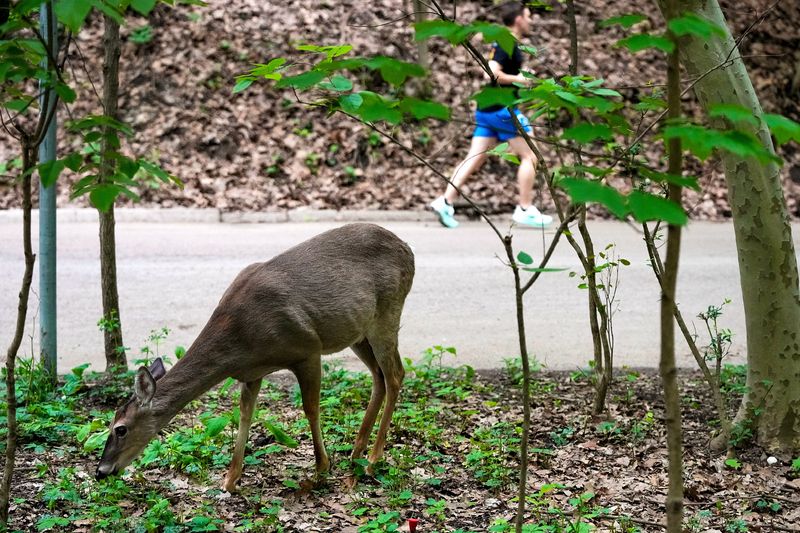
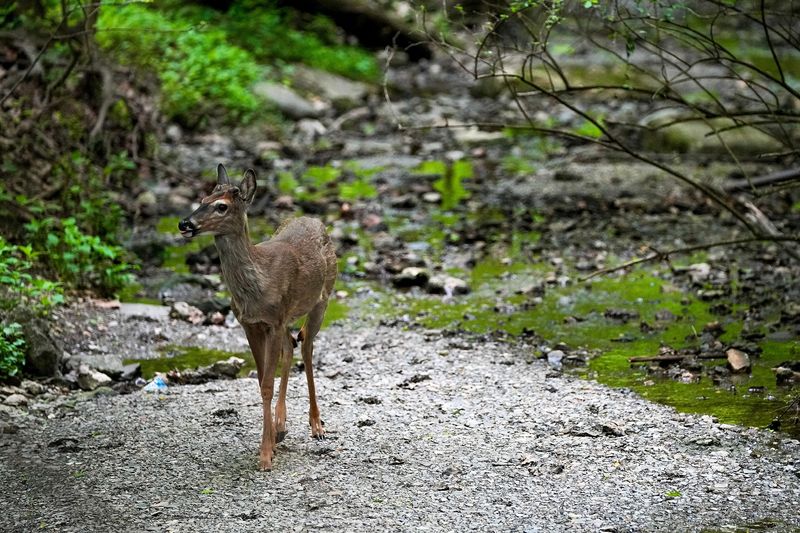
Columbus residents can no longer legally put out snacks for deer, but accidentally feeding the deer with your garden doesn’t count.
Following vehement calls for deer population control from Clintonville residents, a majority of whom said in a survey they want sharpshooters to cull the deer, the city is taking a more measured first step. Columbus City Council voted 8-0 on May 11 to make intentionally feeding deer a minor misdemeanor punishable by a fine of up to $150. There is no jail time.

Passing no-feed legislation received support from nearly 80% of city residents who responded to a public survey in 2025.
Councilmember Nancy Day-Achauer said ahead of the council meeting that her office has spent two years researching deer management and surveying residents. She said that the city does not have a deer overpopulation issue, but certain wooded neighborhoods have a high concentration of the animals.
“We saw clearly that the Clintonville and Olentangy River corridors had an overabundance of deer that was causing problems with property damage and also conflicts between human beings and the deer,” she said.
Day-Achauer said deer have caused hundreds of thousands of dollars worth of property damage, attacked pets, and caused vehicle collisions in the city.
During meetings in Clintonville, neighborhood residents told Day-Achauer about a pervasive problem with people feeding deer there.
“There are people who literally drive to the ravine and dump grain,” Day-Achauer said. “There is a person in the neighborhood who actually wheels out a wheelbarrow of grain to feed the deer. So we have people who are doing large-scale deer feeding in the area.”
Day-Achauer said a no-feed ordinance is phase one. Neighboring cities always started with a no-feed ordinance as a first step in addressing deer, she said.
In Worthington, which is near Clintonville, the suburb has moved onto hiring sharpshooters to cull deer. A total of 100 deer were harvested during the culling there early this year, which was conducted on participating private properties as well as two public properties. More sharpshooter culling is planned over the next several years.
Before the vote, Day-Achauer acknowledged some Columbus residents’ interest in a similar culling program, but she said implementing a sustainable and effective program would not be easy. She said the city would first need to hire a wildlife manager to oversee such a program and find the funds for that in a tight budget.
Day-Achauer said her office is beginning conversations about the future of the city’s wildlife management with the mayor’s office this week.
The city survey on deer also asked residents about their feelings on sterilizing deer or using birth control vaccines on the deer, expensive options in the thousands of dollars per animal. Day-Achauer said research has found such programs are not effective.
Justin Voghel told The Dispatch he’s in the minority of Clintonville residents because he’s pro deer, though he noted that he has never fed them.
“We chose to live in an area that’s kind of a blur between urban and natural and my family is excited when we see the deer,” Voghel said. “It seems silly to allocate police resources to something not harming anybody.”
Day-Achauer said the new prohibition on feeding deer will be complaint-driven enforcement, and residents should report violations to the police nonemergency line so that officers can handle the cases when they have time.
Councilmember Lourdes Barroso de Padilla was absent from the council meeting and did not vote on this legislation.
Government and politics reporter Jordan Laird can be reached at jlaird@dispatch.com. Follow her on X, Instagram and Bluesky at @LairdWrites.
This article originally appeared on The Columbus Dispatch: Columbus bans feeding deer as some in Clintonville push for culling
Reporting by Jordan Laird, Columbus Dispatch / The Columbus Dispatch
USA TODAY Network via Reuters Connect