Last Friday, the Virginia Supreme Court voided a redistricting referendum that voters had approved just two and a half weeks ago. Virginia Democrats drew a new map that would likely flip four of the state’s 11 House seats from Republican to Democratic.
Republicans challenged the process on constitutional grounds, and in a 4-3 ruling, the court threw out the new map. You can debate whether the ruling was legally correct. The bigger story is what drove the whole episode: both parties are now engaged in a no-holds-barred effort to stack the electoral cards in their favor.

The leaders of both parties may think it is good for their political fortunes. But it is terrible for America and the vast political center that No Labels represents. I have spent more than 50 years in courtrooms. As United States Attorney for the Northern District of Illinois, I prosecuted public corruption. I served as Independent Counsel investigating Iran-Contra, and over the years, I have tried cases for clients on every side of the political spectrum. The work has taught me that litigation is always two stories at once: one about principle, and another about motive.
The Supreme Court’s decision last week in Louisiana v. Callais is being framed as a story about principle. By a vote of 6-3, the majority struck down a Louisiana congressional map drawn with two majority-Black districts. Justice Samuel Alito’s opinion narrowed the use of race in drawing districts under Section 2 of the Voting Rights Act, and Justice Elena Kagan, in dissent, said the ruling renders that section “all but a dead letter.” The principle is worth a serious debate because reasonable people disagree about how race should figure in remedying voting discrimination. But it is a mistake to treat this case only as a legal question; there were litigants here, and what happened after the ruling helps explain why they brought the case to begin with.
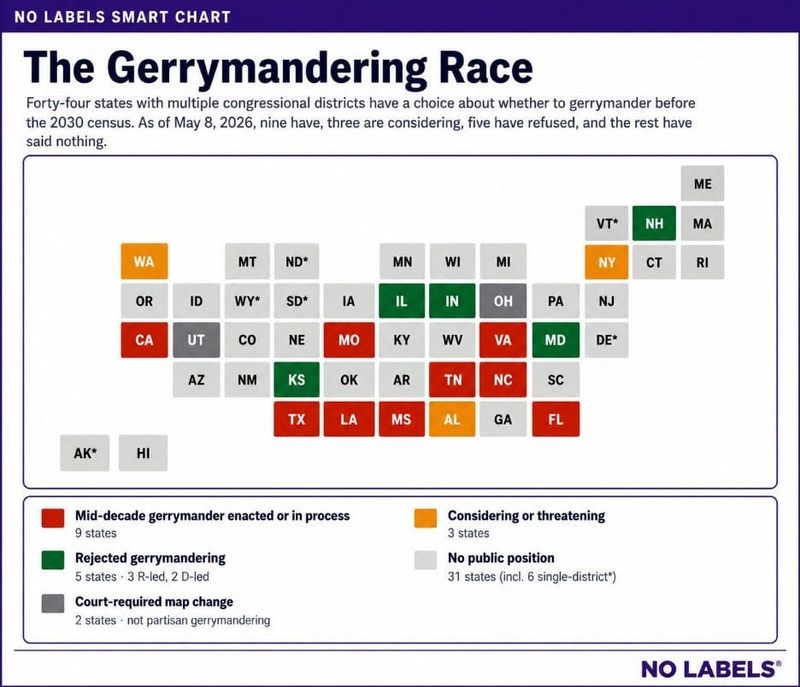
First, Louisiana postponed its primary so its Republican legislature could draw a map that will likely add a Republican seat. Then, Tennessee enacted a new map that carves up Memphis and its majority-Black 9th District, putting Republicans on track to take all nine of the state’s House seats. Mississippi has called a special session, and Alabama recently held one.
All of this is part of an unprecedented mid-decade gerrymandering effort, one that did not start with Callais. Over the past nine months, five other states had already redrawn their congressional maps for partisan advantage outside the normal once-a-decade process. Texas added five Republican-leaning seats and California approved five Democratic-leaning seats; Missouri and North Carolina each added one for Republicans, and Virginia voters approved up to four new Democratic seats (though that state’s Supreme Court reversed the new map). With Florida and Tennessee’s new maps signed last week, seven states have implemented new maps, with Louisiana actively redrawing and Mississippi close behind. There have been exceptions to this trend. In Indiana, the Republican-controlled Senate killed a Trump-backed gerrymander on a bipartisan vote in December. Kansas Republicans dropped their petition drive, Illinois Democrats declined to draw a more aggressive map and Maryland’s Democratic-controlled Senate refused to take up a gerrymander pushed by its own governor. New Hampshire’s Republican governor, Kelly Ayotte, said she will not pursue redistricting at all.
No Labels has long believed that voters should choose their representatives, and not the other way around. Massachusetts sends nine Democrats and zero Republicans to the U.S. House while a third of its voters cast Republican ballots. Last week, Tennessee went further: its legislature redrew the map specifically to remove the one congressional seat that Democratic voters could win. Maps drawn for partisan advantage lock in safe seats, reward the extremes and shut out the broad middle of American politics. We support a Congress where serious people from both parties can win, govern and stay in office long enough to do real work. In America, we litigate our differences at the ballot box, in the courts and in the public square. That is what has sustained us for 250 years. People like Hasan Piker, who preach on social media that violent revolution is inevitable, or the answer to any political problem, are the problem. The fastest way to stop this is for Americans to demand it. Dan Webb is a board member of No Labels.
This article originally appeared on The Detroit News: Both political parties are escalating the gerrymandering arms race | Opinion
Reporting by Dan Webb / The Detroit News
USA TODAY Network via Reuters Connect