INDIANAPOLIS — What unfolded in Indiana on Tuesday goes beyond a simple MAGA revenge narrative: At least five Indiana Senate Republicans went down in defeat. It goes beyond checkbook politics, where politicians buy congressional seats. It is much more consequential than the fitful reach of President Donald J. Trump.
We are experiencing the federalization of state legislative politics.

Before Tuesday night, a mere five Indiana Senate Republicans — less than 1% — had been defeated in 600 primary elections since 2002. Two of the incumbents had been marred by scandal, while Senate leaders Larry Borst and Bob Garton fell to special interest forces.
So Tuesday’s incumbent bloodbath could be seen as a pure outlier — or perhaps a glimpse of the future.
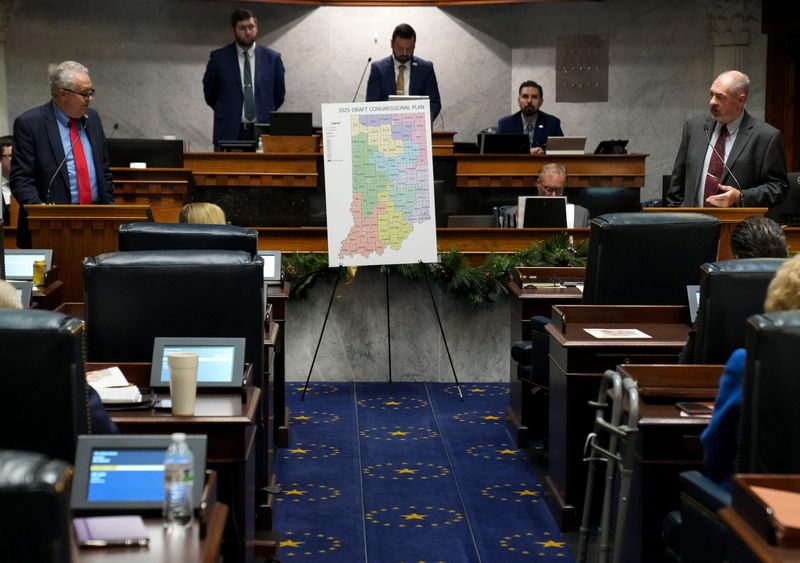
After the Indiana Senate rejected Trump’s mid-decade redistricting effort by a 31-19 vote in December, a half-dozen obscure challengers emerged by the Feb. 7 filing deadline (aside from Whiteland Rep. Michelle Davis, who had already signaled her intent to run for Senate District 41, as did Tipton Commissioner Tracey Powell in SD21).
These challengers raised little money — most under $20,000. They had little or no name recognition.
What Davis, Blake Fiechter, Dr. Brian Schmutzler, Trevor De Vries and Powell had was Trump’s endorsement and access to what Senate President Pro Tem Rodric Bray said was $9 million in Washington money.
“It’s hard to push back against the money that has come from outside the state,” Bray told CNN on Monday. “An awful lot of money has been spent over the last couple months on this issue. It hasn’t really been about redistricting.”
Some $13.5 million in ad spending spilled into these obscure Senate races, most playing out in rural districts in the shadows of tariff-buffeted automotive plants. It didn’t matter that Trump’s war of choice against Iran has prompted spikes in fuel and fertilizer costs that are pulverizing Hoosier automakers and farmers. That’s gubernatorial-level spending.
And it swamped Sens. Jim Buck, R-Kokomo; Holdman, R-Markle; Linda Rogers, R-Granger; and Dan Dernulc, R-Highland, by landslide margins. At this writing, Sen. Spencer Deery, R-West Lafayette, is clinging to a four-vote lead in what will be a recount in his race against Fountain County GOP Chair Paula Copenhaver. The lone survivor was Sen. Greg Goode, R-Terre Haute, who defeated two challengers named Wilson — Brenda and Alexandra, no relation.
Senate District 6 became collateral damage, with Lowell Sen. Rick Niemeyer losing to Jay Starkey after the challenger won the incumbent’s family stronghold of Lake County (where Niemeyer’s cousin Randy Niemeyer is GOP chair). Sen. Niemeyer had opposed the redistricting scheme, but somehow Starkey didn’t garner a Trump endorsement. It didn’t matter.
In Senate District 15, Sen. Liz Brown had a miniscule lead over Darren Vogt in a race headed to recount. Brown voted for redistricting and had Trump’s endorsement.
While these upsets had trappings of an anti-incumbency wave, they didn’t extend to contested congressional primary races, where Republican U.S. Reps. Jim Baird and Jefferson Shreve survived challenges, as did Democratic Rep. André Carson. The big difference between congressional and legislative races came down to money.
The GOP wing of Sen. Richard Lugar, Mitch Daniels and even Mike Pence has been rendered moot.
The carnage now puts Bray’s hold on the Senate presidency in jeopardy.
“Everyone in Indiana politics should have learned an important lesson today: President Trump is the single most popular Republican among Hoosier voters,” U.S. Sen. Jim Banks said in a statement. “Indiana is a conservative state, and we deserve conservatives in our State Senate who have a pulse on Republican voters.”
Banks’ political action committee proved to be a vital funding conduit for challengers.
This marks a new facet of Trump-era politics: the federalization of state legislatures, aimed at creating an essentially bifurcated Congress split along red-blue state lines. Thus, the implications of what happened in the Indiana Senate could reverberate into the 2028 presidential election.
Even before Tuesday’s Indiana primary, Lt. Gov. Micah Beckwith and U.S. Rep. Marlin Stutzman were calling on Gov. Mike Braun to initiate yet another special session to redraw the state’s congressional maps to forge a 9-0 GOP delegation. Braun said on Wednesday that it would not happen this year.
Marc Novicoff, writing for The Atlantic, said the U.S. House of Representatives “is turning into the Electoral College.”
“Thanks to the Supreme Court, the gerrymandering wars, already awful, are poised to get even worse,” Novicoff wrote, citing the Louisiana v. Callais ruling last week that clipped the Voting Rights Act of 1965. “In a few years, almost every seat in the House of Representatives could be safely occupied by a hyper-partisan incumbent, beholden only to primary voters. The chamber could become something like the Electoral College: Whoever wins a state gets all of its representatives, and the winners are there just to vote for or against the president.”
What does this portend for the November election?
The only vulnerable Senate Republican nominee will be De Vries in SD 1, where Dernulc won 52%-48% in 2022 over caucused Sen. Michael Griffin, D-Highland. He will face Democrat Scott Houldieson.
This was a low-turnout primary, where MAGA Republicans obviously dominated. But a Washington Post/ABC News poll published over the weekend revealed only 25% of independents approve of Trump. That sets the stage for a Democratic wave in November.
Brian Howey is an opinion columnist for State Affairs Indiana and the founder of Howey Politics Indiana. His writing offers analysis and opinion shaped by decades of experience covering Indiana politics. Email him at howey@stateaffairs.com.
This article originally appeared on The Herald-Times: The coming federalization of state legislatures | OPINION
Reporting by Brian A. Howey, For the Herald-Times / The Herald-Times
USA TODAY Network via Reuters Connect